CS
Christèle Simeoni
Co-founder & CMO, VRAI Learning
Key points
- In logistics and industry, temporary workers account for a disproportionate share of workplace accidents — often due to inadequate initial training.
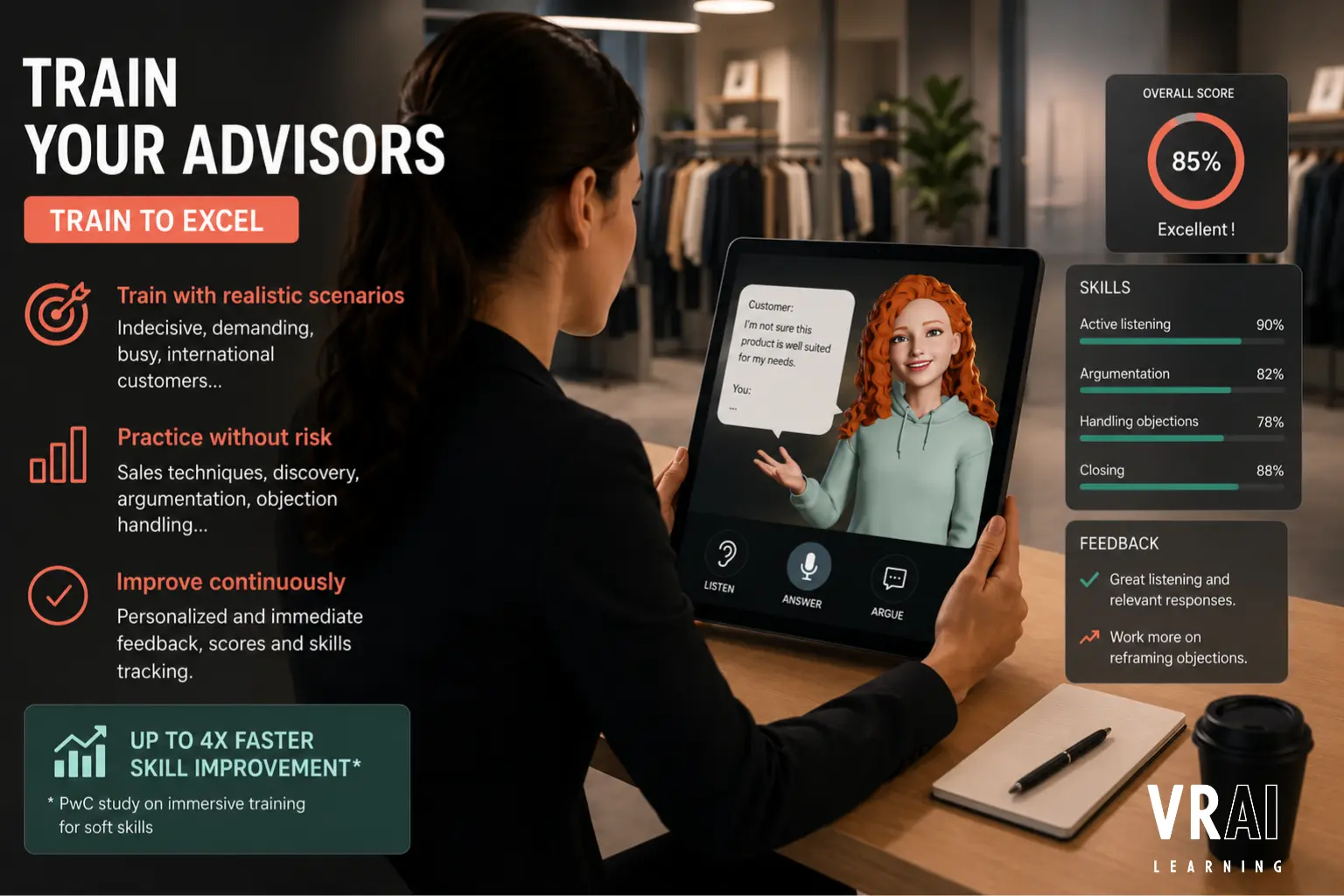
- VR training accelerates skill acquisition up to 4 times faster than traditional classroom training (PwC, 2020).
- The VR + AI avatar combination enables complete onboarding in a few hours, without mobilizing an internal trainer.
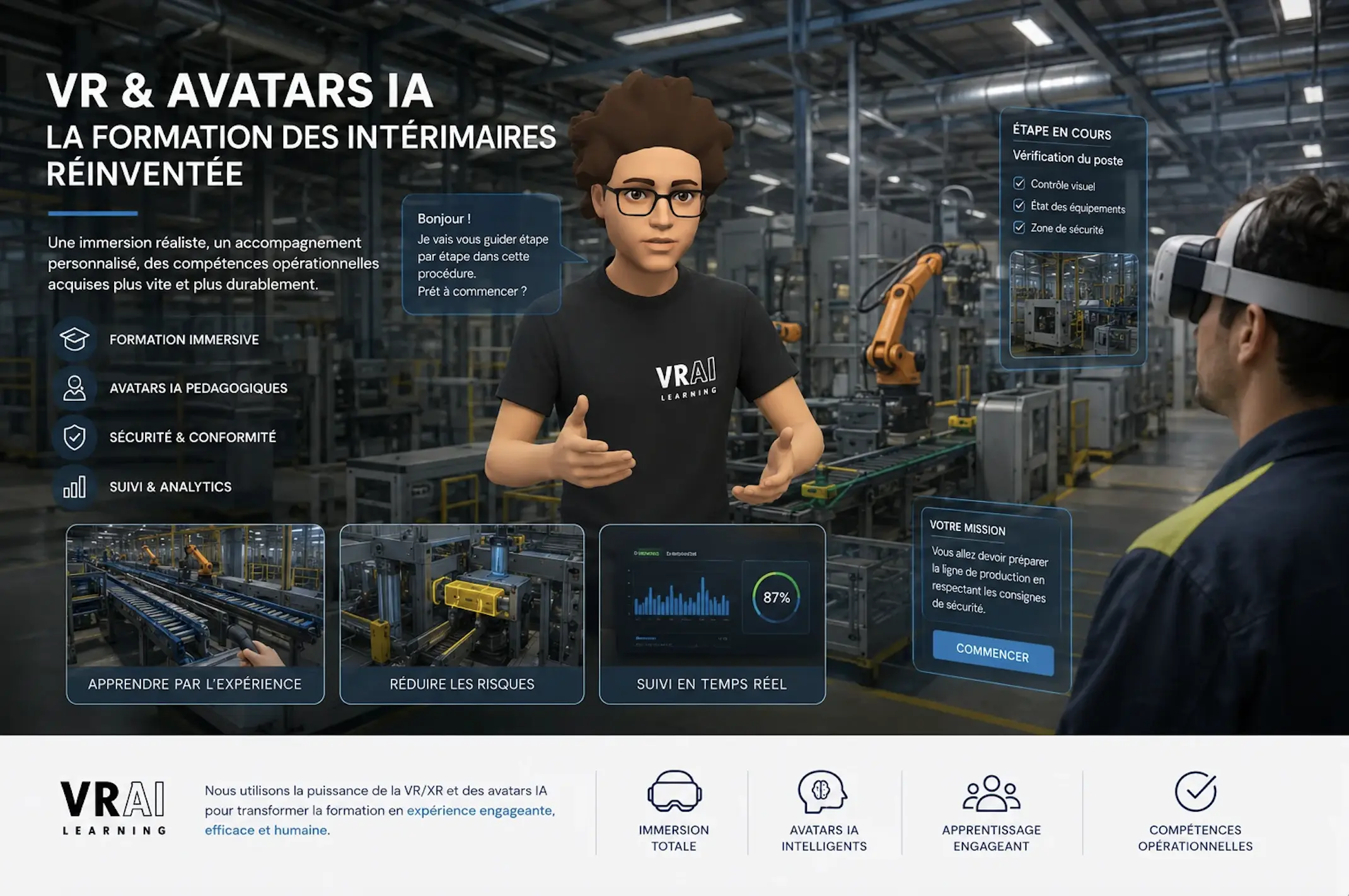
In logistics, retail, food service, healthcare, and construction, a permanent HR challenge paralyzes training departments: staff turnover. Faced with a constant influx of temporary and seasonal workers, companies find themselves caught in an impossible equation — train fast, train well, at scale, with limited budget and time.
How do you make an employee operational in a few hours, without deploying a full-time trainer? In 2026, the answer no longer lies in welcome booklets or static e-learning. It lies in the combination of three technologies: immersive virtual reality training, the conversational AI avatar, and multi-device deployment.
What makes high-rotation professions so hard to train for?
For professions that hire heavily on a temporary basis, the barriers to traditional training are structural:
- The time factor: a temporary worker must be operational immediately. Spending two days in a training room on a one-month assignment is not cost-effective.
- The cost factor: mobilizing a manager or expert trainer to repeat the same safety gestures 50 times a year is expensive and saturates internal teams.
- The risk factor: in logistics or industry, inadequate initial training for temp workers drives workplace accident rates up sharply in the first days.
This is precisely the context that immersive training addresses — as we documented in our article on how VR transforms employee onboarding.
How does VR training make temp workers learn 4 times faster?
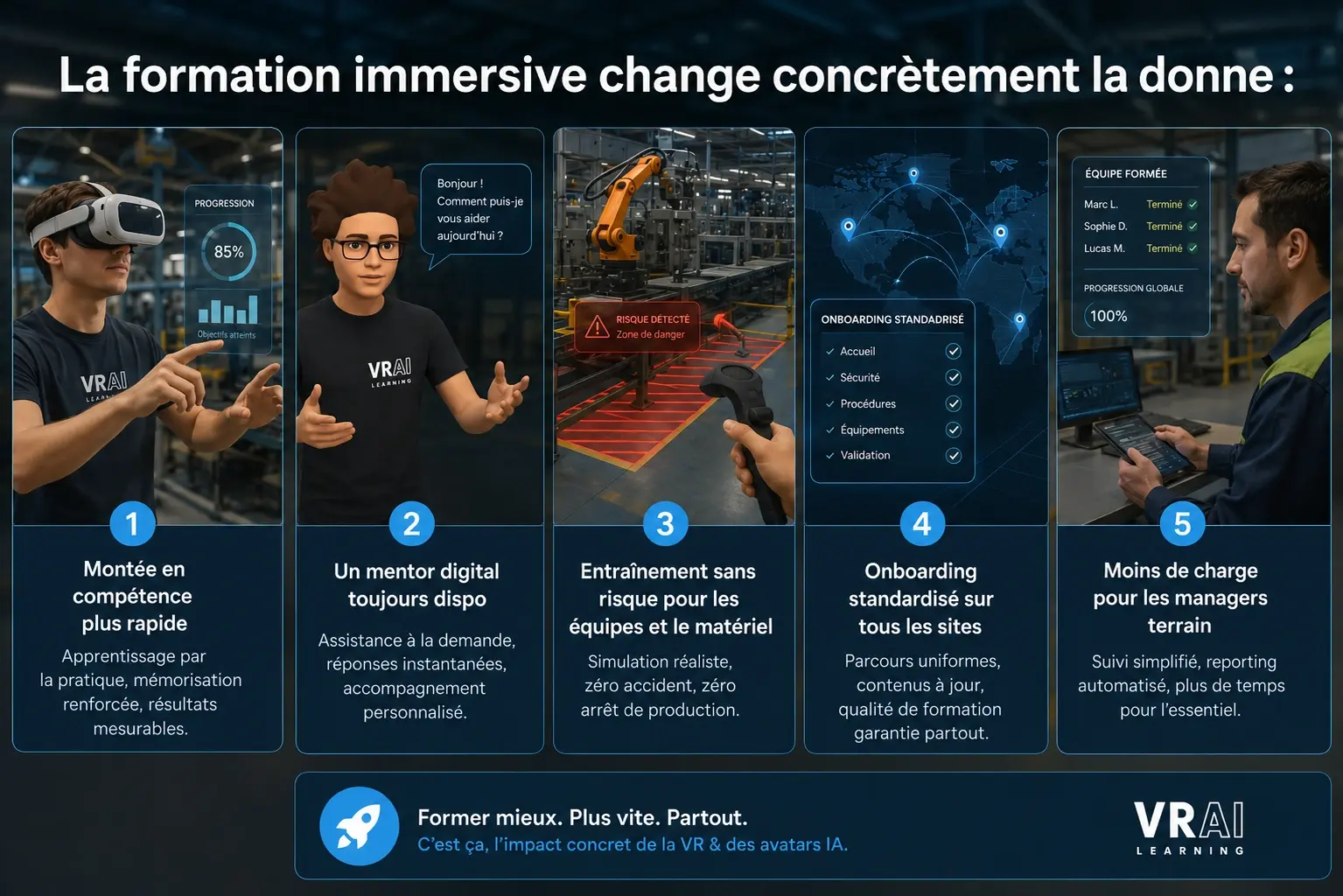
VR training responds directly to field urgency. By immersing the temporary worker in their future work environment — a warehouse, a production line, a retail point of sale — it eliminates the barrier of theory.
Accelerated memorization
The results of VR training on retention are documented: learners memorize up to 4 times faster in simulated situations than in classroom training (PwC VR Soft Skills Training Efficacy Study, 2020). The brain processes the simulation as a genuinely lived experience.
The right to make mistakes safely
Whether manipulating an electric pallet truck or applying a strict hygiene protocol, the temporary worker can make mistakes, start over, and anchor the correct gesture — without risk to themselves or the equipment. In construction as in retail, this principle transforms safety training.
AI avatar as expert tutor: available 24/7 on the ground
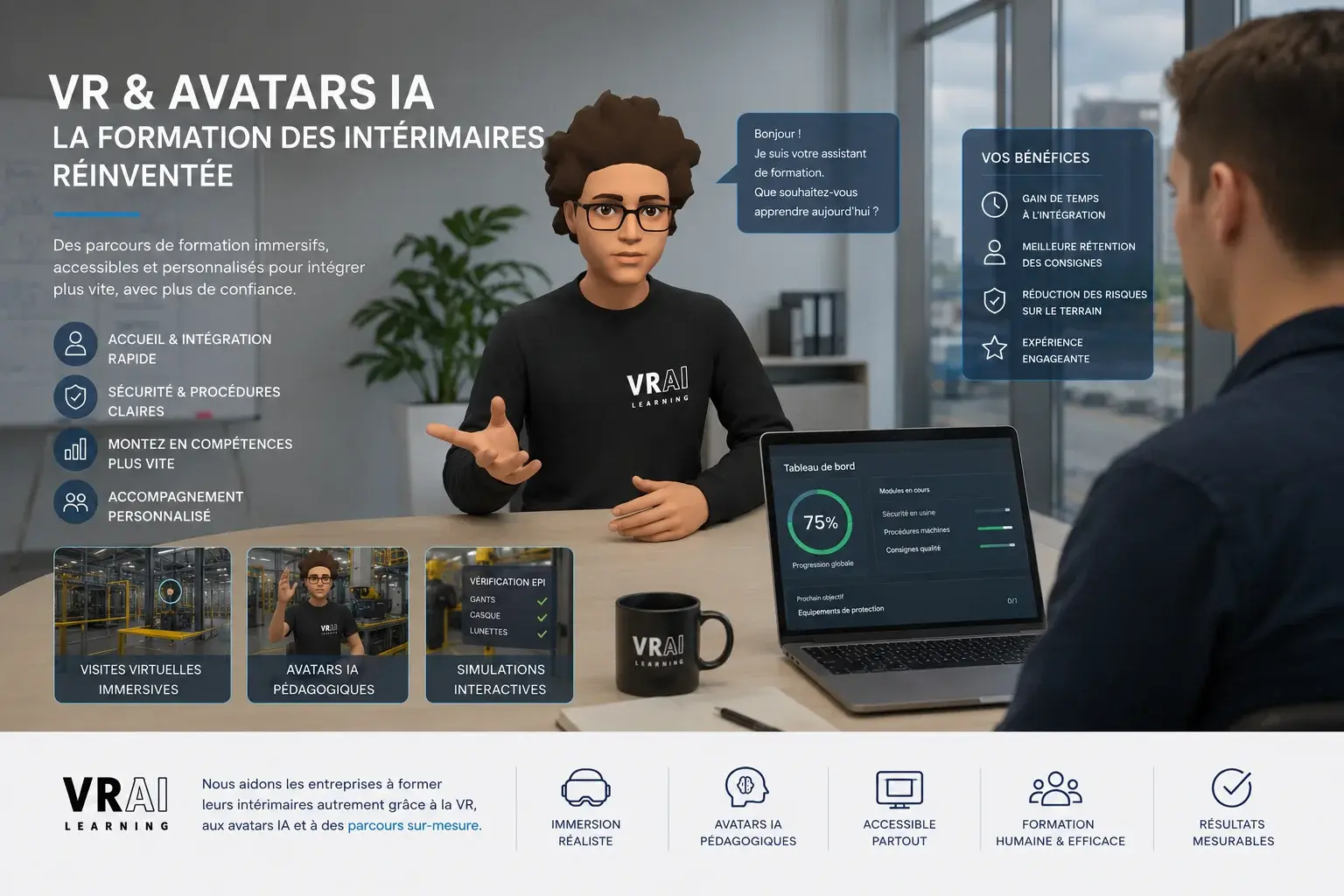
The great revolution of immersive learning lies in the integration of conversational artificial intelligence. Gone are rigid scenarios where the learner clicks through multiple choice. An AI avatar now embodies a disgruntled customer, a manager giving instructions, or a pedagogical tutor — and responds in natural language, in real time.
Practicing human interaction
For retail or food service professions, the temporary worker practices responding to real client cases by speaking naturally to the avatar. Mistakes are corrected immediately, without judgment. For further reading, our complete guide to conversational AI avatars details use cases by sector.
Zero burden on managers
The AI avatar listens, responds, corrects, and evaluates the temporary worker autonomously. Middle management is freed from repetitive training and can focus on human reception and cultural integration.
Multi-device: train anywhere, without heavy logistics
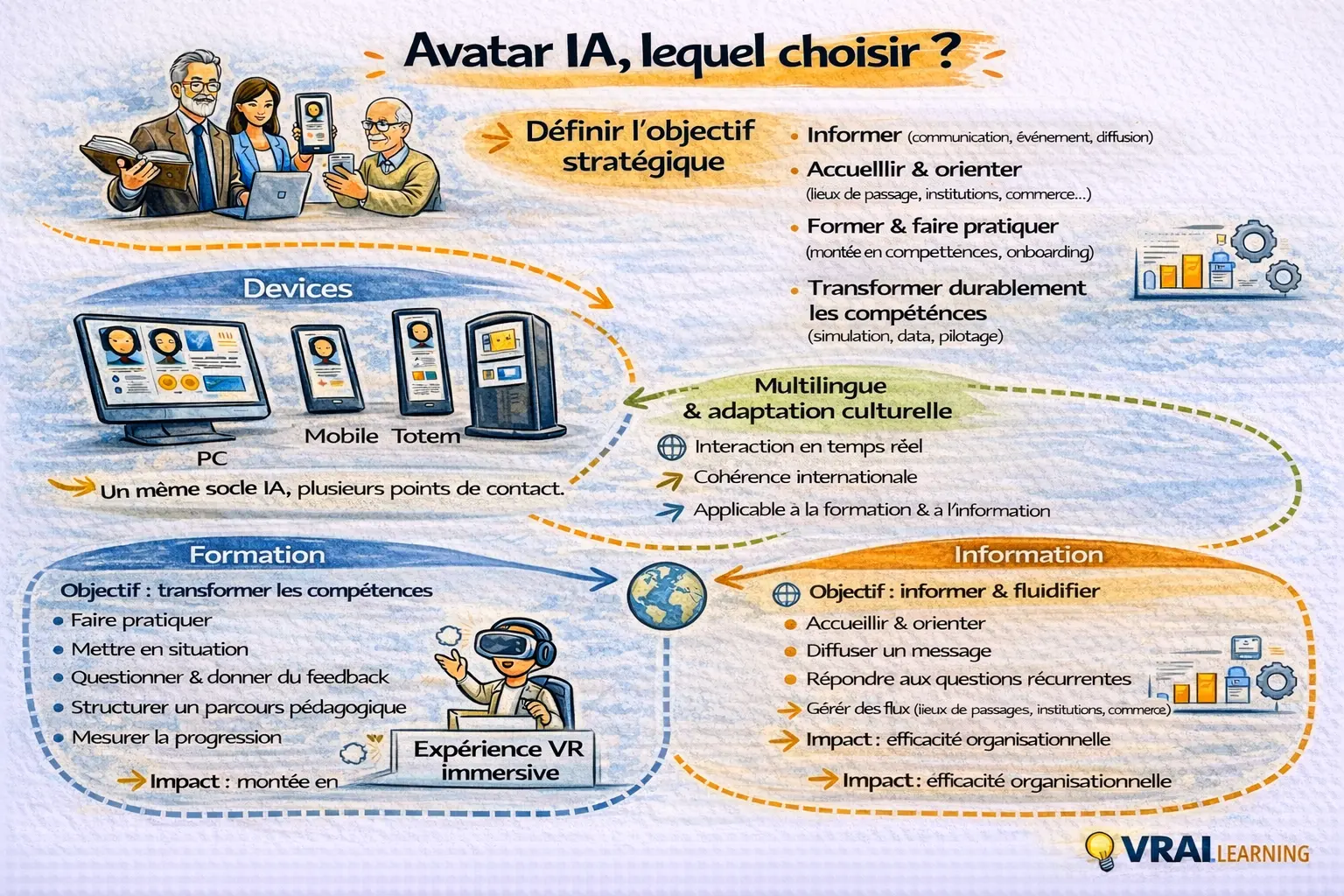
One of VR's historical limitations was headset deployment. For companies managing large flows of temporary workers across multiple sites, the answer is multi-device support.
- VR headset: total immersion for critical skills (safety, technical gestures).
- PC / Tablet: rapid autonomous access in break rooms or at briefing locations.
- Smartphone: refresher micro-learning (e.g., checkout procedure) directly in the temporary worker's pocket.
The ROI moment — The company does not need 500 VR headsets. A temp worker can start training on mobile before their assignment, validate on PC upon arrival, and practice key gestures in VR. Result: modular, adaptable, measurable onboarding.
Standardizing excellence despite flexibility
Employing temporary workers should no longer be synonymous with lower quality or higher risk. By combining VR, AI avatars, and multi-device support, high-rotation companies standardize their training processes — and maximize their training ROI from the very first assignment. Onboarding goes from several days to a few hours. Team engagement is multiplied. And results are measurable, assignment after assignment.
Read also
Virtual reality training in the company: the complete guide →
Methods, costs, use cases and results for deploying VR in your organization.
Frequently asked questions about VR training for temporary workers
What is the cost of a VR training program for temporary workers?
The cost of a VR training program for temporary workers depends on several variables: number of modules, learner volume, and equipment already in place. Generally, companies deploying a solution like VRAI Learning adopt a usage-based model (per session or active learner), avoiding large upfront hardware investments. On a logistics site hosting 200 temporary workers per year, the average cost per learner is often below the cost of half a day of traditional classroom training — trainer, room, and printing materials included. The multi-device approach reduces costs further: a temporary worker can complete part of their onboarding on a smartphone before their assignment starts, without mobilizing a VR headset. The ROI is calculated from the first recruitment wave: fewer accidents, less early turnover, and an internal trainer freed from dozens of annual repetition hours.
How quickly can a temporary worker become operational with VR training?
With the combination of virtual reality and AI avatar, a temporary worker can be operational in 2 to 4 hours depending on the complexity of the role — versus 1 to 2 days with traditional classroom training. The PwC study (2020) confirms that VR enables skill acquisition up to 4 times faster than classroom training, because the brain processes the simulation as a genuinely lived experience. In practice, the pathway unfolds in three rapid steps: a role discovery module on mobile or tablet (30 to 45 min), training in critical gestures in VR (45 to 90 min), and an interactive validation with the AI avatar playing the role of manager or client (30 min). The temporary worker arrives on the job with the right reflexes already anchored. In high-risk sectors — logistics, construction, food service — this time gain mechanically reduces workplace accident rates during the first week of assignment.
Does VRAI Learning support deployment across multiple sites simultaneously?
Yes. The VRAI Learning platform is designed for multi-site deployment without heavy logistics. Modules are hosted in the cloud and accessible from any device — VR headset, tablet, PC, or smartphone — with a single company account. A training manager can oversee deployment across 10 warehouses or 50 retail locations from a single dashboard, assigning pathways by site, role, or profile. The advantage for high-rotation companies: a temporary worker assigned to a new site immediately finds their training history and only completes the modules specific to the new context.
Is VRAI Learning VR training compatible with QUALIOPI certification?
Yes. Training programs designed and delivered with VRAI Learning are compatible with the French national quality standard QUALIOPI. The platform automatically generates the tracking evidence required during audits: digital attendance records, completion rates per learner, assessment scores, session durations, and training certificates. Training organizations partnering with VRAI Learning use this data to meet the standard's indicators without administrative overload. For companies wishing to fund their temporary workers' training through OPCOs (French professional training funds), the traceability provided by the platform also facilitates reimbursement claims.

Christèle Simeoni
Co-founder VRAI Learning (2023) · CMO
Co-fondatrice de VRAI Learning, spécialiste de la formation immersive VR et des avatars IA conversationnels.
See immersive training in action
Personalised demo, no commitment. We show you what it looks like for your context.
Book a demo