Immersive trainingOne journey: VR and AI avatars
Immersive training is one journey built from two building blocks: the 3D environment of VR and the conversation of an AI avatar. The learner doesn't watch, they act, decide, speak, make mistakes and get instant feedback, with no risk to production.
Three modular building blocks. Activate one, two or all three depending on your needs. LMS integration →
Why immersive learning?
Scalability
One module trains 1 or 10,000 learners. No room, schedule or instructor constraints.
Always available
Teams train when they need to, from any device. Zero geographical constraints.
Right to fail
Practice safely, without real-world consequences.
Measurable impact
Real-time analytics, KPIs, and precise data.
VR alone or VR with AI avatars: which should you choose?
Both run on headset, PC, mobile or tablet. You choose the level of interaction you need.
VR training
Immersive 3D environments to simulate technical procedures, field situations and safety protocols. The learner acts, makes decisions and learns from their mistakes without real-world risk.
- Technical gestures & field procedures
- HSE & safety protocols
- Product training & onboarding
- 360° immersive scenario replay
VR + AI avatars
Add conversational AI characters to your VR environments. Each scenario becomes a real conversation a client, a manager, a patient. Ideal for soft skills, leadership and interpersonal communication.
- Roleplay & difficult conversations
- Leadership & management coaching
- Customer relations & conflict management
- Real-time emotional analytics
The journey, step by step
Immersion
The learner enters a realistic 3D environment: their workstation, their field, their real terrain.
Interaction
An AI avatar speaks up in the scene: a customer, a colleague, a patient. The conversation becomes the exercise.
Feedback
Every decision and every spoken response is analysed, scored and explained in real time.
Progression
The journey adapts: harder scenarios, new avatars, tracked in Avatar Academy.
Want the concrete, step-by-step detail of a bespoke VR project? Discover our VR method →
Why does immersive training outperform e-learning and classroom?
Why immersive training changes the equation in numbers.
Is immersive training right for your sector?
Each scenario is built around the realities of your industry, your jobs, your risks.
Industry & HSE
Technical procedures, safety protocols, machine gestures. Train without stopping production.
Discover →Healthcare
Difficult diagnoses, emergency procedures, patient communication. Practice the hardest situations safely.
Discover →Retail & customer service
Welcome, conflict management, sales techniques. Simulate hundreds of customer interactions.
Banking & insurance
Regulatory compliance, complex sales advice, crisis management. Train at scale without risk.
HR & onboarding
Integration, annual reviews, difficult conversations. Prepare managers and newcomers for real situations.
Higher education
Simulated labs, immersive teaching, inclusive learning. Prepare students for real-world conditions.
How does immersive training work in practice?
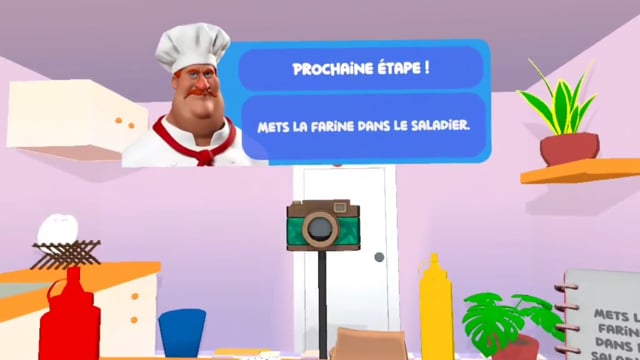
Immersive VR atmosphere
Sorbonne University Abu Dhabi
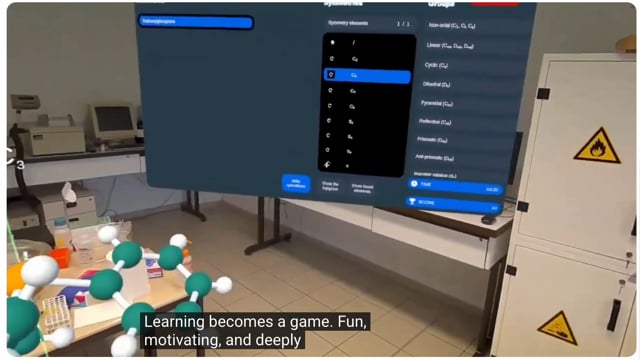
Chemistry lab
Université d'Artois, France
Soft skills in VR
Conflict management, leadership, assertiveness. Immersive scenarios where the learner practises for real, in complete safety.
Soft skills in VR
Ready to discover immersive training?
30 minutes to see how immersive learning transforms your teams.
Book a free demoTrain everyone, everywhere
VR/XR removes geographical, physical, and cognitive barriers. Every learner accesses the same quality of training, regardless of location, disability, or starting level.
Zero travel
Train your teams without moving them. Less CO2, more inclusion.
Disability
Adapted interfaces, subtitles, alternative navigation.
Personal pace
Everyone progresses at their own pace. Unlimited repetition without judgement.
Multi-device
VR headset, mobile, PC, or tablet as needed.
They switched to immersive
Chemistry Department






Questions about immersive training
What is immersive training?
Immersive training refers to any learning approach that places the learner in an interactive simulated environment, virtual reality (VR), augmented reality (AR) or conversational AI avatar. Unlike passive formats (slides, videos), it puts the learner in a real situation: they act, make decisions and learn from their mistakes in a risk-free setting.
What is the difference with the "VR Training" page?
This page presents the full pedagogical journey: how the learner experiences the combination of a 3D environment and a conversational AI avatar. The VR Training page focuses specifically on the concrete production method for a bespoke VR module: the field audit, the playable prototype, 3D production and pilot-then-scale rollout. If you are exploring what immersive training brings to your organisation, this page answers that; if you already want the production process detail for a VR project, head to VR Training.
Immersive training vs e-learning: what are the differences?
E-learning delivers content passively (videos, quizzes, SCORM modules). Immersive training places the learner in a simulated practical situation, with real interactions, decision-making and emotional feedback. Result: +40% memorisation and up to 4× more concentration (PwC, 2020) compared to traditional formats.
Should VR and AI avatars be combined, or can each be chosen separately?
The two building blocks are independent and combinable. VR alone suits technical gestures, procedures and safety protocols, where the 3D environment matters more than conversation. An AI avatar alone suits conversational roleplay, sales or management coaching, with no 3D set needed. Combining them creates a complete journey where the learner acts in a realistic environment and also has to interact with someone who reacts to what they say. The choice depends on the skill you want to build, not on a technical constraint.
Do you need a VR headset to use your training?
No. Our experiences also work on PC, mobile, and tablet. A VR headset offers maximum immersion, but is not a prerequisite.
What is the difference between VR, AR, and XR?
VR (virtual reality) immerses you in a 100% digital world. AR (augmented reality) overlays digital elements onto the real world. XR (extended reality) encompasses both.
How long does it take to deploy VR training?
A first pilot can be operational within a few weeks. Complex projects take 2 to 3 months, including support.
Is VR training suitable for people with disabilities?
Yes. Our experiences include accessibility options: subtitles, alternative navigation, adaptive pace. We follow W3C recommendations for XR.
Which sectors use immersive training?
Industry, healthcare, education, construction, finance, retail, transport, public sector... VR adapts to any profession where practical field experience is essential.
What ROI can be expected from VR training?
On average: -40% training time, +75% retention, and measurable ROI from the first 6 months thanks to integrated analytics.
Can immersive training be taken remotely?
Yes. Our experiences work on standalone VR headsets, PC, tablet and mobile. Learners can complete their modules from anywhere, with no scheduling or room constraints. Ideal for geographically distributed teams.
Is learner data secure?
Yes. European hosting, GDPR compliance, data encryption, and controlled access. Security is built in from the design stage.