VR training Your learner in the situation. Not watching it.
Custom 3D immersive environments that place your teams in real field situations: technical procedures, HSE protocols, critical scenarios. No risk. No production stoppage.
Source: PwC, VR Soft Skills Training Study (2020), VR training compared with classroom and e-learning.
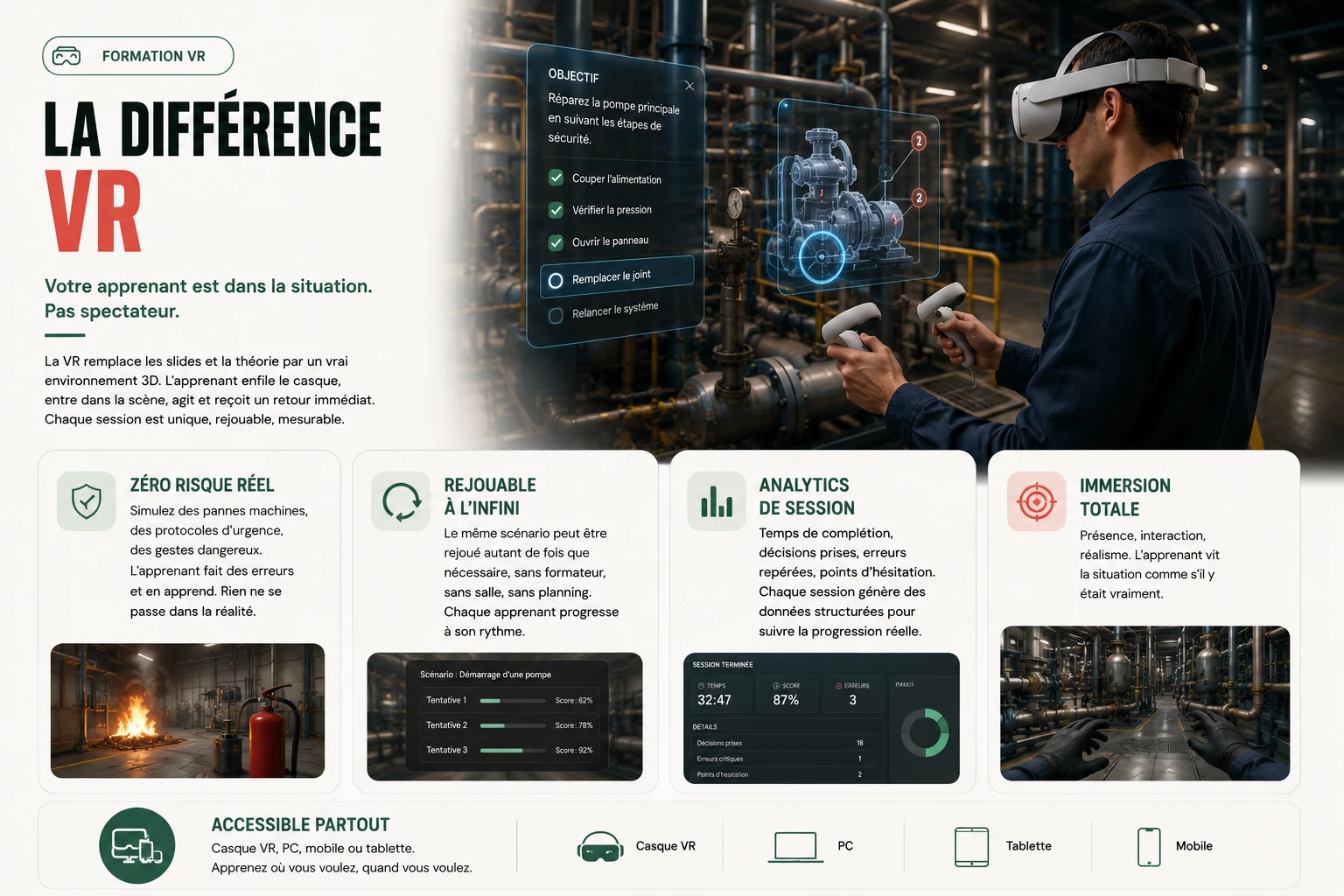
Your learner is in the situation. Not watching it.
VR replaces slides and theory with a real 3D environment. The learner puts on the headset, enters the scene, acts and receives instant feedback. Every session is unique, repeatable, measurable.
Bespoke, without starting from a blank page
A testable prototype before full production, so nothing is rebuilt from scratch if something needs adjusting.
In-depth field audit
On-site observation of real gestures and protocols, interviews with field experts, mapping of critical scenarios and decision points that must stay true to the actual job.
Playable prototype
A greybox mock-up tested with a small pilot group before full 3D production starts, game mechanics get adjusted here, not after the module is built.
3D production & integration
Environments built in a real-time engine, compatible with standalone headsets, PC and mobile. SCORM/xAPI/LTI connectors are wired in during production, not bolted on afterwards.
Pilot, then scale
Launch on one site or team, adjustments based on real session analytics, then the module is duplicated to other sites or teams without repeating the field audit.
Already use an LMS? Discover our SCORM/xAPI/LTI integration →
VR scenarios built for your field
Industry & HSE
Machine lockout/tagout, fire evacuation, PPE procedures, accident prevention. Train without stopping the line.
Healthcare
Emergency room protocols, resuscitation, medication errors, difficult patient communication. Practise the critical moments.
Retail & customer service
Customer welcome, conflict de-escalation, checkout procedures, queue management. Simulate peak hours without impact.
Banking & insurance
Fraud detection, complex advisory, regulatory compliance. Simulate high-stakes situations without client risk.
HR & onboarding
Premises discovery, tool handling, process simulations. New starters are operational from day one.
Higher education
Chemistry labs, dissections, archaeological excavations, industrial workshops. Safe access to complex practical sessions.
Headset for maximum immersion. Other devices by choice.
Our VR modules run on headset, PC, tablet and mobile. The headset delivers the full 3D experience. The other devices allow access from anywhere, without hardware prerequisites.
VR Headset
Full 3D immersion, 360° presence
PC / WebGL
Full access, no headset needed
Mobile
Train anywhere, anytime
Tablet
Field teams, group sessions
AI avatars, integrated directly into your VR scenarios
Add a conversational AI character to any VR environment. Your learner interacts with a virtual colleague, a manager, a patient or a customer, in the scene, in real time, with emotional analysis.
- Avatar present inside the 3D scene (not a chat window)
- Real-time spoken conversation, voice detection
- Emotional analytics: stress, confidence, assertiveness
- Configurable role, personality and expertise
Puts on the headset. Enters a realistic 3D warehouse.
A virtual colleague approaches and asks for guidance on a procedure.
The learner responds verbally. The avatar reacts, asks follow-up questions.
End of session: emotional score, hesitations spotted, areas for improvement.
Sorbonne University Abu Dhabi, University of Artois... see our case studies →
Questions about VR training
Can we reuse or adapt an existing VR module rather than rebuild from scratch each time?
Yes. Bespoke does not mean starting over every time: we draw from a library of reusable VR mechanics (movement, object manipulation, dialogue, safety checklists) that we adapt to your specific context, which reduces both budget and timeline compared to a fully original build. A module designed for one site can also be duplicated and localised for other sites or teams without repeating the field audit, only the specific procedures and constraints of the new context need reviewing.
Who needs to be involved on the client side during the project?
During the field audit: one or two subject-matter experts plus a training or HR contact to frame the objectives. During script and storyboard validation: the same experts, for a few hours of review per iteration. No VR technical skill is required from your team at any stage, VRAI Learning handles 3D production and LMS integration end to end. Your role is to validate that the simulation reflects the real job, not to build anything yourself.
Can VR training be combined with AI avatars?
Yes, this is one of our key differentiators. An AI avatar can live inside a VR environment, adding a conversational layer on top of the immersive simulation: the learner not only acts in the scene but also talks to a character who listens, responds and gives real-time feedback. This combination suits scenarios that mix technical gestures with a human interaction, such as safety briefings or client-facing situations. VR and AI avatars can also be used independently depending on the training need.
Does VR training integrate with our LMS?
Yes. Our modules connect to your existing LMS via SCORM, xAPI (Tin Can) and LTI connectors, wired in during production rather than added afterwards. Completions, scores and session analytics flow directly into your platform, with no parallel infrastructure to maintain. This is a structural differentiator: most VR training providers only offer LMS integration for 2D screen-based content, while VRAI Learning delivers native tracking for fully immersive VR and AI-avatar scenarios, compatible with over 100 LMS platforms including Moodle, Cornerstone and SAP SuccessFactors.
What happens after deployment? Can the module evolve?
A VR module is not frozen once launched. Content can be updated, new branching scenarios added, and language versions created without repeating a full field audit, updates build on the existing script and 3D assets. We also recommend reviewing the module after the first cohorts based on real session analytics: if learners consistently struggle at a specific decision point, that scene can be adjusted to better match the field reality it is meant to simulate.
What engines and headsets are compatible with your VR modules?
Modules are built in a real-time 3D engine and run on standalone headsets (Meta Quest, Pico and similar), PC and mobile, there is no dependency on proprietary hardware. No software installation is required on the client side beyond the headset or device itself; deployment and updates are managed by VRAI Learning. This matters for IT and procurement teams evaluating a project: hardware choice stays flexible and is not locked to a single vendor.
What is the difference with the "Immersive Training" page?
Immersive Training presents our overall approach (VR, AR and AI avatars together), along with the pedagogical benefits of immersive learning in general. This page focuses specifically on how a bespoke VR module gets built: the field audit, the playable prototype, 3D production and pilot-then-scale rollout. If you are exploring what immersive training can do for your organisation, start with Immersive Training; if you already want to understand the concrete production process for a VR project, this page answers that.
Ready to launch your first VR module?
Personalised demo, no commitment.