Christèle Simeoni
6 min min read
AI Avatar : Train Your Advisors and Embody Your Brand
CS
Christèle Simeoni
Co-founder & CMO, VRAI Learning
In retail, everything happens within the first 90 seconds. How an advisor welcomes a client, the clarity with which they present a product, their ability to handle objections without backing down — these micro-moments make the difference between sealing a sale or seeing a customer leave empty-handed.
The challenge: training each advisor to this level of excellence is a constant struggle. Turnover is high, seasonal workers come in without experience, and international customers may not speak the store's language. Traditional training — PowerPoint sessions, role-playing with colleagues — is no longer sufficient to prepare teams to meet the standards of a premium brand.
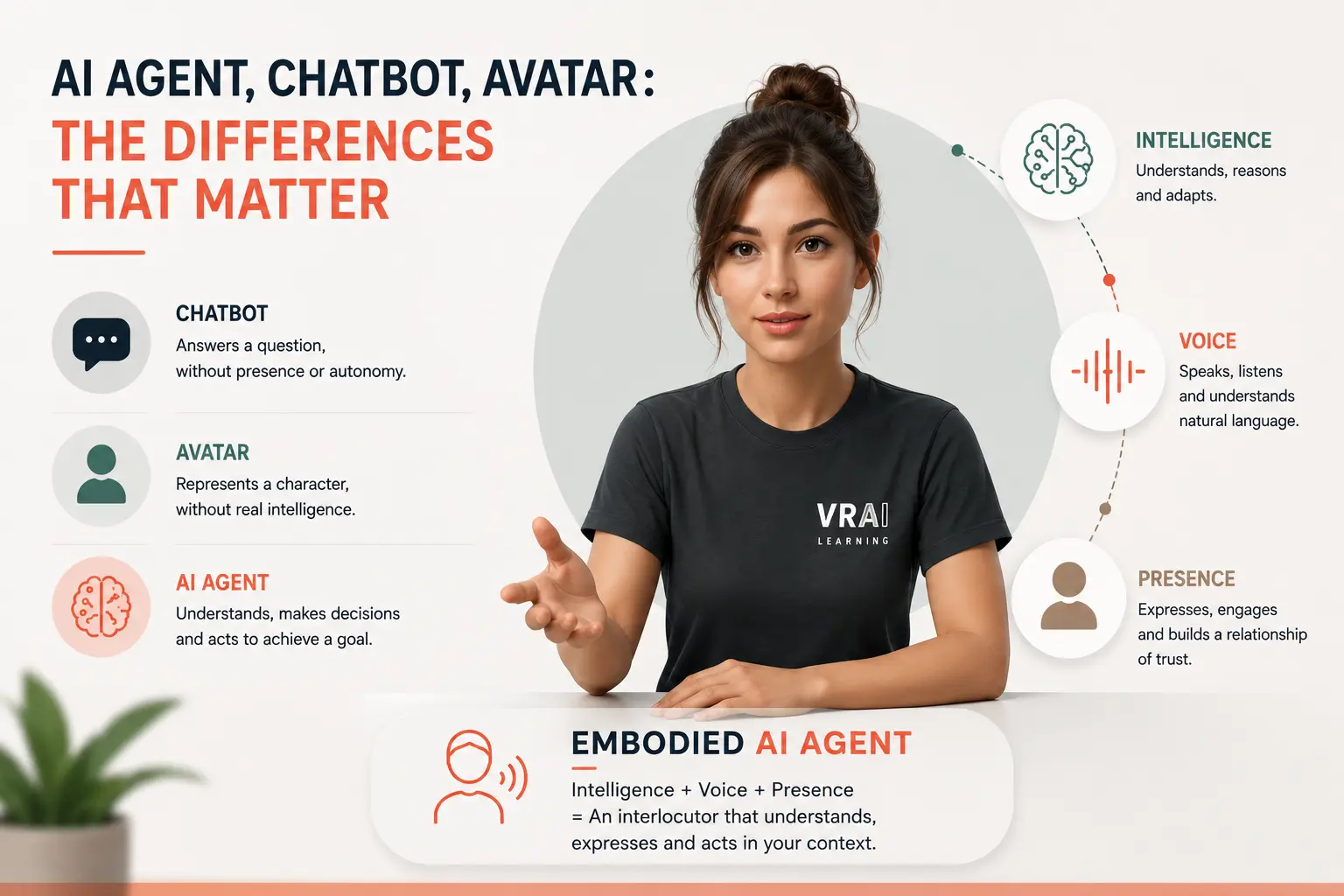
The AI avatar opens a new path. It addresses two distinct needs that retailers often discover separately: training your teams internally and embodying your brand directly in stores.
The two uses of the AI avatar in retail
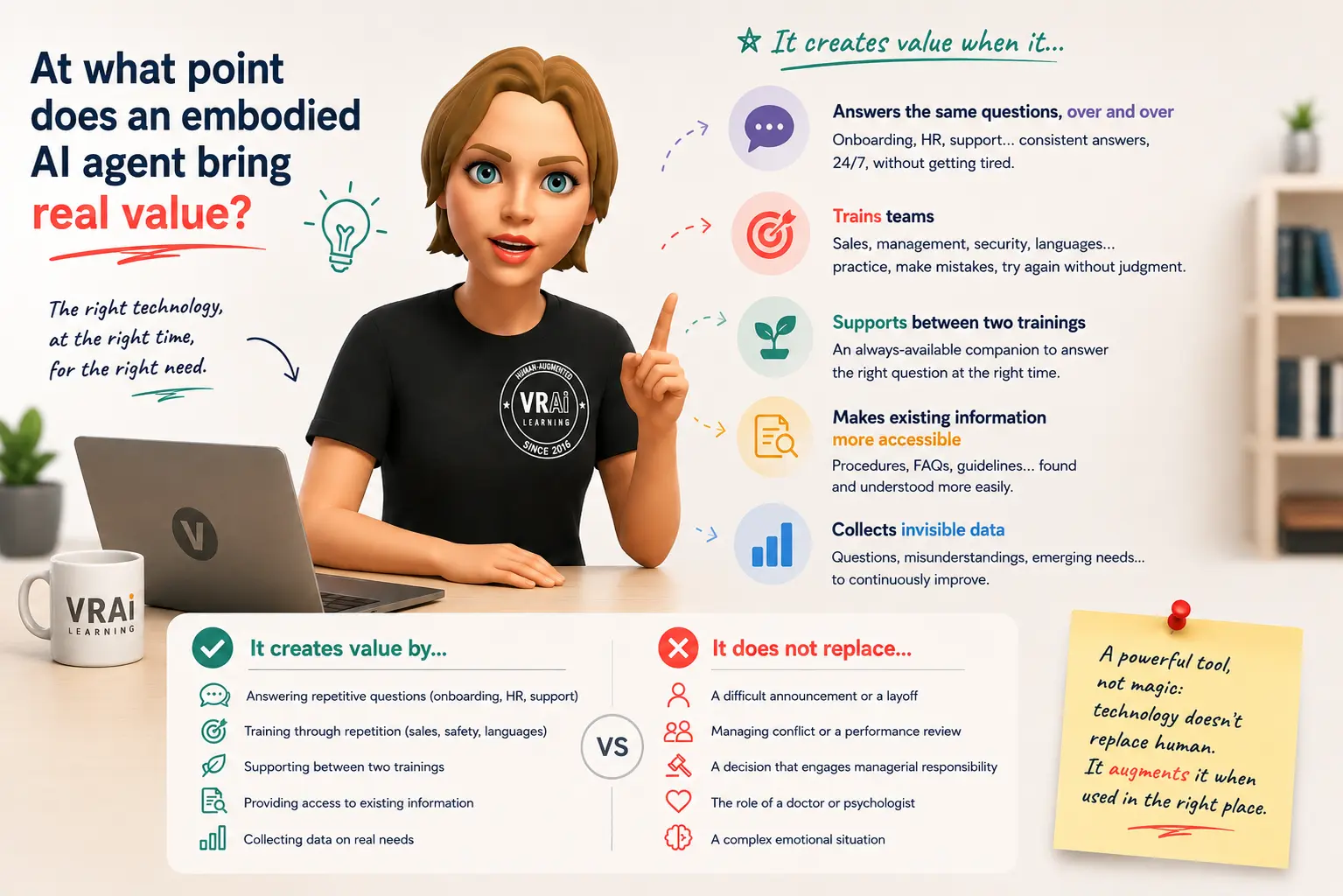
Before detailing how it works, it’s important to clarify what the AI avatar can do in a retail context — because its use cases extend beyond training:
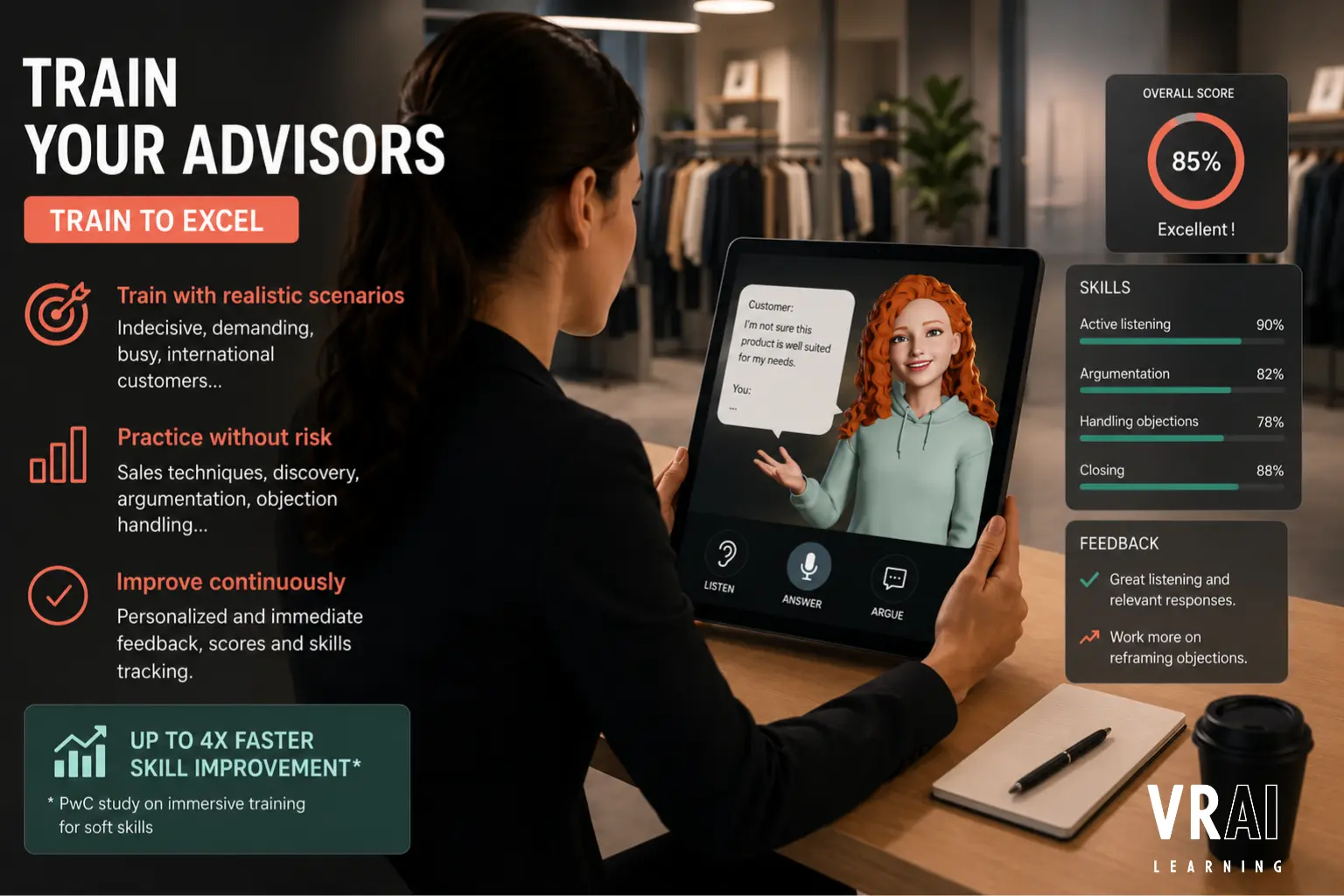
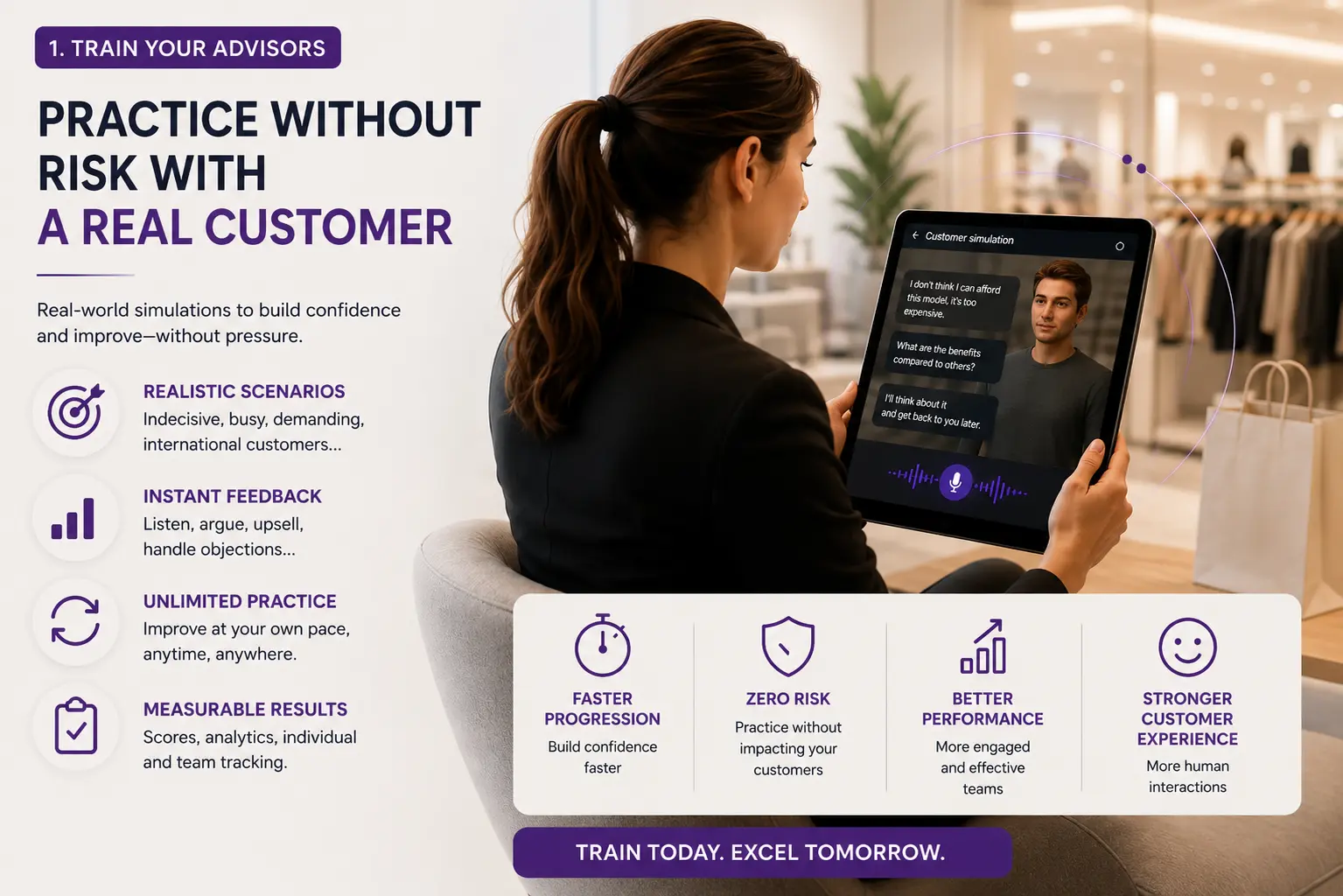
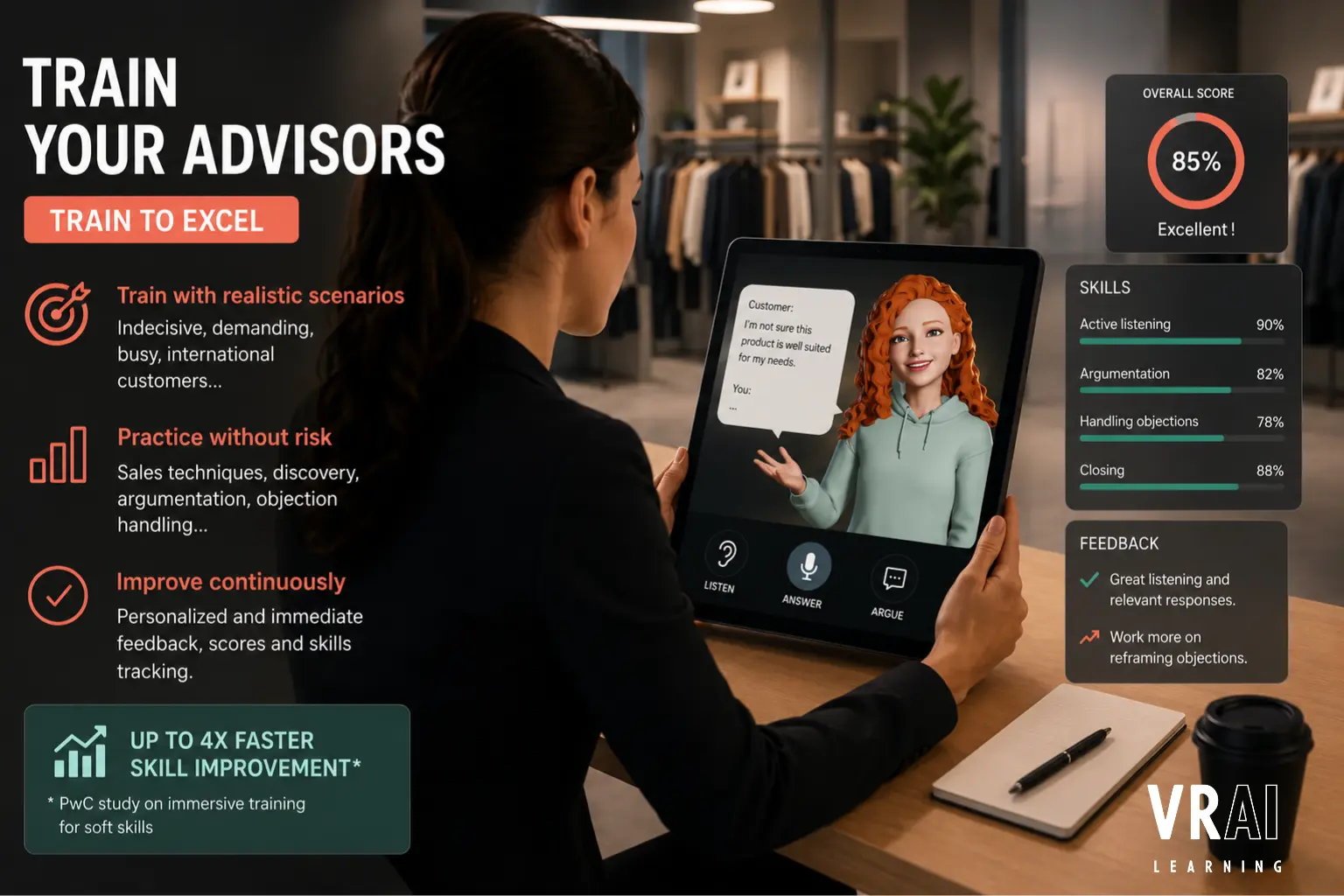
- Advisor Training: the avatar plays the role of a fictional customer with whom the advisor trains. It simulates the indecisive, the hurried, the demanding, the international customer. The advisor practices sales techniques, discovery, and objection management without risking a real customer relationship.
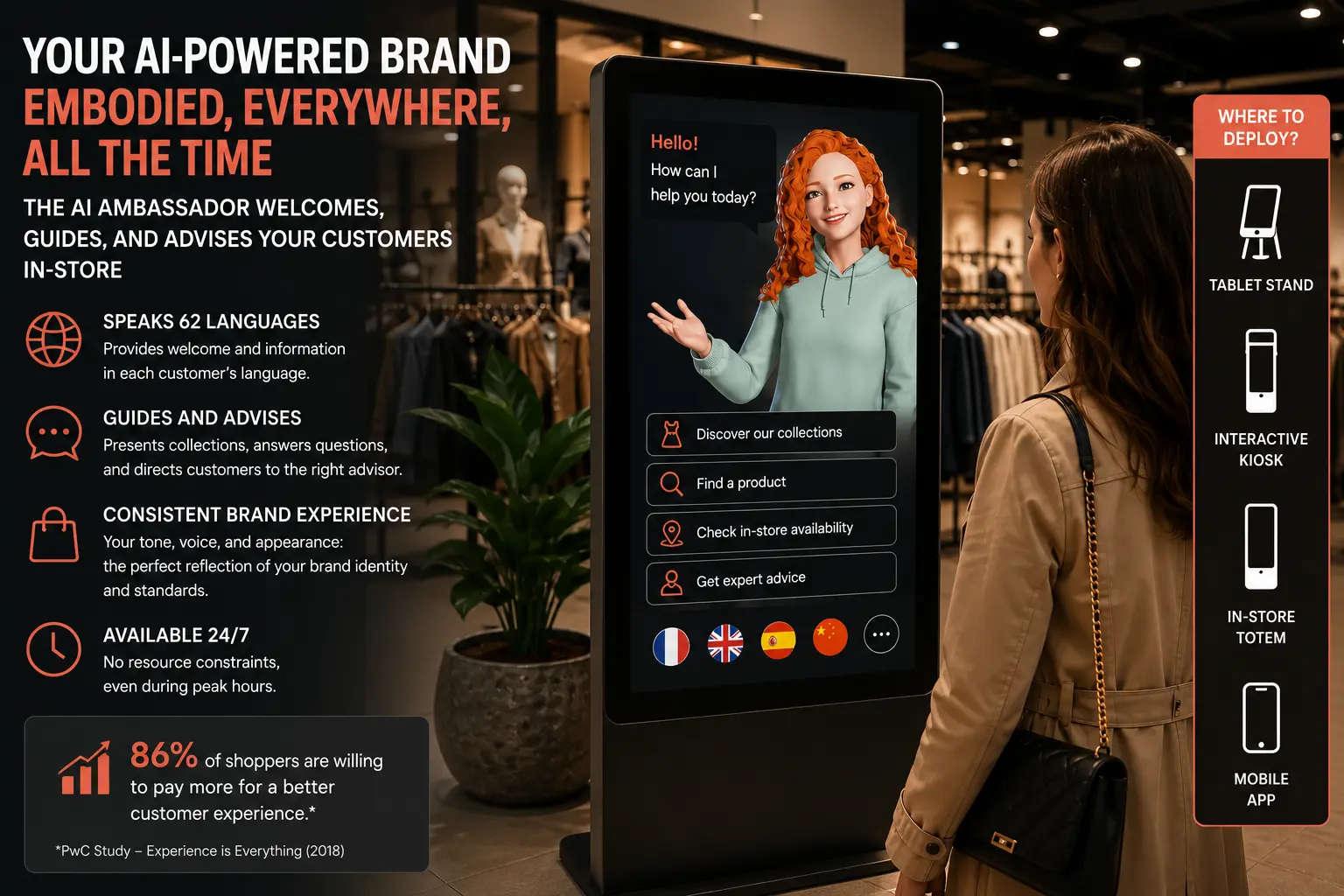
- Brand Ambassador Avatar: deployed in-store on a tablet stand, interactive kiosk, or totem, the avatar greets and guides customers directly. It speaks their language, presents the collections, and directs them to the right aisle or human advisor.
These are two different functions that can be activated separately or together depending on the store's needs.
Training your advisors: practice without risking real clients
The fundamental issue with sales training is that real skills are only acquired through action — but action involves real clients, who aren't there to be experimental subjects.
Simulation via avatar resolves this contradiction. Advisors train on realistic scenarios based on the most frequent situations in your store: the customer comparing two products without deciding, questioning the price, leaving without buying although interested.
During each session, the avatar evaluates listening quality, argumentation relevance, upsell timing. The advisor receives immediate feedback without the pressure of a real interaction and can replay the scenario as often as needed, whether on a breakroom tablet or at home.
The results are documented: according to a PwC study on immersive training in soft skills, learners trained through simulation are four times quicker to master targeted skills than those taught through conventional classroom training. For stores with high turnover or seasonal peaks, this is a significant operational advantage.
CSO Insights and MHI Global further document a direct correlation: sales teams benefiting from simulated coaching programs show, on average, a 28% higher closing rate than those trained without simulated practice.
Brand policy: it's trainable too
Beyond sales techniques, there's something subtler and often neglected in retail training: the transmission of brand culture and codes.
An advisor who masters generic sales techniques but doesn't speak the brand's language, doesn't know the products' history, or doesn't reflect the expected level of quality — that’s a brand that erodes interaction after interaction.
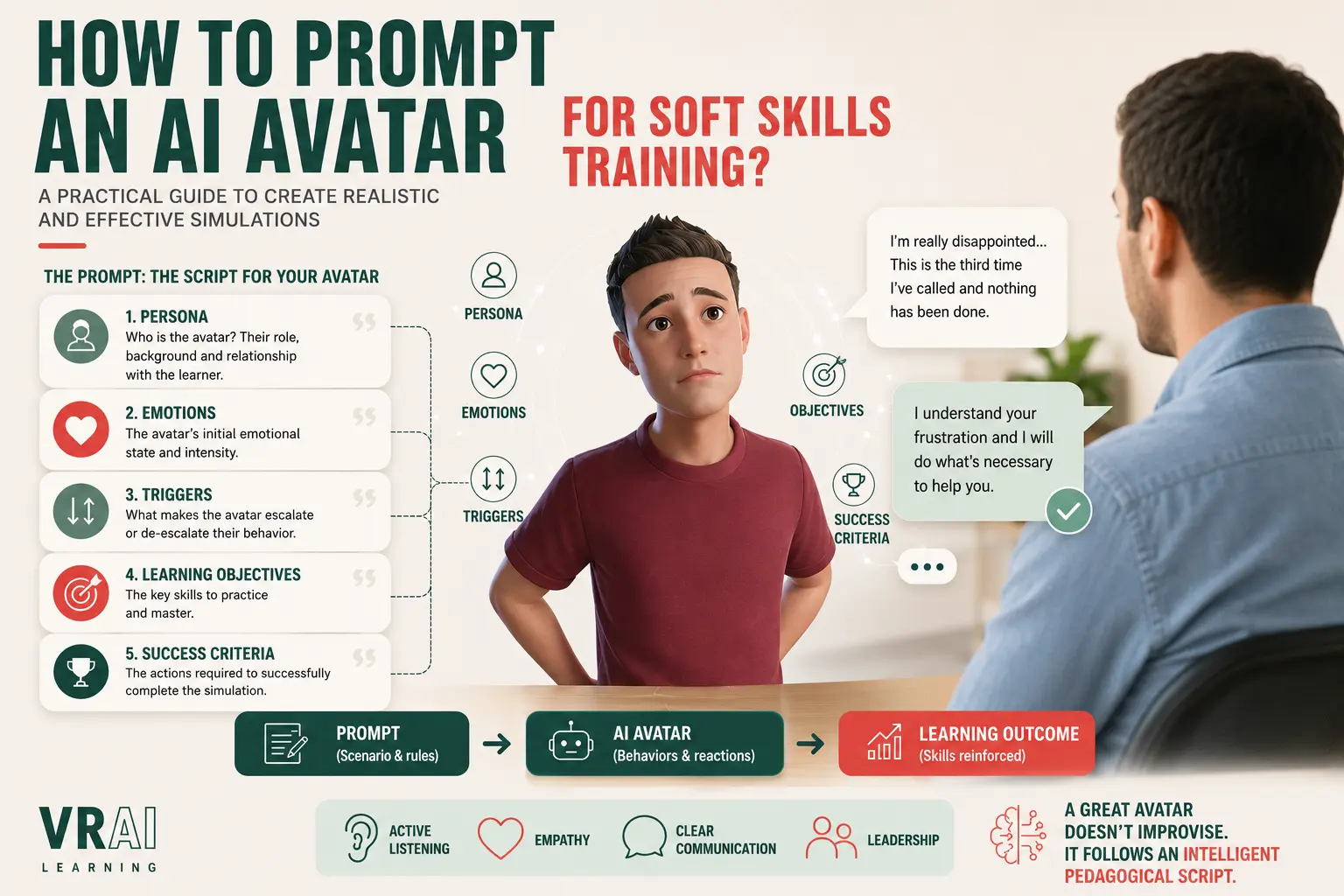
The avatar also allows training this aspect. Scenarios can be designed around situations specific to the brand's universe: presenting a new collection while staying in tune with the editorial tone, answering technical questions without straying from the brand's vocabulary, handling a complaint without deviating from service standards. Everything is customizable — vocabulary, values being tested, situations unique to your target clientele.
The ambassador avatar: your brand embodied, everywhere, all the time
The second use might be the most surprising at first: deploying the avatar not to train the teams, but directly to the clients. This is what we’ve developed with our Retail Avatar Training solution.
At an interactive kiosk at the store entrance, on a stand-mounted tablet in a specific department, or on a totem in a waiting area, the avatar can welcome customers, present collections, answer product questions, and direct them to the right human contact.
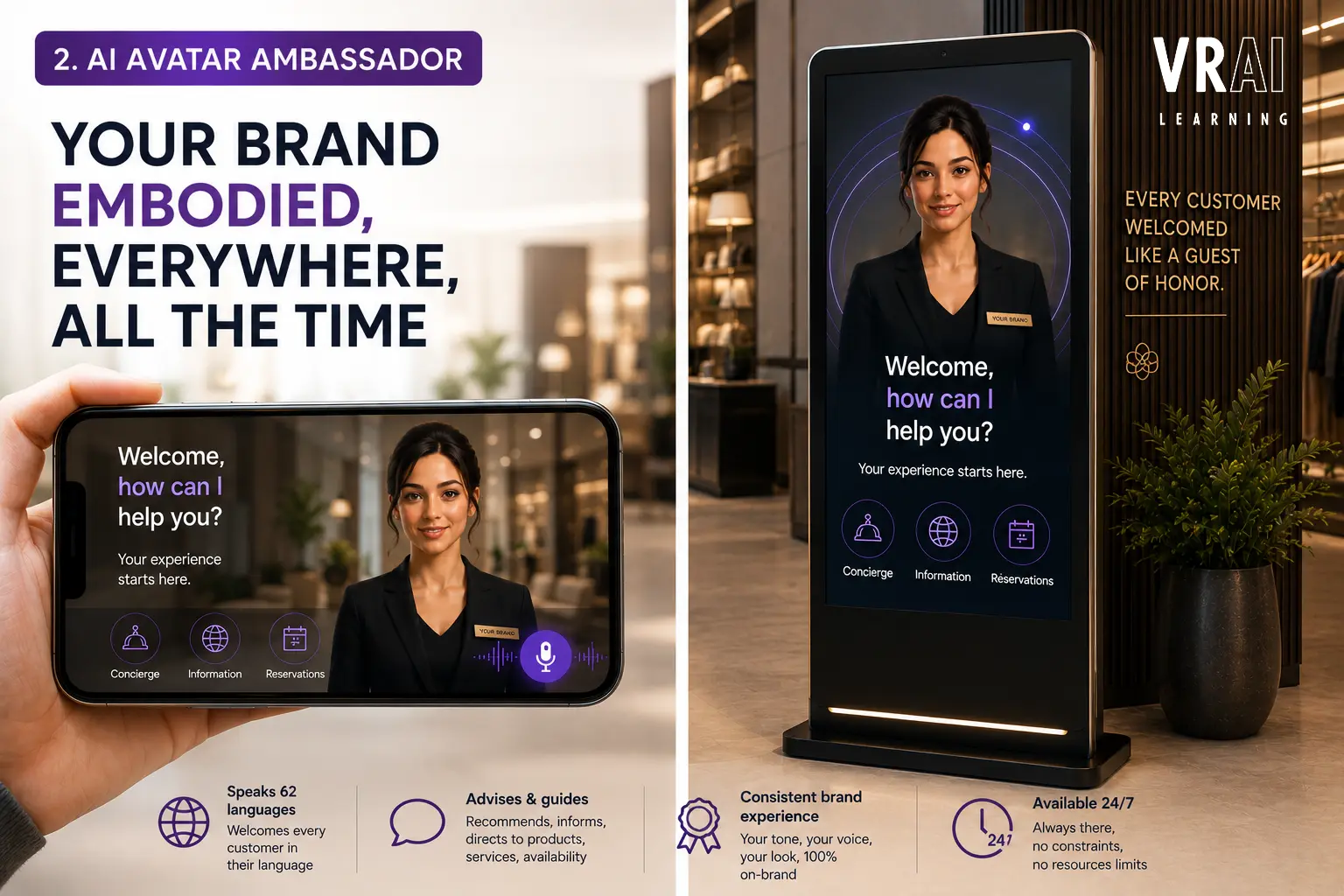
What sets it apart from a simple informative screen is that it communicates. It has a voice, tone, and appearance configured to reflect the brand identity. It can speak to a customer in their language as soon as they approach — in 62 languages — without needing a bilingual advisor.
For stores receiving international clientele — in tourist downtowns, airports, high-traffic shopping areas — this ends the language barrier.
86% of buyers say they'd pay more for a better customer experience, according to PwC's 2018 Experience is Everything study. The ambassador avatar is specifically designed to elevate this experience at every touchpoint, including those without a human advisor available.
Analytics: when every interaction becomes usable data
Whether serving to train teams or welcome clients, each session generates precise behavioral data.
For training: the store manager can view in real-time each advisor’s progress scores — listening quality, assertiveness, mastery of argumentation techniques. They identify collective blockages, weaknesses across the team, and adapt the training plan accordingly.
For client welcoming: data records the most-asked questions, most requested products, languages used, average interaction duration. It’s a direct assortment signal — if a significant portion of clients requests a color absent from the range, the commercial department knows before analyzing point-of-sale data.
Training data is exportable in xAPI to the store's LMS, for complete traceability and HR reports complying with GPEC requirements.
What deployment for your brand?
One recurring barrier to adopting digital solutions in retail is the perceived complexity of deployment. The AI avatar is designed to avoid this.
It works on tablets, kiosks, browsers, or mobile apps — no VR headset required. VR can be integrated additionally for some complex field training modules, but it isn’t a prerequisite. Most of the deployment can be done with equipment already owned by the store.
The typical process unfolds in three phases:
- Audit and customization: analysis of key sales situations, typical client profiles, and brand DNA. Configuring the avatar with the brand’s vocabulary, tone, and visual codes.
- Multi-device deployment: deployment on selected devices, LMS integration for training, standalone deployment for client welcoming.
- Monitoring and continuous improvement: dashboard access from day one, data by advisor and store, scenario iterations based on field feedback.
For who?
The solution is primarily aimed at stores facing:
- Turnover and onboarding: quickly integrating new advisors and seasonal workers without occupying managers.
- Brand coherence across a network: ensuring the same experience level across all points of sale.
- International customers: welcoming and training without language barriers.
- Commercial performance: improving conversion rates and average basket through regular sales technique practice.
Fashion, luxury, sports, beauty, high-tech, hospitality, pharmacy: retail sectors where the advisory experience is crucial are directly concerned.
To summarize
The AI avatar in retail stores is no tech gimmick. It’s a structured response to two issues every store knows: quickly training teams up to brand standards, and offering a consistent customer experience at every touchpoint.
The two uses complement each other and are managed through the same infrastructure — making the AI avatar one of the few retail tools benefiting HR, marketing, and commercial management simultaneously.
Discover our Retail Avatar Training solution or book a demo specific to your context.

Christèle Simeoni
Co-founder VRAI Learning (2023) · CMO
15+ years of expertise in digital marketing and EdTech. International career: Québecor (TVA), Adviso Montreal, Marketing Director at Holberton School. On this blog, she unpacks the best marketing and communications strategies to maximise the ROI of immersive learning and AI avatars.
See immersive training in action
Personalised demo, no commitment. We show you what it looks like for your context.
Book a demo