Christèle Simeoni
2 min min read
When Does an Embodied AI Agent Truly Add Value?
CS
Christèle Simeoni
Co-founder & CMO, VRAI Learning
An embodied AI agent is not a colleague. It's a tool. And like any tool, it only serves a purpose if it meets a real need.
Written by the VRAI Learning team · Published on July 15, 2026 · Reading time: 9 min
For the past two years, a new platform promises every week to replace an advisor, a salesperson, a trainer, or customer service with an increasingly realistic avatar. In 2026, adoption follows: 50% of American workers now use AI in their work at least occasionally, compared to 46% the previous quarter (Gallup, 2026). The tool spreads quickly. The reflection on its use, however, rarely keeps pace.
- In 2026, 65% of employees feel that AI improves their productivity, but only 12% say it has changed their way of working (Gallup, 2026): AI enhances existing work, it does not reinvent it.
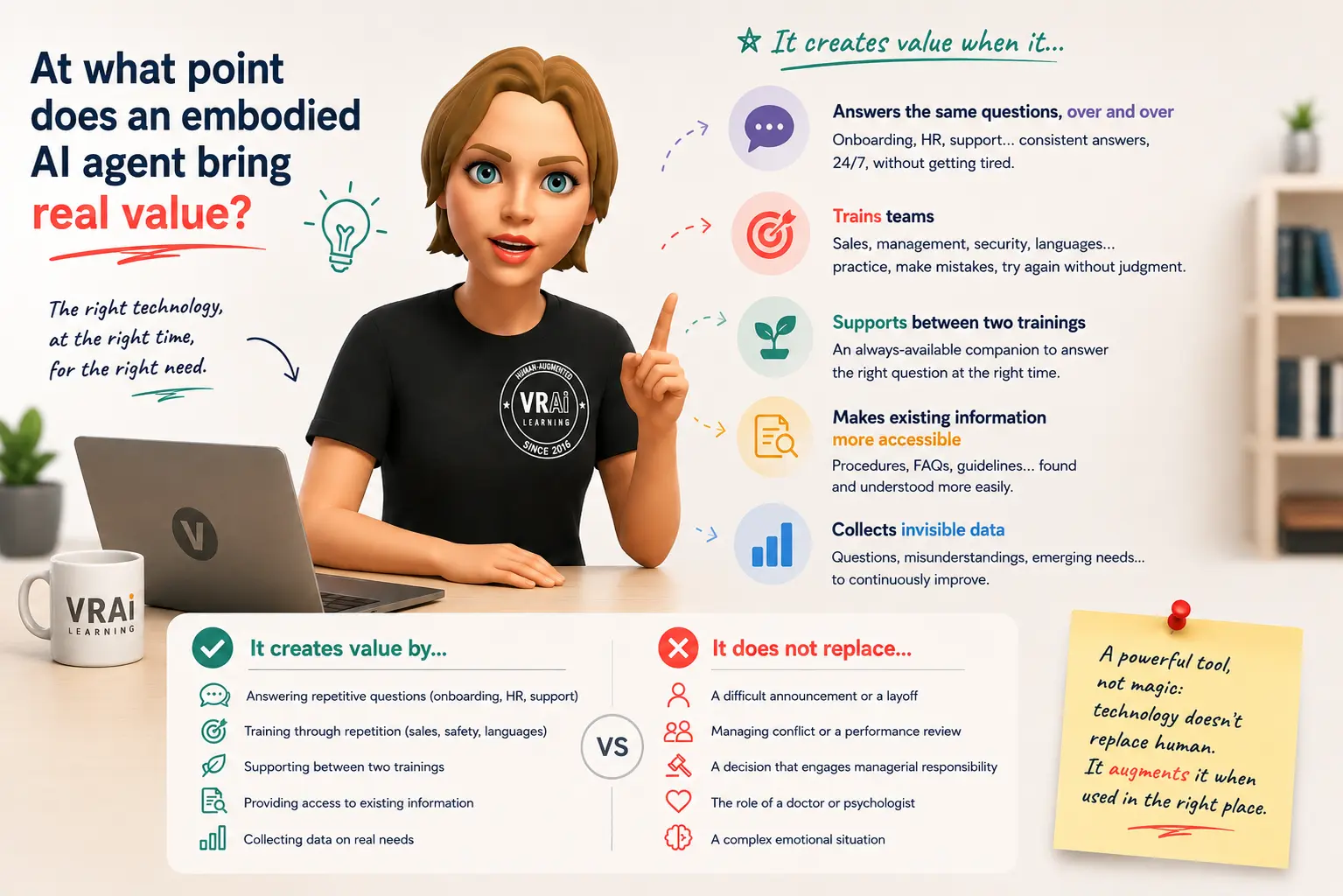
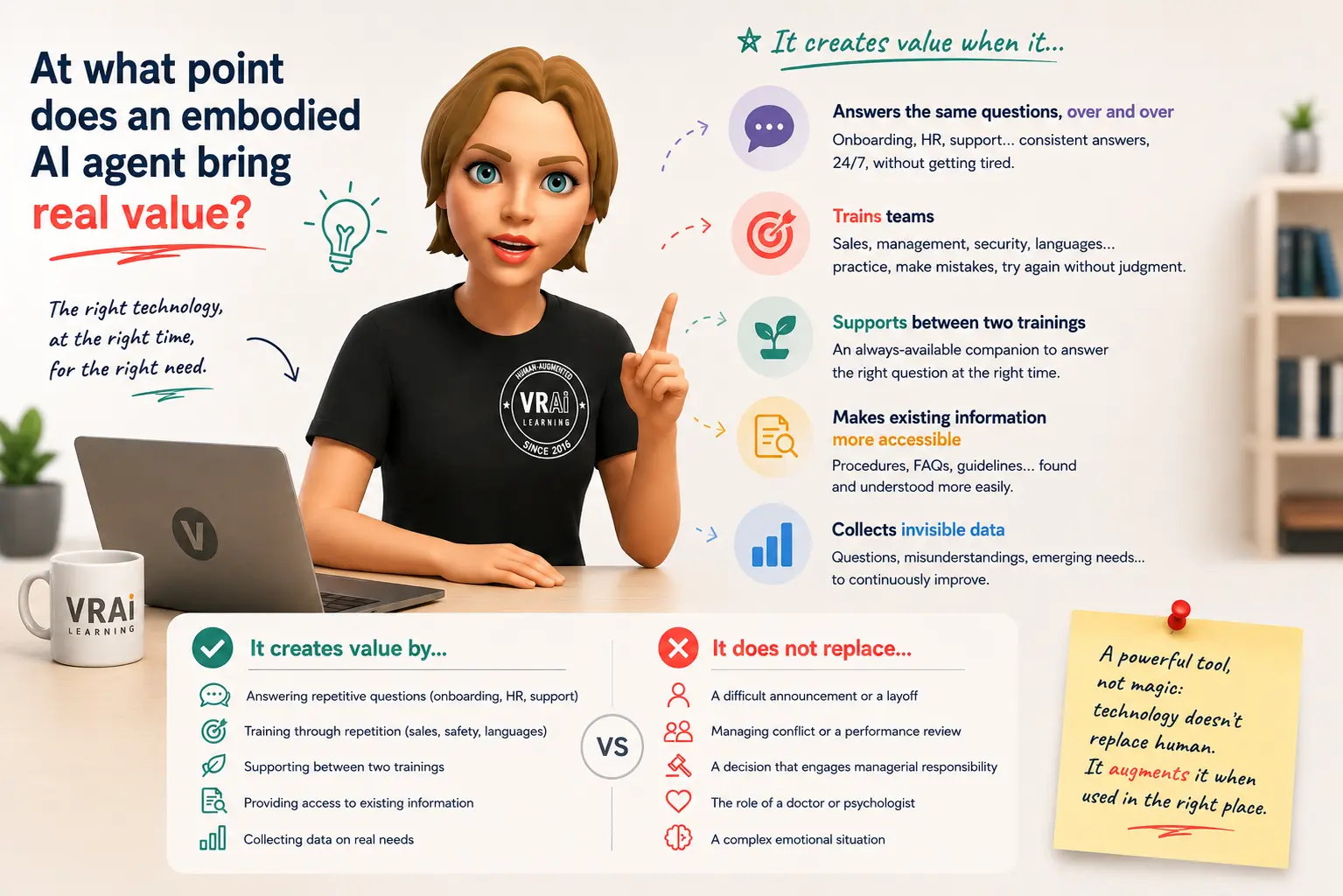
- An embodied AI agent creates value in repetitive tasks, non-judgmental training, and continuous support, not in decisions requiring empathy or human responsibility.
- Researchers from MIT identify five human abilities that machines struggle to replicate: empathy, presence, judgment, creativity, vision (EPOCH framework, MIT Sloan, 2025).
An AI Agent is Not an End in Itself

Christèle Simeoni
Co-founder VRAI Learning (2023) · CMO
15+ years of expertise in digital marketing and EdTech. International career: Québecor (TVA), Adviso Montreal, Marketing Director at Holberton School. On this blog, she unpacks the best marketing and communications strategies to maximise the ROI of immersive learning and AI avatars.
See immersive training in action
Personalised demo, no commitment. We show you what it looks like for your context.
Book a demoExplore our solutions