Christèle Simeoni
6 min min read
Embodied AI Agents: Smart Avatars for Training
CS
Christèle Simeoni
Co-founder & CMO, VRAI Learning
Since the end of 2023, the term 'AI agent' has become entrenched in global tech vocabulary, driven by the rise of language models and advanced conversational interfaces. Research on the subject has exploded in a few months, but definitions remain unclear: AI agents, chatbots, avatars, virtual assistants are often used as synonyms even though they cover very different realities. This article clarifies what an embodied AI agent is, how it differs from its technological counterparts, why the 'embodied' aspect changes its impact, and where the market stands in 2025 for French and Francophone businesses.
AI Agent, Chatbot, Avatar: The Differences That Matter
Before going further, it is essential to provide clear definitions. These three terms coexist within the same ecosystem but do not address the same needs and do not rely on the same levels of technological sophistication, particularly in the uses of immersive training and corporate support in France and Europe.
The Chatbot
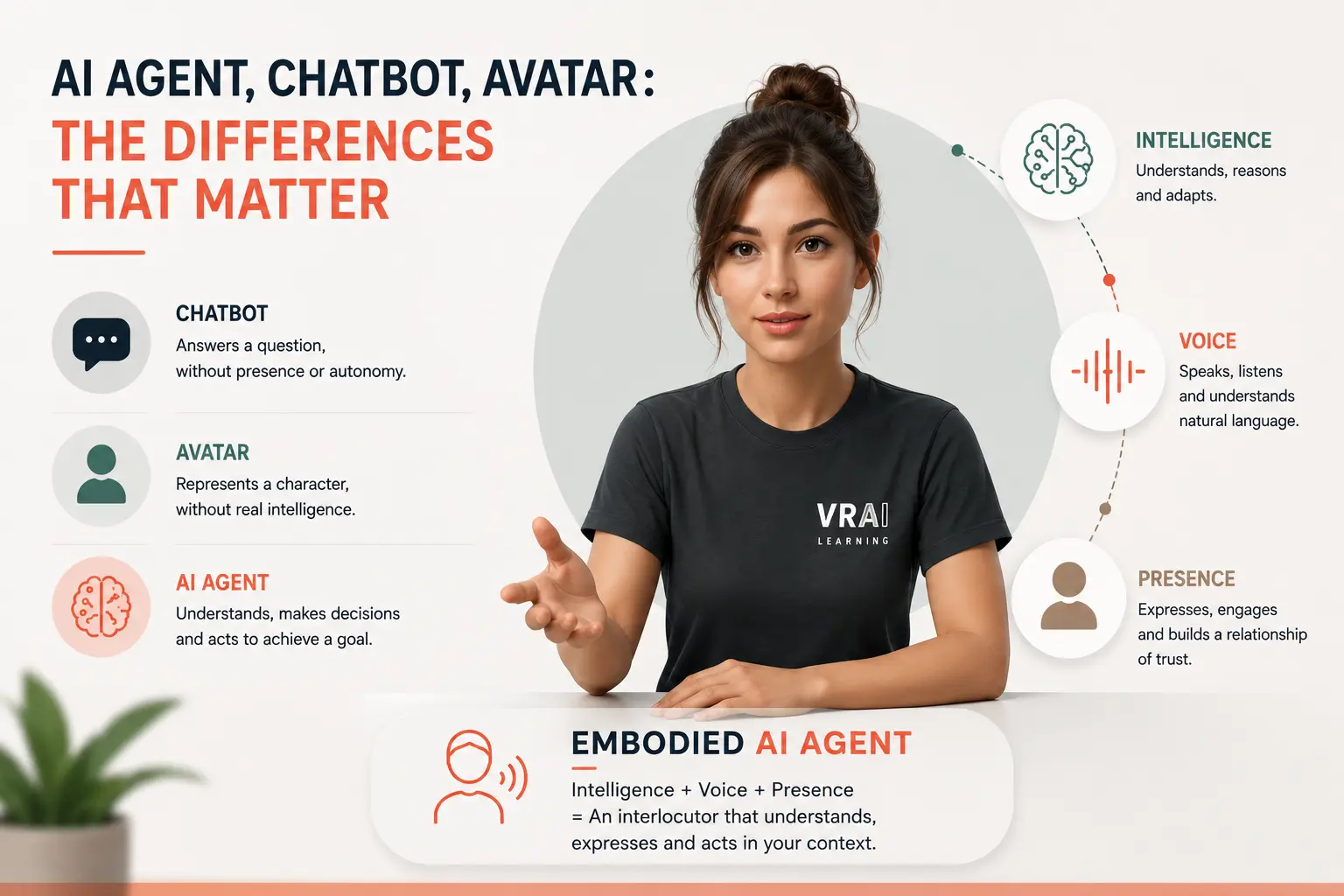
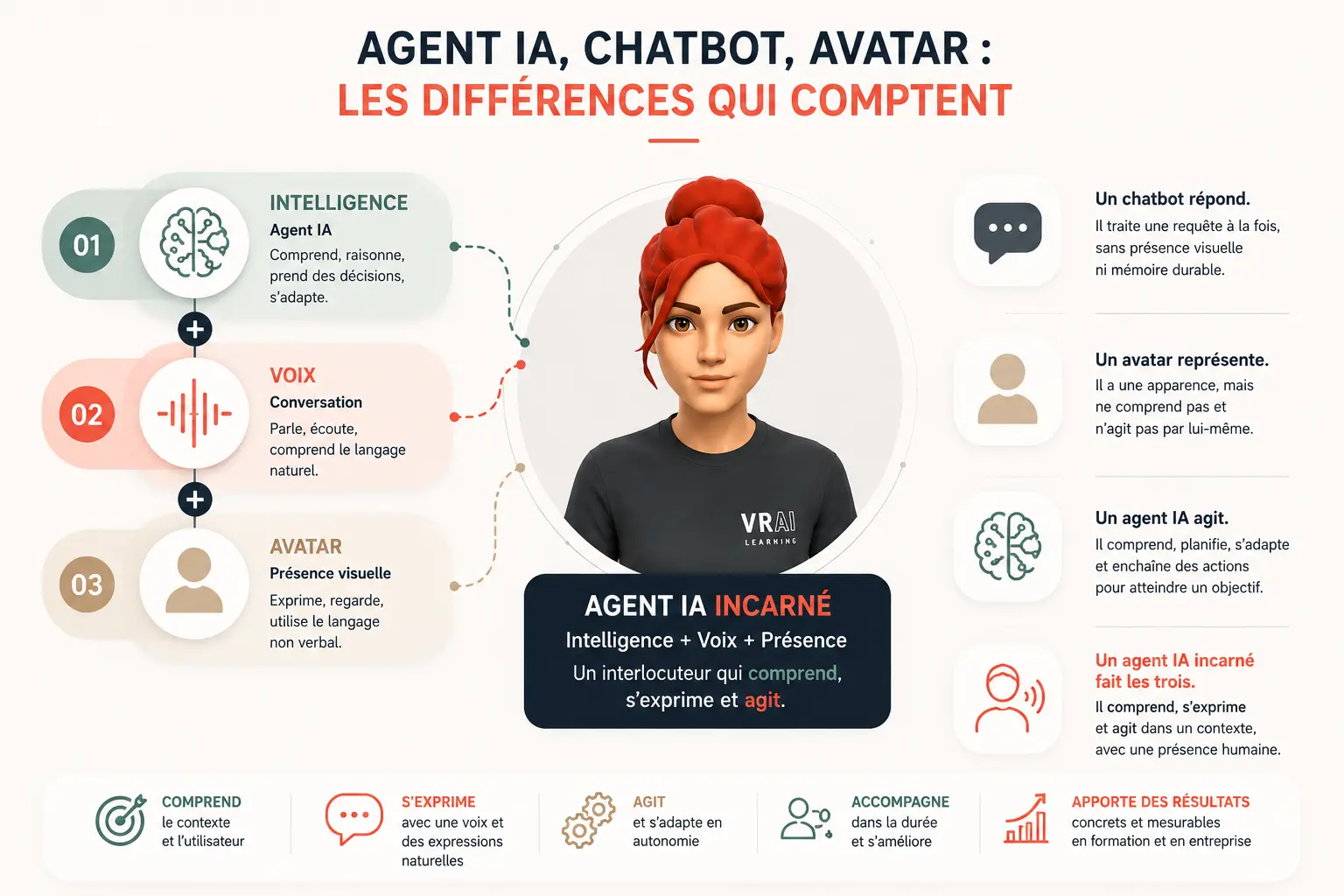
A chatbot is a program that responds to textual messages, either according to predefined rules or – in its modern version – by relying on a language model. It has no visual presence, no voice, and very often, little real autonomy: it handles one request at a time, has limited memory of the relationship, and rarely initiates interaction on its own.
The Avatar
An avatar is primarily a visual representation, a digital character. On its own, it does nothing: it is a graphic shell that can be used in very varied contexts (video games, social networks, VR training) without being necessarily intelligent or autonomous. Some existing avatars are fully scripted: they play a predefined role without real capacity for adaptation based on the user or context.
The AI Agent
An AI agent is a system capable of perceiving its environment, making decisions, and acting autonomously to achieve a goal. What fundamentally distinguishes it from a chatbot is its autonomy: it can plan, chain multiple actions, adapt to unforeseen situations, and learn from its interactions. It does not just respond; it acts within a given framework, making it a powerful tool for French companies engaged in their digital transformation.
What Is an Embodied AI Agent?
An embodied AI agent combines three dimensions: the intelligence and autonomy of an AI agent, the visual shell of an avatar, and voice with a natural expression capacity. Concretely, it is a digital interlocutor that 'exists' visually, expresses itself, understands the context of the situation, and acts accordingly to respond to a question, guide through a process, evaluate a performance, or adapt its speech to the user's profile.
The difference is not cosmetic; it is behavioral and psychological, which is its key interest for training, onboarding, and supporting employees in Francophone organizations.
Why the 'Embodied' Dimension Changes Everything
One might think that the visual aspect is just marketing wrapping similar to a chatbot. However, research in cognitive sciences and pedagogy shows otherwise, particularly in the context of immersive training.
Social Presence Effect
When an interlocutor has a visual presence – a face, expressions – the human brain automatically identifies it as a social agent and engages interpersonal circuits. This 'social presence effect' directly impacts engagement. Studies in learning psychology show that learners interacting with an animated character retain significantly more information than with a purely textual interface.
Psychological Safety for Learning
Facing a digital interlocutor, users dare more. They ask questions they wouldn't dare to address to a colleague or manager, accept feedback without viewing it as a personal assessment, and try again without shame. This psychological safety precisely makes embodied AI agents so effective in training contexts: error becomes a tool for learning, free of sanction.
Consistency in the Relationship Over Time
An embodied AI agent can maintain a memory of the relationship: it knows where the user stands in their journey, what they have already practiced, and where their difficulties lie. It adapts its interactions accordingly, allowing for a continuous educational relationship. This continuity is particularly useful for companies training regional teams and major French groups.
Business Applications
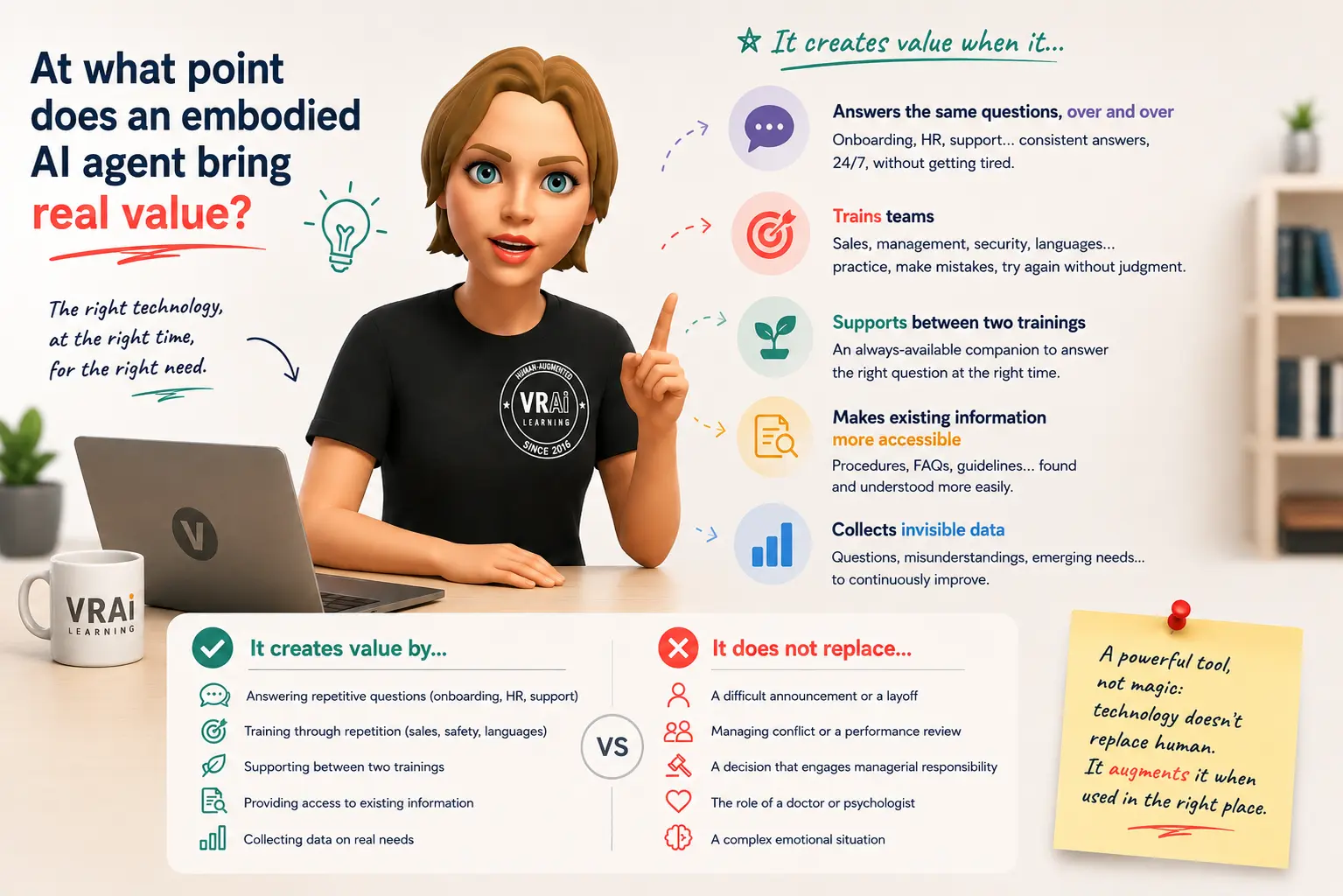
Embodied AI agents are currently applied to three major categories of business needs, in France and internationally.
Training and Skills Development
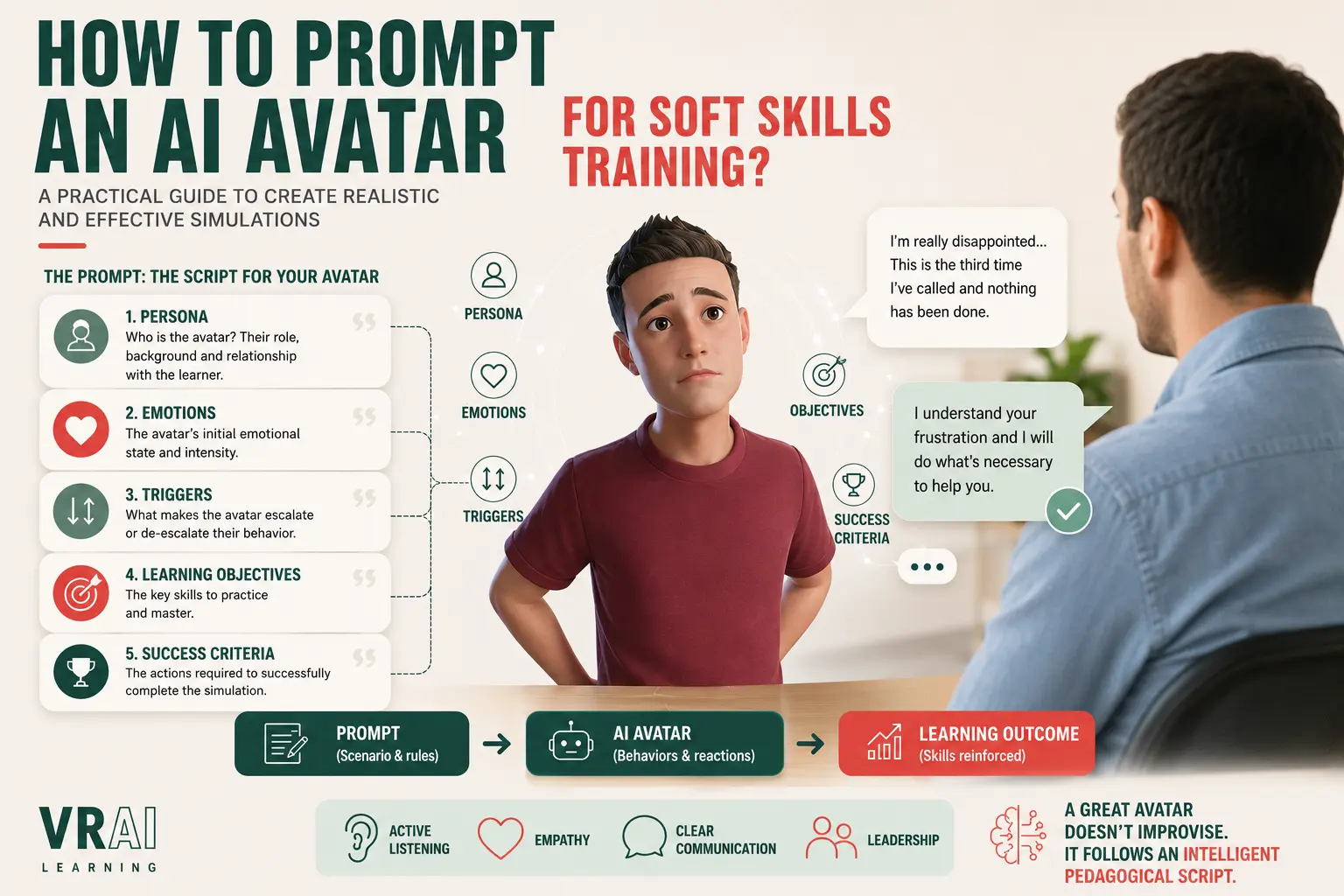
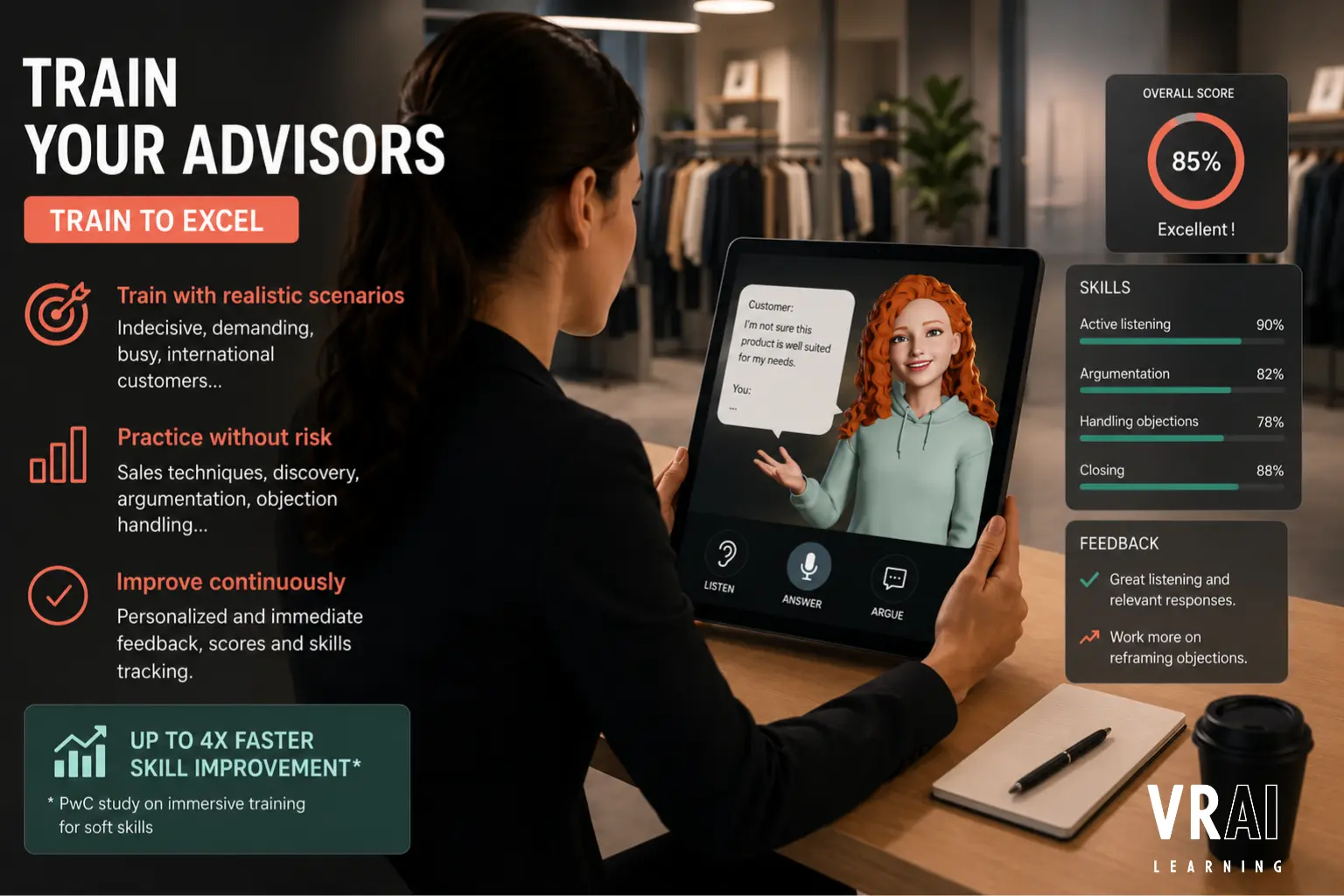
This is the most mature use case. The agent plays a role in simulations – stressed customer for a salesperson, anxious patient for a caregiver, collaborator in conflict for a manager. The learner practices in realistic conditions, receives immediate feedback, and studies at their own pace, all on a tablet, web, or VR headset, depending on the desired level of immersion. Studies by firms like PwC show that immersive learning significantly accelerates skill acquisition, especially in soft skills.
Information and Daily Support
The embodied AI agent can also serve as a permanent point of contact to answer questions, guide through a procedure, or explain an internal policy. Where a text-based chatbot might be perceived as a simple enhanced FAQ, the embodied agent creates a relationship: usage rates are higher, users return because the interaction is pleasant, not just functional. This continuity ideally relies on LMS integration to track progress and feed HR dashboards.
Reception and Orientation
In an interactive kiosk, at the reception of a store or public space, it can welcome, direct, and inform in the visitor's language. No waiting line, no time constraints, no language barrier. It does not replace human contact but extends the organization's presence to times and places where no staff is available.
Where Will the Market Be in 2025?
The AI agent market is already estimated at several billion dollars and shows sustained growth prospects until 2034, driven by the industrialization of language models and conversational platforms. This growth is not driven by a single sector: applications are developing simultaneously in healthcare, industry, retail, financial services, and human resources.
In the specific segment of training, conversational simulation by AI avatar has seen notable acceleration since 2024. Organizations positioning themselves now are building a lead with tested data, calibrated scenarios, and performance benchmarks—assets difficult to catch up on for those who wait.
The Francophone Market: A Window of Opportunity
In France and the Francophone world, the term 'embodied AI agents' is beginning to build in professional vocabulary. This represents both a slight terminology lag and a real opportunity: organizations that adopt, document, and share use cases now can position themselves as domain leaders.
For organizations based in France, Belgium, Switzerland, or Quebec, it's an opportunity to take an early stance on a subject still scarcely covered in French. The first to build feedback, metrics, and expert content will be the ones identified as the experts by search engines, prescribers, and prospects.
What Distinguishes a Good Implementation From a Poor One
Not all embodied AI agents are created equal. Failed implementations often share common pitfalls.
- An Isolated Deployment: an embodied AI agent without data feedback, without integration into the existing training pathway, creates a technological 'island.' Effectiveness comes from integration into the training school.

Christèle Simeoni
Co-founder VRAI Learning (2023) · CMO
15+ years of expertise in digital marketing and EdTech. International career: Québecor (TVA), Adviso Montreal, Marketing Director at Holberton School. On this blog, she unpacks the best marketing and communications strategies to maximise the ROI of immersive learning and AI avatars.
See immersive training in action
Personalised demo, no commitment. We show you what it looks like for your context.
Book a demoExplore our solutions