Conversational AI avatar Practise, not just listen.
A lecture does not teach you to handle the pressure of a clinical interview, it explains the context but does not make you live it. AI roleplay and conversational simulation put the learner in the situation: it speaks, it reacts, it can unsettle. For many, progress comes from repetition, not memorisation.
Scenarios are infinite, every sector is affected
Preparing students for oral exams
A student can practise their philosophy oral, prepare a thesis defence or train in a foreign language with an avatar available at 11pm. The avatar plays the examiner, asks unsettling questions, handles silences and adjusts its difficulty level. Each session generates a score and specific areas to work on.
- Preparation for oral exams, defences and assessments
- Foreign language training on any subject
- Conversational tutoring available 24/7, in any language
- Accessible on PC, tablet or mobile, no installation
Léa practises at 11pm from her flat. The avatar plays the examiner and asks the opening question.
It rephrases her arguments, introduces a contradiction, holds an 8-second silence to test her stress handling.
At the end of the session she receives a fluency score, structure score and the passages to rework.
She repeats the next day with increased difficulty. Without disturbing her lecturer.
Thomas practises his first consultation interview. The avatar plays an anxious patient defined by the instructor.
The patient alternates between withdrawal and passive aggression, without warning. Thomas must maintain the therapeutic framework.
The instructor reviews Thomas's empathy, active listening and rephrasing scores remotely.
The following week, the same scenario with a more complex profile. No real patient involved.
Clinical interviews & difficult disclosures
Students in psychology, nursing or medicine need to practise situations impossible to simulate with real patients: delivering a serious diagnosis, managing an agitated patient, conducting a first consultation. The avatar plays these complex emotional profiles (anxious, resistant, in denial) with zero risk to a real patient.
- First consultation interviews and anamnesis
- Delivering a difficult diagnosis and emotional support
- Managing agitated or crisis patients
- Empathy and active listening analytics for the instructor
Resistance to social engineering
90% of cyberattacks start with a human opening a door. Training teams to resist requires putting them in real situations, not a video, not a quiz. The avatar plays the attacker: fake IT technician, fake executive in an emergency, fake supplier. It escalates pressure, creates urgency, exploits politeness. The employee learns to identify and refuse.
- Vishing (voice phishing) and fake IT support simulation
- Manipulation scenarios: urgency, authority, reciprocity
- Resistance score and replay of weak moments
- Automatic error debrief after each session
The avatar calls posing as IT support. It requests emergency access to "resolve a critical incident".
It escalates: 5-minute deadline, authoritative tone, fake reference to the CTO. It exploits politeness and a sense of responsibility.
The employee must identify the warning signals and refuse without creating conflict, a skill that cannot be learned by reading.
Resistance score, replay of the 3 moments where they could have given in. Automatic debrief of the tactics used.
The feedback grid, in conversational simulation
Every AI roleplay exchange is scored on the same dimensions, whatever the scenario, comparable session to session to track real progress.
clarity of speech, flow of ideas
rephrasing, adapting to the interlocutor
silences, pressure, moments of weakness
specific points to rework after the session
From scenario to practice
Scenario audit
We identify the key situations with you: which skills, which emotional profiles, which difficulty levels. Every sector has its critical moments.
Avatar scripting
Creation of characters and their behavioural profiles. Progressive levels, languages, emotional reactions. You validate before deployment.
Deployment & tracking
Access via web link or integration into your LMS (xAPI/SCORM). Instructors track each learner's progress in Avatar Académie.
Go deeper
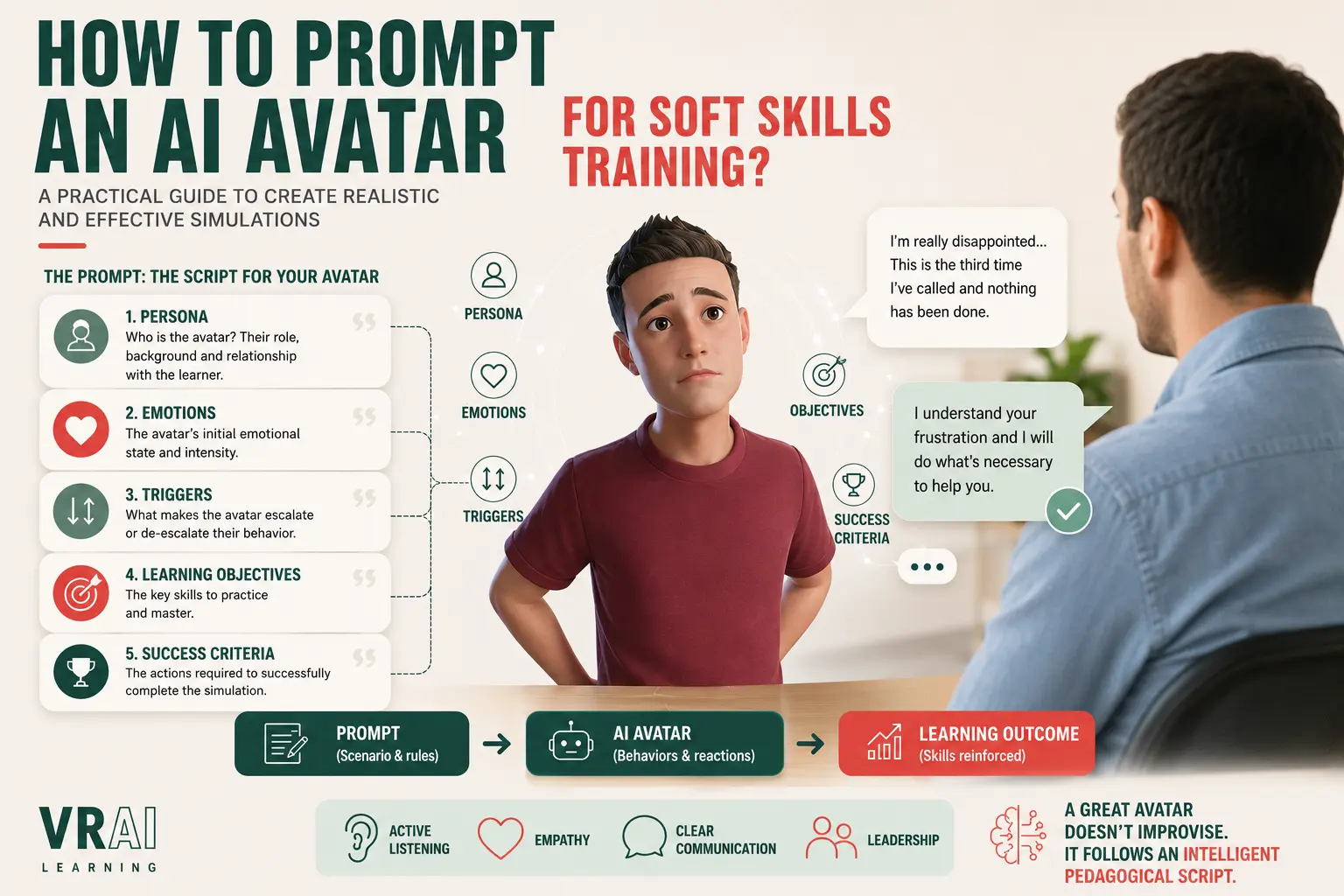
How to Prompt an AI Avatar for Soft Skills Training
Prompting a training AI avatar is like writing the script for a virtual actor. This guide details the 5 structural variables of an effective system prompt with ready-to-use blueprints for customer service, healthcare, and management.
Read article →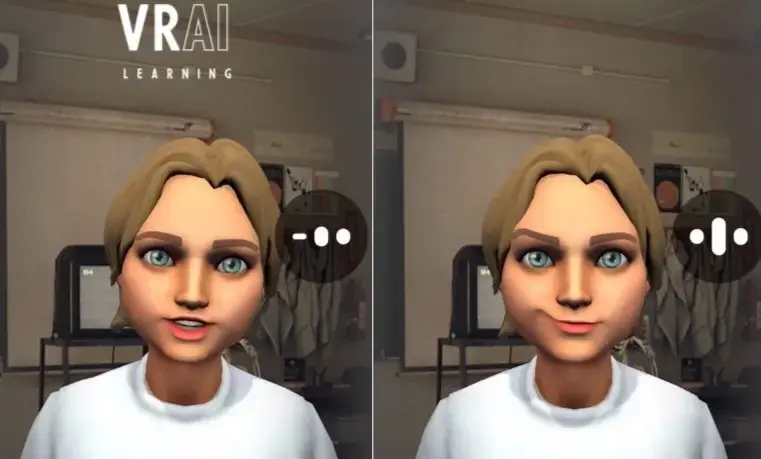
AI Avatars: Why Non-Verbal Language Matters
In immersive experiences, non-verbal language—looks, gestures, expressions—plays a crucial role. With the rise of AI conversational avatars and immersive learning, these signals become key to creating credible, empathetic, and engaging interaction. Here's why non-verbal transforms training and how it enhances presence, understanding, and motivation in next-generation learning environments. Because a look, a gesture, or...
Read article →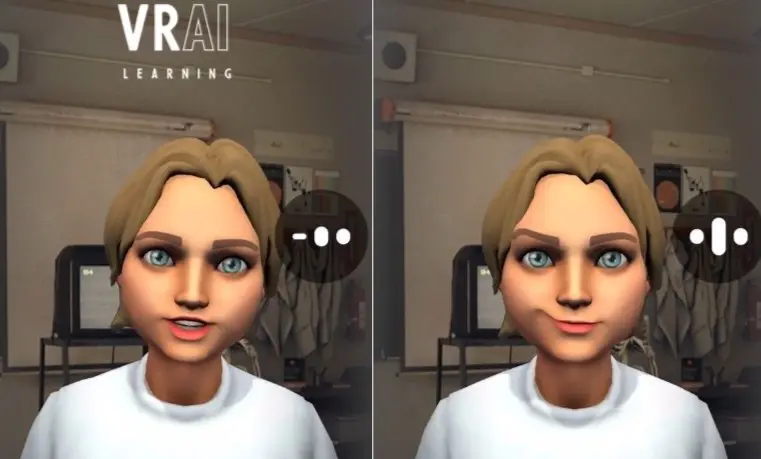
When the non-verbal of AI avatars transforms learner engagement
"Because a glance, a gesture or a virtual smile are often worth more than a thousand words to capture and engage." In an immersive...
Read article →Questions about soft skills training
Can the avatar play different emotional profiles?
Yes. Each scenario defines the avatar's profile: an anxious student, an aggressive patient, a persuasive attacker. Difficulty levels can be adjusted progressively to accompany the learner from beginner to expert.
How do you measure progress in soft skills?
Via Avatar Académie: fluency score, empathy indicators, resistance to pressure, number of conversations completed. The instructor sees the progression of each learner without being present during the session.
Is this suitable for higher education and business schools?
Yes. The avatar integrates directly into the institution's LMS (Moodle, Canvas, 360Learning) via xAPI/SCORM. Teachers define the scenarios, students practice autonomously at their own pace.
How many scenarios can be created?
There is no limit. Once the avatar is set up, creating a new scenario takes a few hours. Each situation (oral exam, clinical interview, social engineering attack) is an independent module.
Does the solution work without an LMS?
Yes. The avatar can be deployed as a web application accessible via a simple link, no installation or LMS required. LMS integration via xAPI/SCORM remains available for institutions that want centralised tracking.
Ready to put your learners into practice?
Personalised demo, no commitment.