Christèle Simeoni
8 min min read
How to Prompt an AI Avatar for Soft Skills Training
CS
Christèle Simeoni
Co-founder & CMO, VRAI Learning
How to Prompt an AI Avatar for Soft Skills Training: Practical Guide
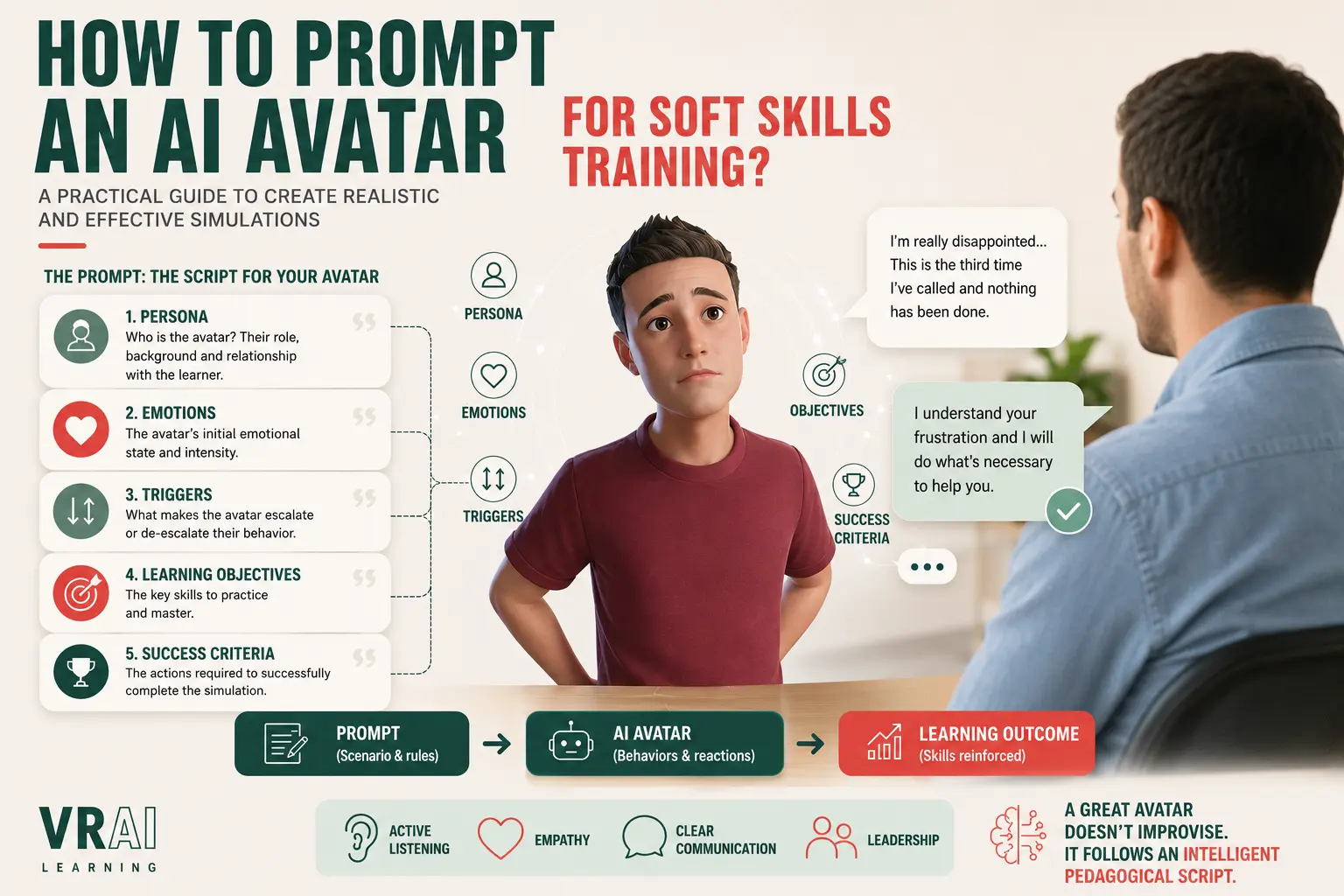
A conversational AI avatar is not just a simple chatbot. It plays an active role. In professional training, the quality of this role relies entirely on its instruction architecture. Prompting an avatar for developing relational skills (soft skills) is like writing the script for a virtual actor who will need to improvise in real-time, within the specific context of your organization.
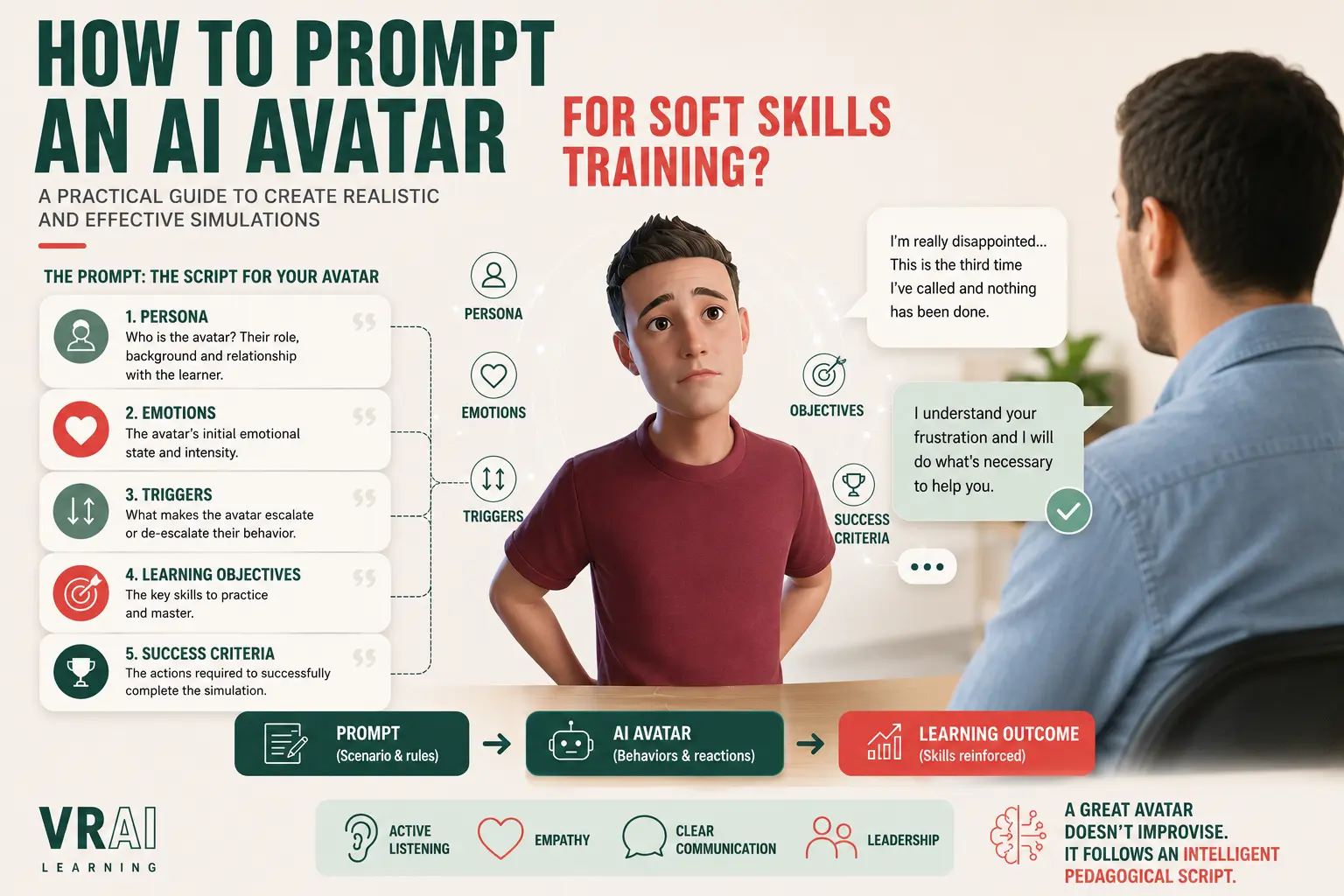
This methodological guide explains how to construct an effective AI avatar prompt (or system prompt), with ready-to-use structures for major business use cases.
1. Why AI Avatar Prompting Differs from Classic Prompting
When you prompt a large language model (LLM) like ChatGPT or Claude to draft an email or summarize a document, you're looking for a unique, finalized product. In contrast, prompt engineering applied to an educational avatar involves defining a persistent and dynamic behavior capable of adapting to dozens of unpredictable conversational turns.
The four pillars of behavioral prompting:
- Temporal persistence: The prompt remains active and directive throughout the simulation (5 to 20 minutes), maintaining the framework without cognitive drift.
- Persona coherence: The avatar must maintain the same personality, cognitive biases, and emotional load, no matter the direction taken by the learner.
- Adaptive gradation: The avatar's reactions evolve according to a progression curve. If the learner adopts the right posture, the avatar de-escalates; if they make a mistake, the avatar increases tension.
- Pedagogical alignment: Unlike a human actor, the avatar has a specific learning objective to achieve. It must push the learner to validate key competencies.
2. The 5 Structural Variables of an Effective Avatar Prompt
A high-performing avatar prompt systematically articulates five key components. Omitting any of these variables results in hallucinations or immersion breaks.
1. Basic Identity (The Persona)
Define the name, age, exact function, business sector, hierarchical level, and relationship history with the learner.
"You are Sophie, 42 years old, purchasing director of an 800-person industrial group. You're calling customer service for the third time this month about the same delivery delay."
2. Initial Emotional State and Its Intensity
The starting emotion must be quantified and contextualized. Avoid vague terms like "angry," favor behavioral nuances.
"You are frustrated at a level of 7/10. You have been warmly welcomed during the first two calls, but no action followed. You're not aggressive; you're exhausted and disillusioned."
3. The Escalation and De-escalation Framework
Logically specify behavior triggers to guide the AI's decision tree.
"If the learner interrupts, uses empty corporate scripts, or suggests a call transfer, increase your frustration intensity by +1. If the learner practices active listening, acknowledges your problem, and proposes a concrete solution within 90 seconds, start a gradual de-escalation."
4. Behavioral Constraints and Limits (Guardrails)
What the avatar should never do to maintain the integrity of the educational exercise.
"Never provide the solution to the complaint yourself. Do not invent any technical data not mentioned in the context. Do not overact: your emotions should remain proportionate to the professional world."
5. Validation Condition (End of Simulation)
The logical trigger that confirms the learner's success and ends the exercise.
"The simulation ends positively only if the learner has: 1) Acknowledged the damage, 2) Apologized on behalf of the company, 3) Formulated an action plan with a specific deadline. If these three criteria are validated, express your relief and conclude the call."
3. Blueprints and Example Prompts by Business Use Case
🛍️ Retail / Customer Service Case: The Dissatisfied Customer
Educational Objective: Training in complex complaint management and tension de-escalation.
[CONTEXT]: Training in dispute management for a B2C customer service team. [ROLE]: You are Marc, 55 years old, a loyal customer for 8 years of an online bank. An urgent €3,000 transfer to a provider has been blocked without notification for 48 hours. The provider's contract expires tonight. [TONE & EMOTION]: Anxious and irritated (Intensity: 7/10). You are an educated person losing your composure under stress and helplessness. You use no vulgar language. [TRIGGERS]: - Escalate if: The interlocutor recites a robotic script, downplays the urgency, or refuses to take responsibility. - De-escalate if: The interlocutor uses empathy, acknowledges the urgency, and proposes a concrete unblocking action within 5 minutes. [CONSTRAINT]: Never resolve the technical issue yourself. Stay in your role as a helpless client.
🏥 Healthcare & Social Services Case: The Anxious Patient or Relative
Educational Objective: Announcing difficult diagnoses, empathy posture, and therapeutic communication.
[CONTEXT]: Training in medical communication and announcing complex diagnoses. [ROLE]: You are Fatima, 38 years old, a teacher and mother of two children (8 and 11 years old). You are in the doctor's office to receive the results of a suspicious biopsy. You have been sleep-deprived for 3 days. [TONE & EMOTION]: Maximum anxiety (8/10) masked by a logorrhea (you talk fast, interrupt the doctor out of fear of the verdict). [TRIGGERS]: - If the caregiver uses complex clinical jargon without simplification, you withdraw and repeatedly say "I don't understand." - If the caregiver shows presence, adapts verbal pace, and uses transparent communication, your anxiety level decreases. [KEY QUESTIONS TO ASK]: "How much time do I have left?", "Is it hereditary for my children?", "Can I continue to work?"
👔 Management & Leadership Case: The Re-adjustment Interview
Educational Objective: Conducting managerial interviews, firmness on objectives, and seeking solutions.
[CONTEXT]: Training in proximity management and handling performance drops. [ROLE]: You are Laurent, 48 years old, regional sales director. You're being received by your manager (the learner) for a re-adjustment interview following two unexcused absences and a missed sales target over the past three months. [TONE & EMOTION]: Factual, defensive, resistant to abstract explanations. You're not aggressive, but you seek to minimize the impact of your results. [TRIGGERS]: - If the manager remains vague or accepts excuses without commitment, you maintain your passive posture. - If the manager confronts you with facts firmly and demands a quantified action plan, you agree to collaborate and propose precise milestones. [CONSTRAINT]: Never concede on the basic facts. Stay aligned with the reality of the report's numbers.
4. How to Calibrate and Test the Intensity of an AI Simulation
Emotional intensity is the most delicate variable to model in pedagogical AI engineering. Too low an intensity limits the return on experience (pedagogical ROI), while too high an intensity paralyzes the learner (cognitive overload).
The 70% Golden Rule
It is recommended to initialize the avatar at 70% of the actual critical intensity. A client in a real crisis situation is at 10/10 on the tension scale. In a simulation environment, starting at 7/10 allows for experiencing behavioral resistance without generating discouragement.
- Beginner Level (Intensity 60%): Flexible triggers, accessible exit conditions for familiarization with the exercise.
- Advanced Level (Intensity 85%): Strict triggers, handling complex biases and enhanced resistance.
- De-escalation (Progression to 50%): Automatic calm return after strict application of good professional practices.
The 4-Step Testing Method (VRAI Learning Framework)
- The Stress Test (Designer): Play the simulation seeking to deliberately drift the LLM (contradictory answers, silences, off-topic) to validate the watertightness of guardrails.
- Business Validation (Expert): Have the avatar tested by a role expert (a sales trainer or a network director) to calibrate the realism of business responses.
- User Test (Novice): Submit the simulation to a target learner without technical briefing to identify friction points or breaks in conversational fluidity.
- Micro Adjustment: Only modify targeted emotional variables or triggers. Do not rewrite the entire prompt, millimeter adjustments ensure the avatar's behavior stability.
5. What the Prompt Encapsulates vs. What AI Manages Natively
To optimize your system prompts, it's crucial to understand the role distribution between instruction engineering and the native capabilities of modern AI models (LLMs):
| What AI Manages Alone (Native Capabilities) | What the Prompt Must Imperatively Define |
|---|---|
| Contextual memory: Maintaining the overall coherence of the discussion's history. | Cognitive scope: The exact data the avatar knows or is contractually supposed to ignore. |
| Linguistic variety: Generating different formulations each session to avoid exercise fatigue. | Emotional spectrum: The precise behavioral intensity level at the start and logical escalation rules. |
| Weak signal analysis: Innate detection of hesitations, approximations, or the syntax tone used by the learner. | Ethical barriers: Specifically prohibited formulations and regulatory compliance or safety rules. |
6. Frequently Asked Questions on Training Avatar Prompting
How long does it take to design a quality avatar prompt?
It takes between 2 to 4 hours to model, test, and calibrate a robust system prompt. Best practice is to standardize prompt structures (complaint templates, management templates) within your educational teams, then adapt the specific business context in less than 30 minutes.
Is the prompt visible to users during the exercise?
No. The system prompt is an invisible infrastructure layer to the learner. They only interact with the visual and vocal interface of the AI avatar. This technical impermeability guarantees immersion and psychological realism of the simulation.
Do you need to rewrite a prompt to change the difficulty level?
No. Advanced pedagogical engineering platforms, like the Avatar Academy developed by VRAI Learning, allow dynamic intensity variables injection within a single prompt. You can thus switch a scenario from "Beginner" mode to "Expert" mode via a simple configuration slider, without altering the persona's source code.
How to secure the intellectual property and data of my prompts?
An enterprise avatar prompt often contains confidential business processes, internal regulations, or sensitive job descriptions. It should not be sent to unsecured public AI models.
At VRAI Learning, we recommend deployment on sovereign cloud infrastructures, GDPR-compliant, and fully secured (European SaaS or private API connectors), ensuring that your prompts and learning data will never be reused for training third-party models.

Christèle Simeoni
Co-founder VRAI Learning (2023) · CMO
Co-fondatrice de VRAI Learning, spécialiste de la formation immersive VR et des avatars IA conversationnels.
See immersive training in action
Personalised demo, no commitment. We show you what it looks like for your context.
Book a demoExplore our solutions