Christèle Simeoni
6 min min read
AI Avatar for Business: Training, Onboarding or Information?
CS
Christèle Simeoni
Co-founder & CMO, VRAI Learning
An AI avatar that informs is not an avatar that trains
The AI avatar market is taking shape.
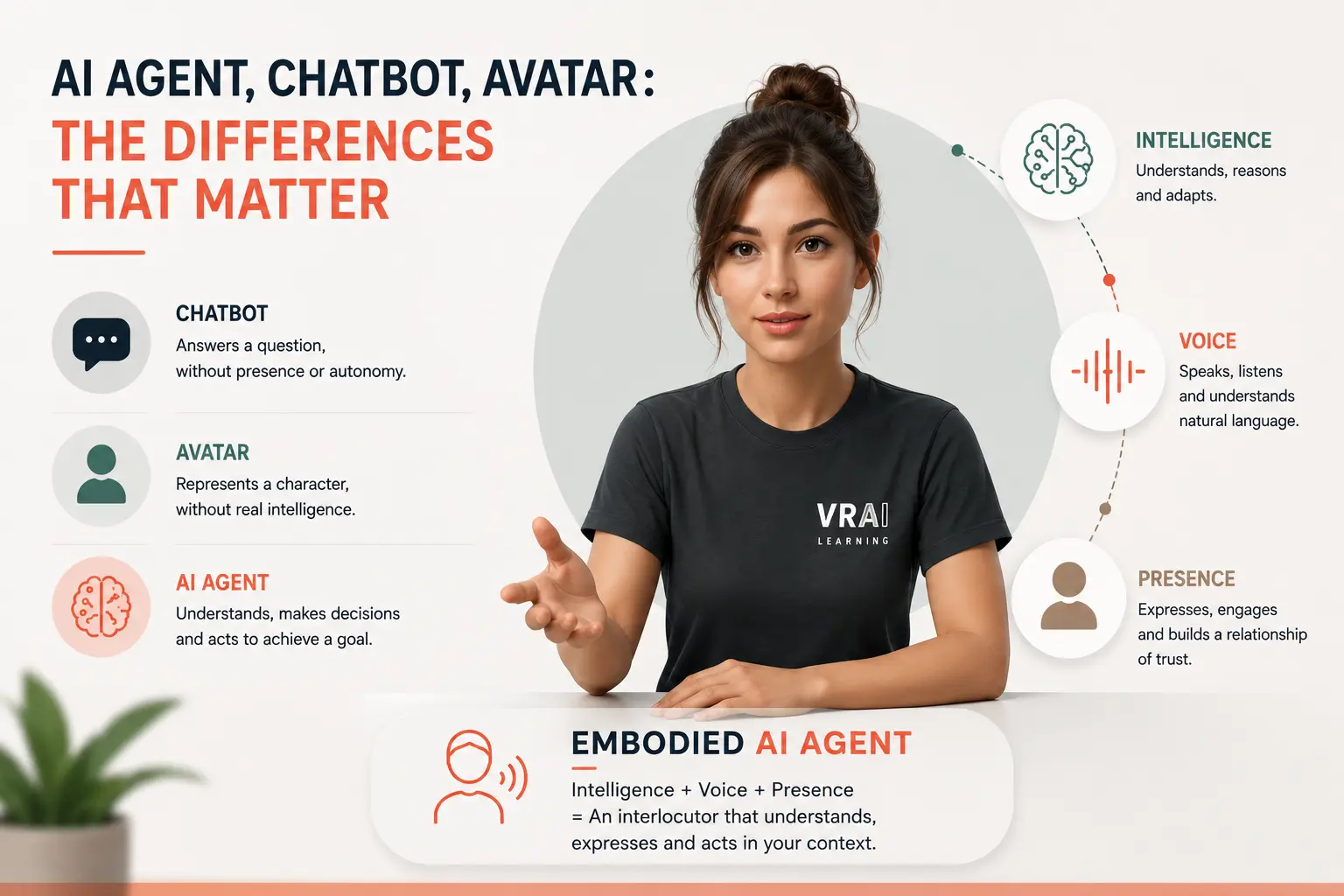
On one side, avatars designed to inform; on the other, avatars designed to "help people learn".
But behind the term "AI avatar", confusion persists — and mixing them up means missing the point, and potentially investing in the wrong tool for the wrong use case.
Understanding this distinction has become essential for training, innovation and HR decision-makers.
Not all avatars serve the same function, they don't produce the same level of impact, and they don't all address the same strategic challenges!
Two distinct logics, one technology — let's break it down:
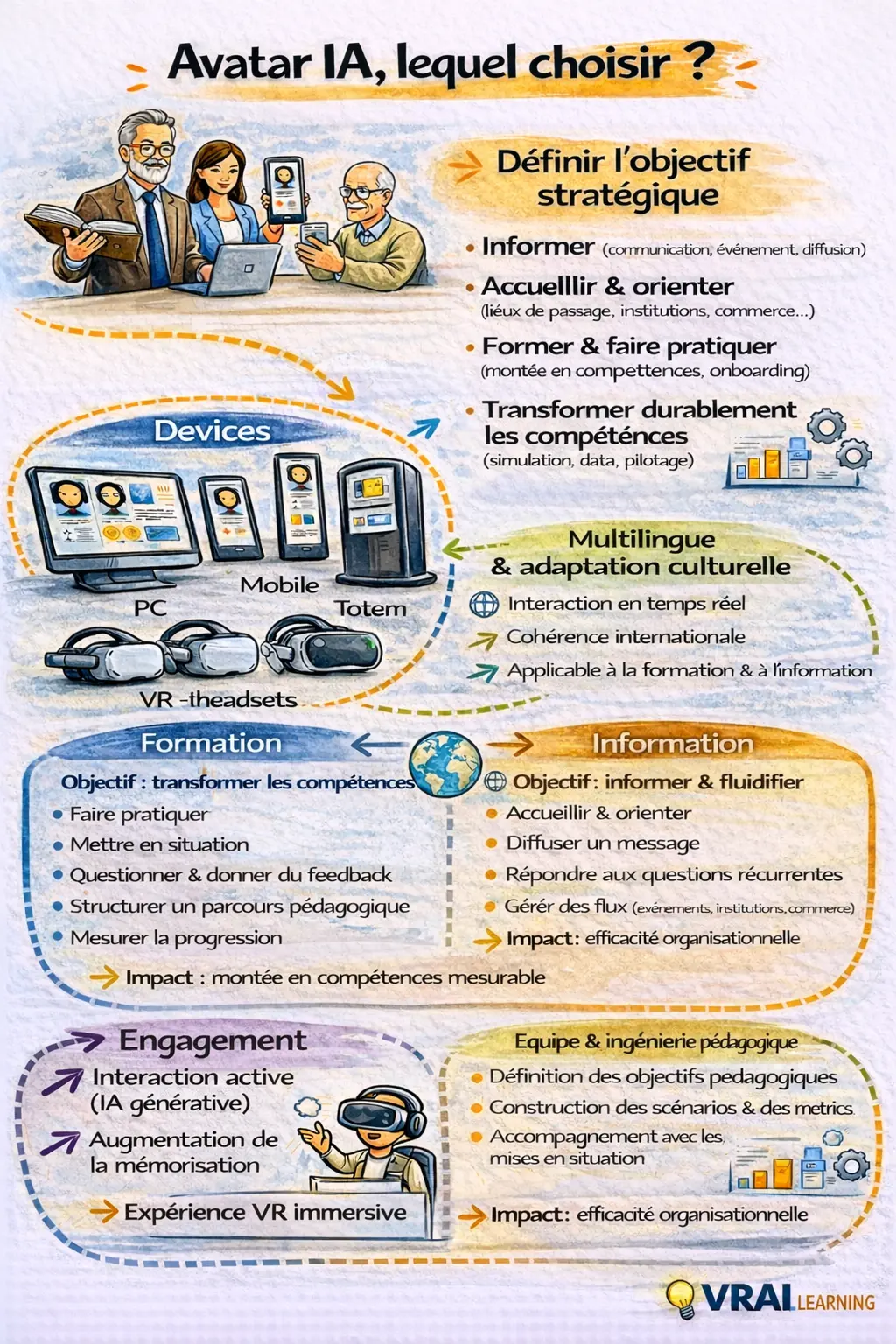
The training avatar: the augmented trainer!
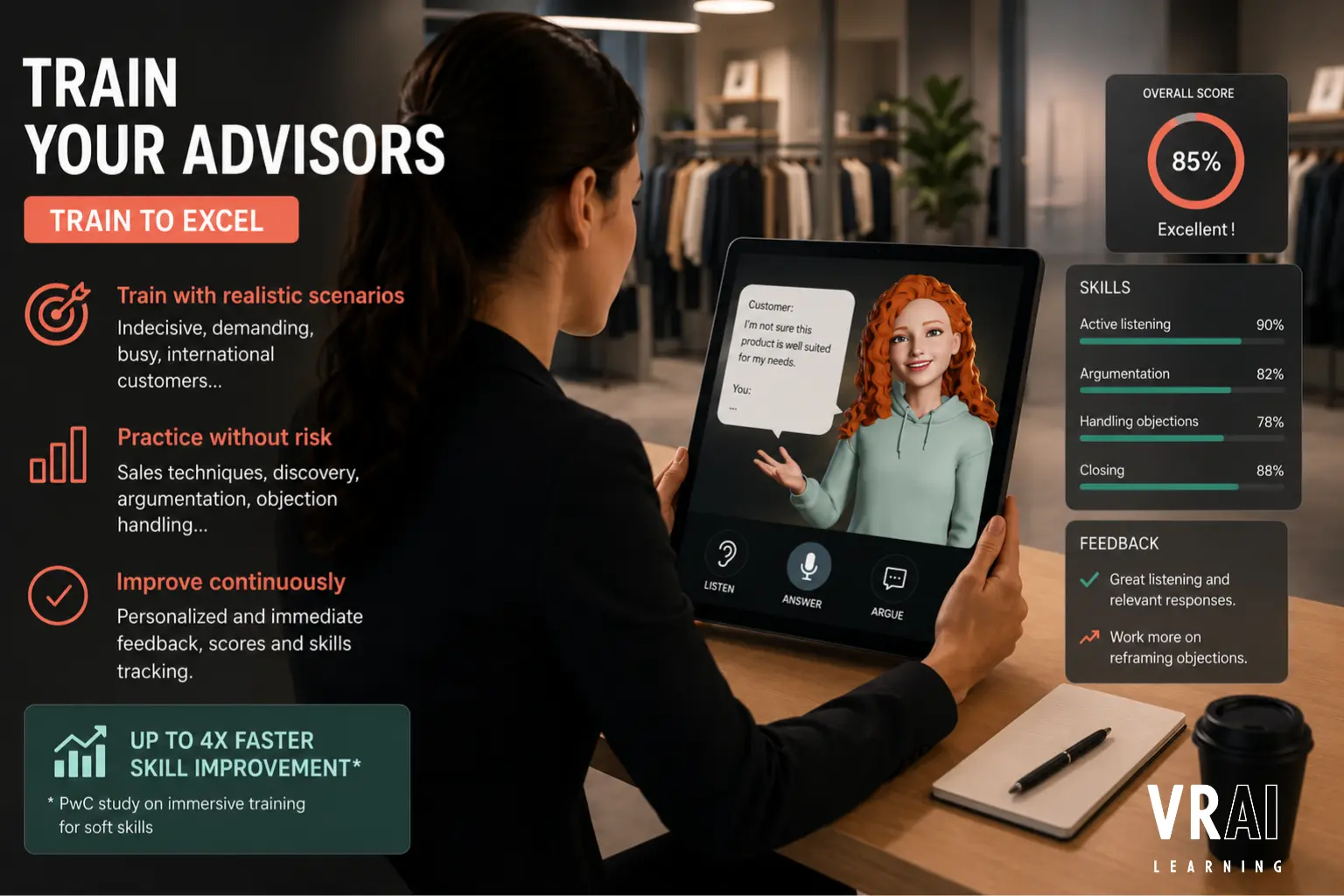
At VRAI Learning, training has been our core business for 20 years — our generative AI conversational avatars don't just inform, they teach, challenge, correct, adapt, and measure progress.
A few use cases:
- Soft skills: difficult customer management, management, delicate feedback
- Immersive onboarding: complex procedures, company culture
- Safety/job gestures: critical protocols, maintenance
- Role-play scenarios: high-risk or high-cost situations
A concrete example: a banking network trained 420 advisors on managing demanding customers. The avatar "Sophie" embodies a range of profiles (an unhappy customer, a hesitant prospect).
Result: +275% real-world confidence (PwC) and 76% preference for the avatar over a human trainer.
Its unique strength? Real-time instructional intelligence:
- Analyses the learner's level and adapts the difficulty
- Asks constructive trick questions
- Gives immediate, personalised feedback
- Adjusts the learning path based on answers
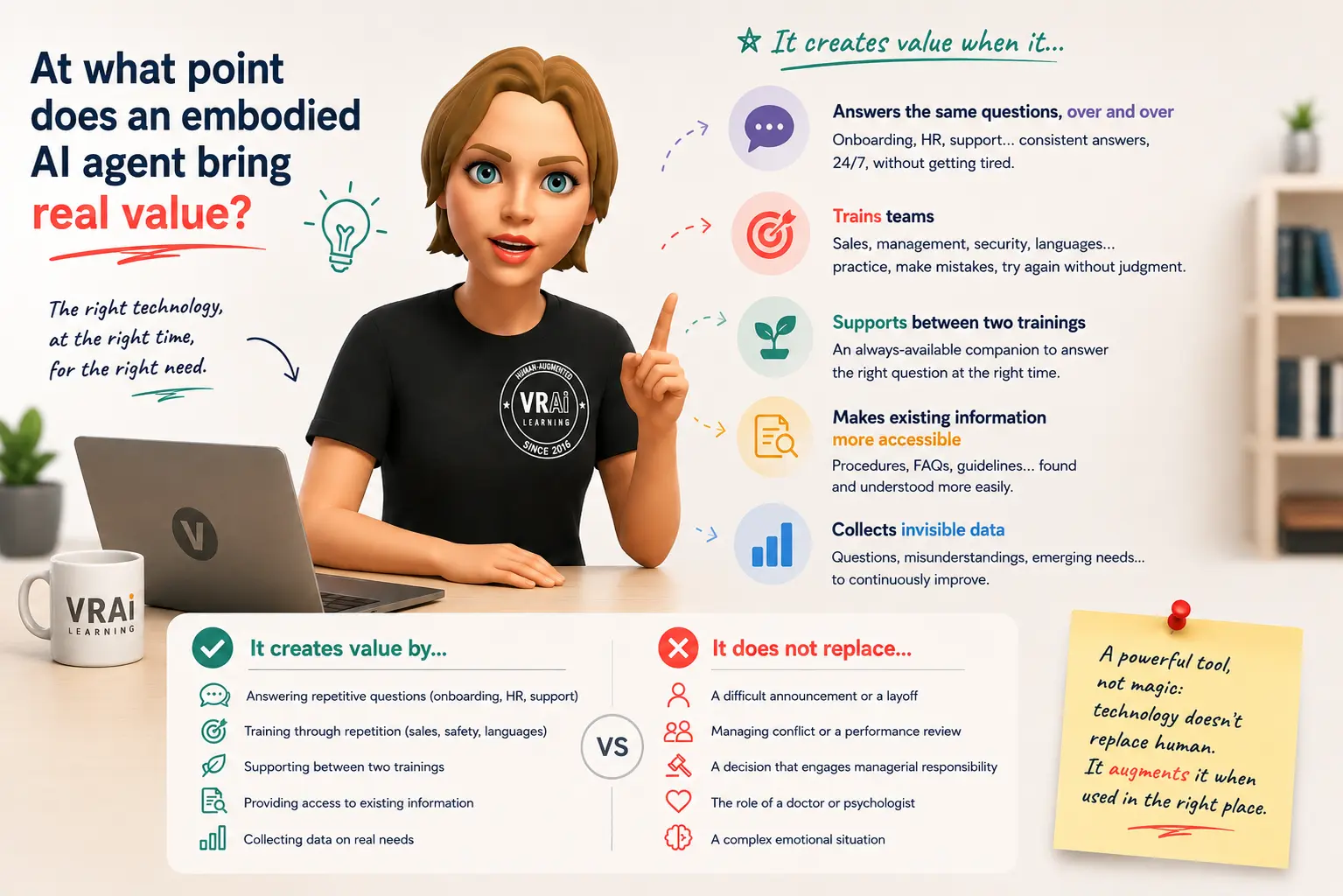
The information avatar: an intelligent receptionist (who's never tired...)
Where training transforms skills, information guides and reassures. Our avatars also shine in these high-footfall contexts.
Concrete use cases:
- Institutional reception: government offices, universities, train stations
- Retail/services: customer guidance, dynamic FAQs
- Events: trade shows, open days, webinars
Government office example: welcoming international students for visa procedures. The avatar "Lila" answers 15 languages' worth of recurring questions (timelines, required documents, procedures). Measured results:
- -52% questions to staff
- +41% user satisfaction
- ROI within 3 months
Avatar Academy: the platform that makes the difference
Not just a simple avatar generator — it's really a complete instructional cockpit!
Advanced customisation
• Appearance, voice, personality, role (manager, customer, expert) • Internal content injected (procedures, business objectives) • Multi-device: VR, kiosk, mobile, desktop, tablet
Real-time steering
• Live conversation tracking by trainers • Human intervention when needed • On-the-fly scenario adjustments • Smooth handoff to a human
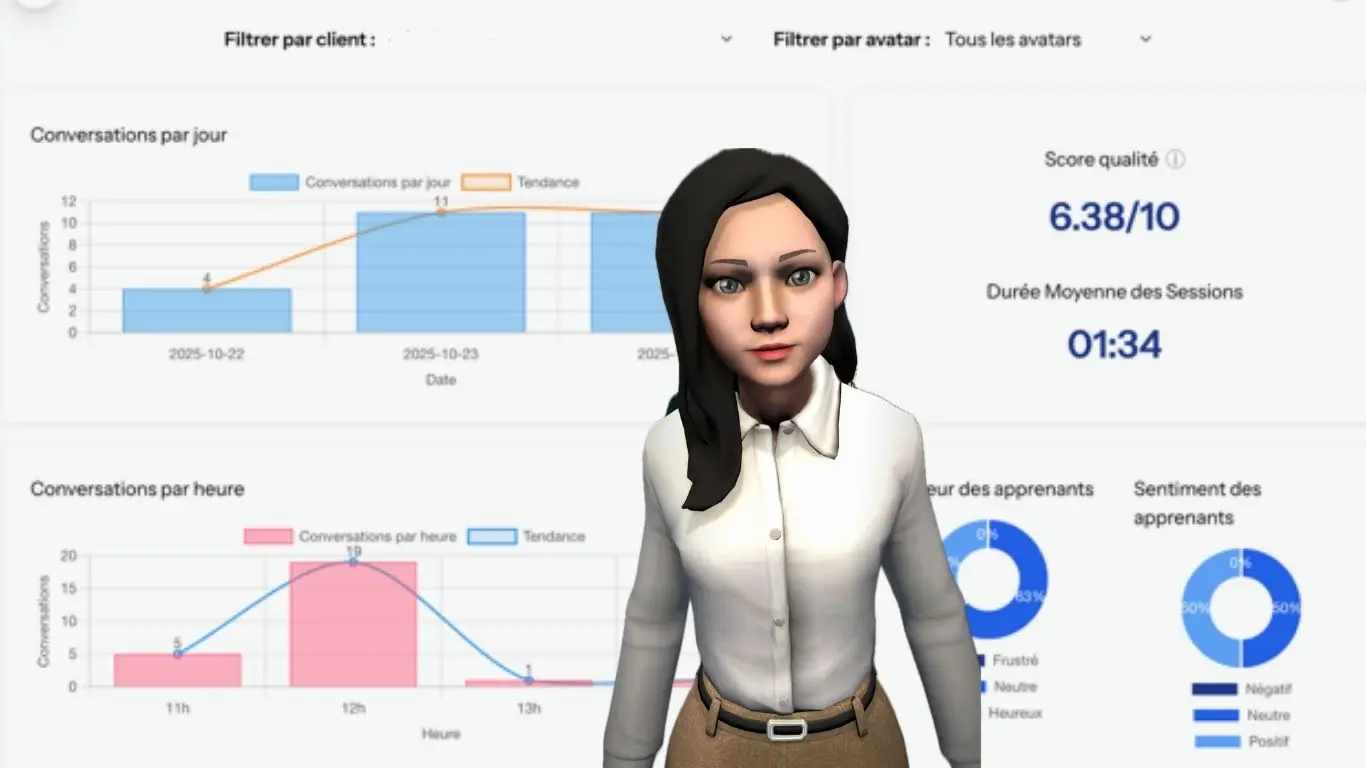
Data & KPIs: classic + emotional
✅ Classic: completion, scores, time spent, success rate Emotional (our expertise): - Stress/anxiety detected from speech and gestures - Semantic analysis (confidence vs. doubt) - Emotional vocabulary - Confidence progression via patterns
A few concrete use cases
Sector
Avatar
Mission
Results
Industry
Serge, team leader
Safety and maintenance
95% retention vs 62% for e-learning
-73% training time
Banking
Sophie, demanding customer
Customer relations soft skills
+275% real-world confidence
Government office
Lila, multilingual host
International student visas
-52% questions to staff
Telecom operator
Alex, phone agent
Subscription sales
3M users/year
Retail
Emma, manager
Onboarding
-42% procedural stress
and you can imagine plenty of other scenarios...
Multi-device: accessibility + full immersion
Our avatars adapt to every device for maximum accessibility: tablet, PC, smartphone, digital kiosk.
But the real strength? Optional integration into VR/XR experiences for full immersion.
For example, an operator can start their onboarding on a kiosk (procedure information), move into VR (job-gesture simulation), then come back to mobile for revision.
Perfect for frontline training: a technician repairs a machine in mixed reality (AR + an avatar guiding them in real time), without ever leaving their workstation.
This guarantees everyday accessibility plus immersive power whenever it's needed!
Stats
3x engagement with an embodied avatar +40% progression through personalisation 2x real-time retention 85% preference over a chatbot 4x real-world confidence application (PwC)
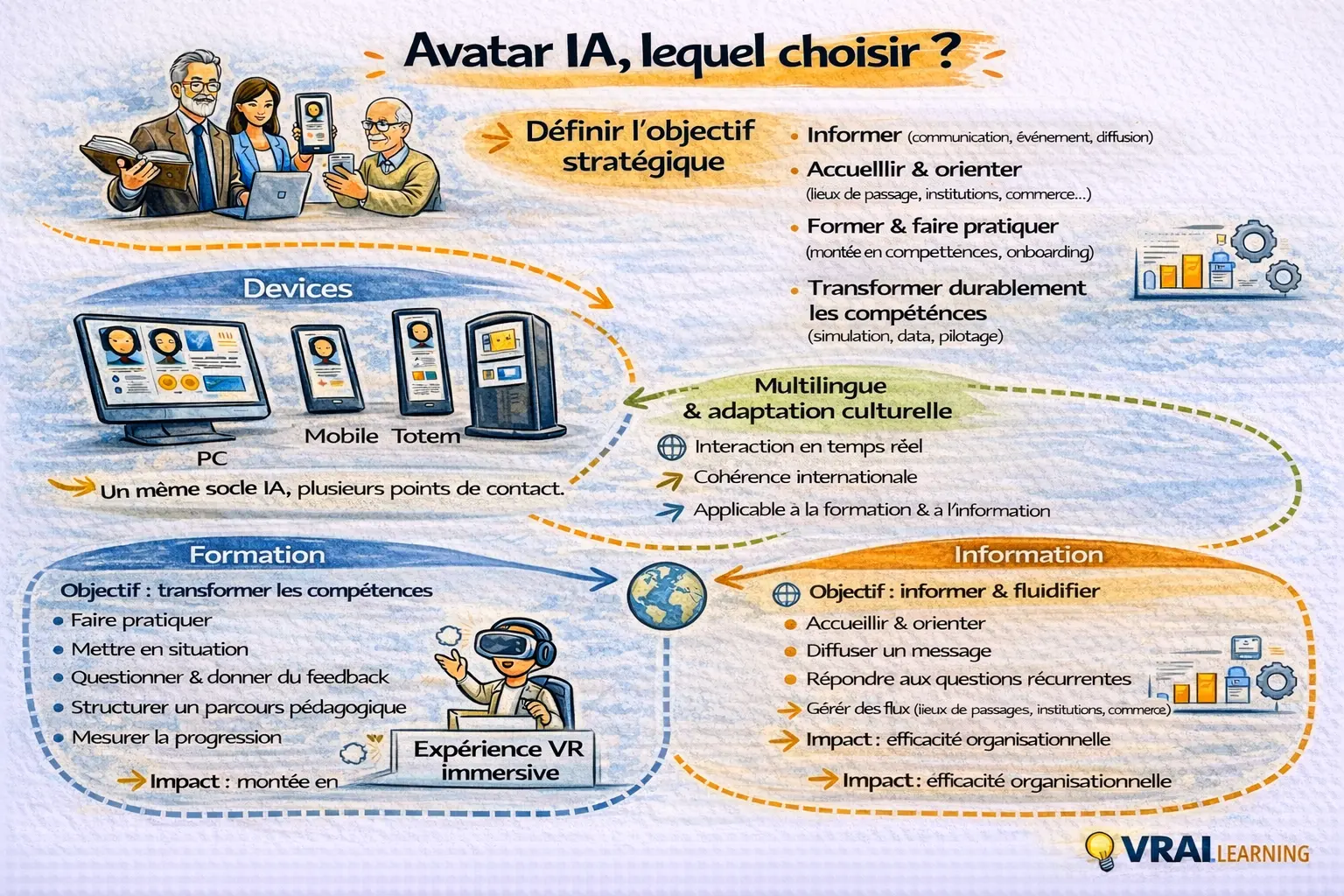
So which strategy should you adopt?
Dynamic information → Real-time conversational avatar
Training/learning → Conversational avatar + instructional data
The classic mistake: "Let's get an avatar because it's trendy".
The wrong solution means disappointing ROI.
Companies need to distinguish between:
- A message to broadcast → Video or simple avatar
- Reception/guidance → Conversational avatar
- Structured training → Avatar + data platform
So, concretely, where do you start?
- What are your priority first use cases?
- Are you measuring the emotional impact of your current tools?
- Do your trainers have full real-time control over their performance?
One more thing: VRAI Learning supports you to:
- Define the right avatar and its objectives
- Configure and customise it via Avatar Academy
- Deploy it across your platforms
- Measure the impact (classic + emotional)
- Scale it up!
Ready to try an avatar that actually makes a difference?
*Sources: PwC VR Study, VRAI Learning client feedback, Avatar Academy data, Learning Technologies 2026
FAQ — AI avatar for business: training, onboarding or information?
What is a conversational AI avatar for business? A conversational AI avatar is a virtual character animated in real time by generative artificial intelligence. Unlike a pre-recorded video avatar, it adapts to the user's answers, asks questions, gives feedback, and steers a journey — instructional or reception-focused — in a personalised way.
What's the difference between a training AI avatar and an information AI avatar? An information avatar broadcasts a standardised message: it's smooth and scalable, but doesn't adapt to the person it's talking to. A training avatar is conversational: it interacts, corrects, adjusts to the learner's level and measures their progress. One communicates, the other teaches.
Can an AI avatar replace a human trainer?
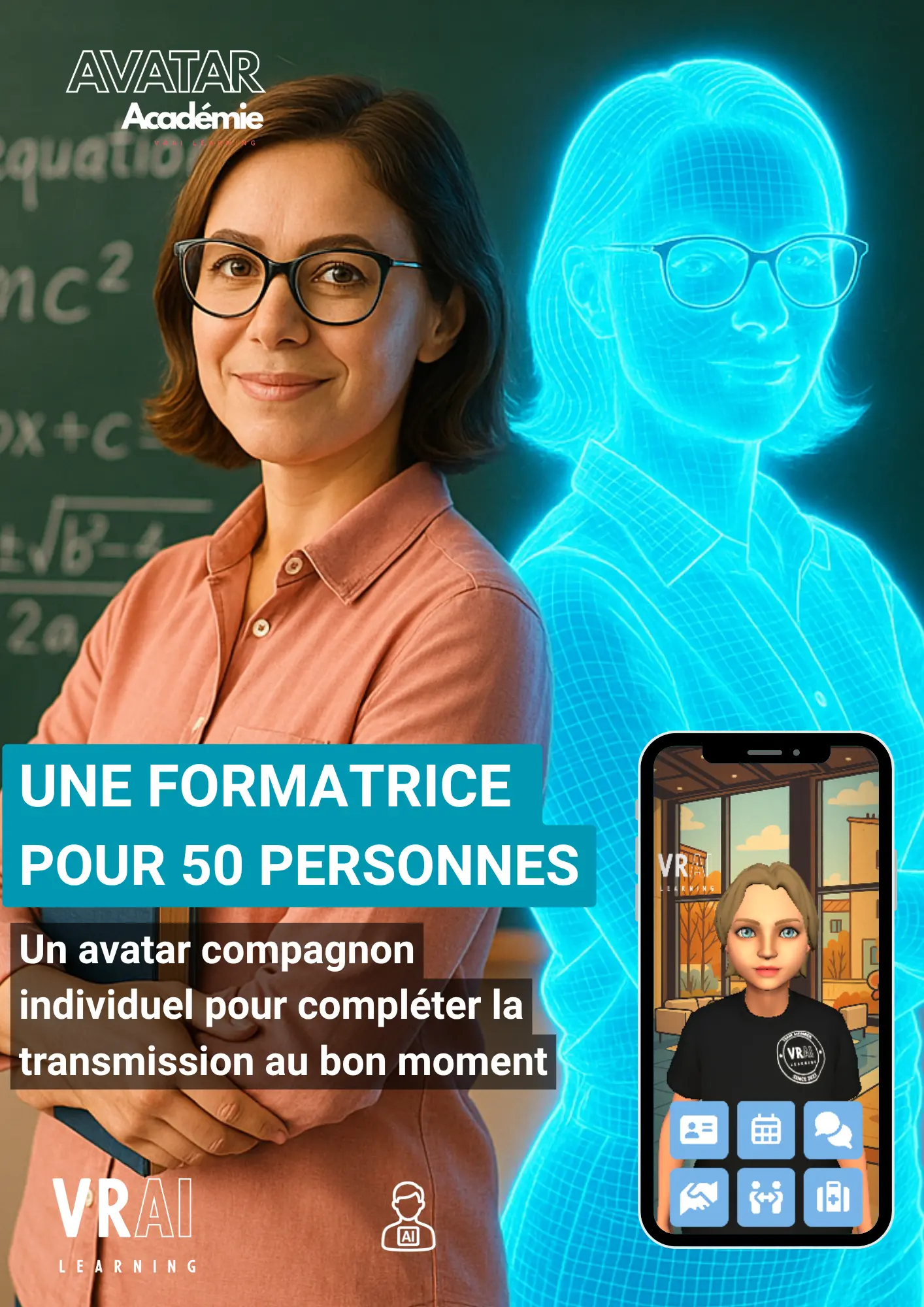
No, and that isn't the goal. The conversational AI avatar complements the human trainer: it standardises content, allows unlimited practice without tying up an expert's time, and frees the trainer up for high-value interactions. It's particularly effective for repetition, role-play and procedural drilling.
What are the most effective use cases for a business AI avatar?
The best-documented use cases are training on technical gestures and safety procedures, onboarding new employees, simulating complex interpersonal situations (conflict management, interviews, customer relations), and interactive reception in high-footfall locations. In every one of these cases, the avatar delivers repeatability, standardisation and measurable impact.
How do you measure the effectiveness of an AI avatar in training?
Key indicators include the completion rate of the learning path, the average assessment score, time spent per module, and the rate of recurring errors. Platforms like VRAI Learning's Avatar Academy go further, incorporating semantic and linguistic analysis of exchanges, which surfaces areas of misunderstanding or resistance that numbers alone can't reveal.
What is Avatar Academy?
Avatar Academy is VRAI Learning's proprietary platform dedicated to designing, deploying and managing conversational AI avatars. It lets you build instructional or reception scenarios, track learning paths in real time, and analyse performance through both classic and emotional KPIs. It's designed to be usable without advanced technical skills.
Why choose VRAI Learning to develop an AI avatar?
VRAI Learning was founded by instructional design experts with over 20 years of experience in corporate training. This combination of pedagogy and technology guarantees avatars designed first for learning effectiveness, not just visual appeal. Every project starts from a clear instructional objective and comes with structured impact measurement.
How much does an AI avatar for corporate training cost?
The cost varies depending on the level of customisation, the number of scenarios, learner volumes, and the steering features required. Contrary to popular belief, ROI is measured quickly: reduced training logistics costs, standardisation across multiple sites, and faster time-to-competency. VRAI Learning offers a tailored approach based on your objectives.

Christèle Simeoni
Co-founder VRAI Learning (2023) · CMO
Co-founder of VRAI Learning, specialist in immersive VR training and conversational AI avatars.
See immersive training in action
Personalised demo, no commitment. We show you what it looks like for your context.
Book a demoExplore our solutions