Christèle Simeoni
10 min min read
Virtual Training at the Service of Construction Workers: Experience, Learning and Safety
CS
Christèle Simeoni
Co-founder & CMO, VRAI Learning
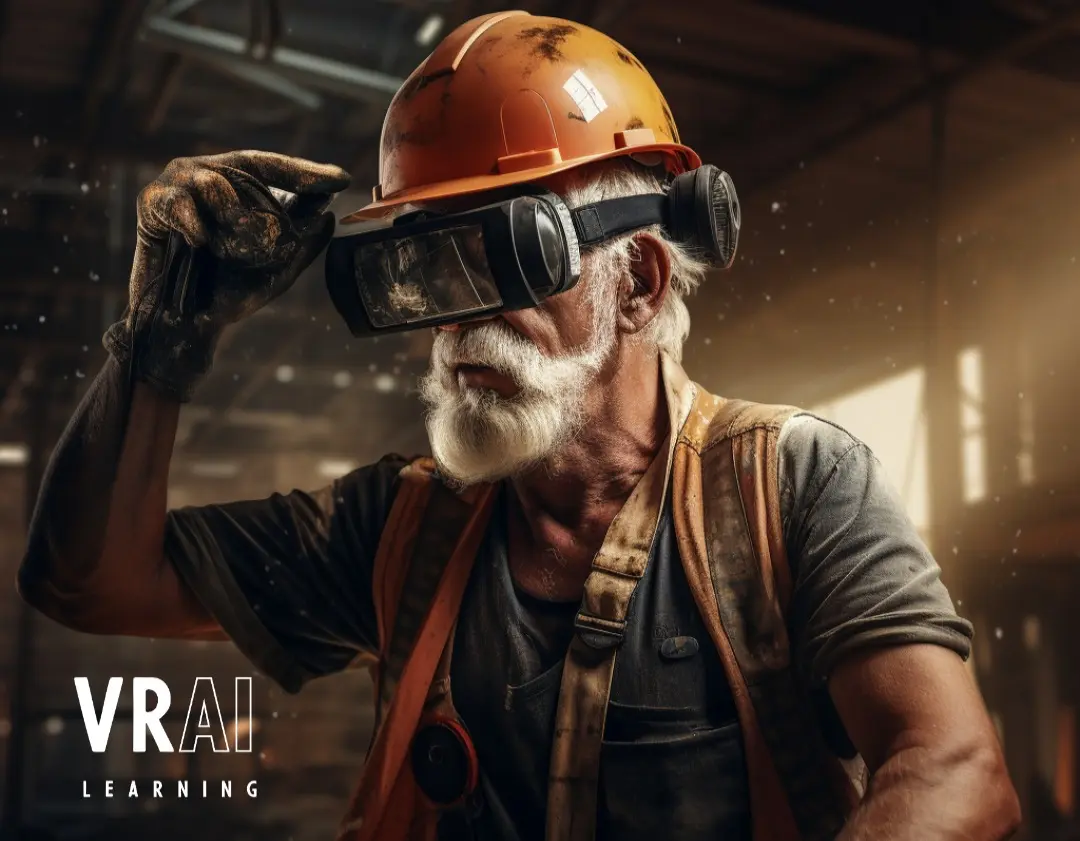
Virtual reality (VR) training is revolutionising the pedagogical approach in construction sector trades. Long confronted with recruitment challenges and the transmission of on-site expertise, the construction industry is finding in VR a practical, safe, and economically relevant tool.
But what are the concrete advantages of VR training for construction workers and technicians?
Why do construction trades have such specific training needs?
Construction trades demand rigorous training because on-site errors can put workers' safety at risk and expose companies to liability. The sector faces a dual constraint: recruiting enough qualified profiles while training workers in precise technical gestures, in potentially hazardous environments. Traditional methods — on-site training, apprenticeship-based learning — involve accident risks, costly equipment downtime, and the impossibility of reproducing critical situations such as a fire or a fall from height. VR training directly addresses these constraints by recreating ultra-realistic construction site environments, accessible without any physical risk, infinitely reproducible, and deployable anywhere in the country.
Traditional on-site training has real limitations:
- Risks associated with the presence of inexperienced trainees on site
- Equipment and team downtime during sessions
- Impossibility of reproducing certain critical situations (fire, falls from height, partial collapse)
- High logistical costs for multi-site organisations
Practical, realistic learning
VR training allows construction professionals to practise in high-fidelity virtual environments that faithfully replicate real-world conditions. Through interactive simulations, they practise:
- Handling tools and equipment specific to construction sites
- Installing materials (insulation, waterproofing, formwork, cladding…)
- Site management and team coordination
- Using BIM software for project visualisation and planning
- Drone inspection techniques and digital surveying
The learner acquires practical skills before working in the field, which reduces errors and associated risks. According to a PwC study (2020), learners trained in VR are 4× more confident in their abilities than those trained in a classroom setting.
How does virtual reality improve safety and risk prevention in the construction industry?
Virtual reality improves safety in the construction industry by allowing workers to experience dangerous situations — falls from height, fires, partial collapses — in a completely safe environment, with no physical risk whatsoever. The construction sector has one of the highest rates of workplace accidents, making prevention an absolute priority. With VR, learners can repeat the correct gestures as many times as necessary, experience the consequences of a bad decision in an immersive way, and internalise safety procedures under simulated stressful conditions. This controlled right to fail is one of the most valuable assets of immersive training: it embeds safety reflexes far more effectively than a theoretical lesson or an on-site demonstration.
The learner can:
- Repeat the correct gestures with no physical risk
- Experience the consequences of a poor decision in an immersive setting, without real danger
- Internalise safety procedures in simulated stressful situations
- Prepare for emergency situations (evacuation, first aid on site)
Does immersive training really boost skills and productivity?
Yes, immersive VR training significantly accelerates skills development and improves productivity in the construction industry. Repeating gestures in a virtual environment creates automatisms that transfer directly to the field from the very first weeks on the job. Unlike theoretical training, VR engages the body and the senses, which promotes deeper memorisation and smoother task execution. Multiplayer simulations also make it possible to work on team coordination remotely, without requiring all participants to be physically present on the same site. For multi-site construction groups, this is a powerful lever for standardising skill levels across all sites, regardless of geographical location.
Immersive training goes beyond safety alone. It accelerates the development of both technical and cross-functional skills:
- Adapting to new tools and equipment (exoskeletons, BIM technologies, inspection drones)
- Building collaborative working skills through multiplayer simulations, enabling remote team training
- Certification milestone validation, reinforcing motivation and the perceived value of training
- Reducing the onboarding time for new arrivals on a construction site
Reducing training costs
While the initial cost of developing a VR module may seem high, the return on investment is real once the learner volume justifies it. Savings are made on:
- Elimination or reduction of travel and accommodation expenses
- Unlimited reuse of the module with no marginal cost per additional learner
- Reduced downtime for real equipment during sessions
- Fewer training accidents and associated costs (sick leave, liability)
For multi-site construction groups, VR training makes it possible to standardise skill levels across all sites, regardless of geographical location.
The most common VR use cases in the construction industry
Among the most widely deployed uses of virtual reality in the construction sector:
- Risk prevention: evacuation procedures, emergency management, PPE (Personal Protective Equipment) fitting and inspection
- Technical gesture training: working at height, handling heavy materials, installing complex systems
- Site onboarding: discovering a new site or a new organisation before physically arriving
- Maintenance and inspection: procedures on sensitive equipment, reading 3D plans
- Site management: priority management, team coordination, communication in crisis situations
VRAI Learning supports construction companies
At VRAI Learning, we develop bespoke virtual reality training modules for construction companies. Every project begins with an in-depth analysis of your pedagogical objectives, your on-site constraints, and your industry environment.
We combine immersive 3D environments, conversational AI avatars, and the Avatar Academy tracking platform to create comprehensive, measurable training experiences that can be deployed at scale.
Would you like to assess the relevance of a VR project for your construction company? Contact us for an initial discussion.
Frequently asked questions
Is virtual reality training suitable for all construction trades?
Virtual reality training is suitable for a very wide range of construction trades, from site workers to project managers, maintenance technicians, and HSE managers. It is particularly effective for trades involving repetitive technical gestures, high physical risks, or emergency situations that are difficult to reproduce in real conditions. Modules can be fully customised for the targeted role: formwork carpenter, electrician, welder, plant operator, and more. The flexibility of VR allows content to be adapted to the specific characteristics of each company, its actual equipment, and its internal procedures, guaranteeing training that is directly transferable to the field.
How long does it take to develop a VR training module for the construction industry?
The development time for a VR training module for the construction industry typically ranges from 8 to 20 weeks, depending on the complexity of the scenarios, the expected level of realism, and the number of situations to be modelled. A fall-risk awareness module, for example, can be developed more quickly than a full multiplayer site management simulation. At VRAI Learning, the process begins with a pedagogical scoping session with your teams, followed by 3D environment modelling, interaction integration, and user testing. Modules are then deployable via our Avatar Academy platform, accessible on standalone VR headsets without complex IT infrastructure.
What measurable results does VR training deliver in the construction sector?
The measurable results of VR training in the construction industry include a significant reduction in workplace accidents, a decrease in onboarding time for new employees, and improved scores in skills assessments. According to a PwC study (2020), learners trained in VR are 4 times more confident in their abilities than those from traditional classroom training. On an operational level, companies report fewer errors during the first weeks on site, better application of safety procedures, and a more consistent skill level across different sites. These results are tracked and documented via the dashboards of the learning management platform.
How can a construction company finance a VR training project?
Several schemes are available to finance a VR training project in the construction sector in France. OPCOs (Opérateurs de Compétences — Skills Development Operators) such as Constructys, the OPCO dedicated to the construction industry, can cover all or part of the development and deployment costs. Companies can also draw on their skills development plan, the CPF (Compte Personnel de Formation — Personal Training Account) for certified training programmes, or France Travail (the national employment agency) funding for jobseekers. Some projects may benefit from regional innovation grants or European funding. VRAI Learning supports its clients in identifying available funding and preparing the relevant applications.
Read also
Virtual reality training in the workplace: the complete guide →Methods, costs, use cases and results for deploying VR in your organisation.

Christèle Simeoni
Co-founder VRAI Learning (2023) · CMO
Co-fondatrice de VRAI Learning, spécialiste de la formation immersive VR et des avatars IA conversationnels.
See immersive training in action
Personalised demo, no commitment. We show you what it looks like for your context.
Book a demoExplore our solutions