Christèle Simeoni
5 min min read
Inclusive Training: How VR and AI Avatars Adapt to Employee Neurodiversity
CS
Christèle Simeoni
Co-founder & CMO, VRAI Learning
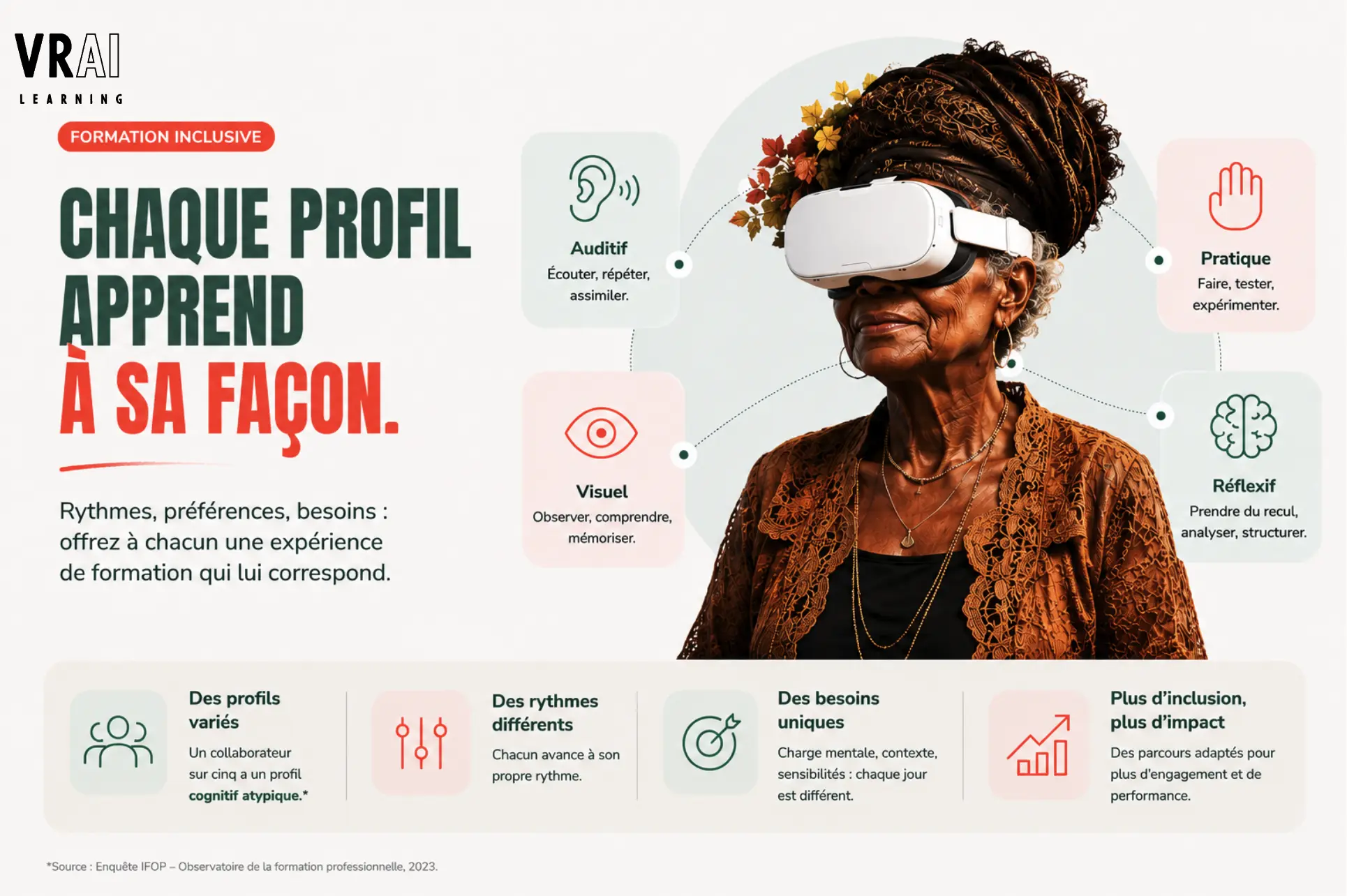
Corporate training can no longer be designed for a single "average" learner. In France, nearly one in five employees has an atypical cognitive profile — dyslexia, ADHD, sensory hypersensitivity, or learning differences — without this necessarily being declared or taken into account in training programs. And beyond these identified profiles, every employee has their own pace, preferred learning styles, and current mental load.
This is precisely where the combination of virtual reality and the conversational AI avatar changes the game: it makes it possible to offer learning experiences that are more flexible, more engaging, and accessible to all profiles — without multiplying pathways or increasing the burden on Training teams.
Why does traditional training reach its limits for neurodiverse learners?
Many programs still rely on top-down, uniform formats: PowerPoint slides, dense reading, abstract theory, and group sessions at an imposed pace. While this approach suits some profiles, for others it rapidly generates:
- Cognitive overload and visual fatigue that block memorization
- A sense of social pressure in front of the rest of the group, particularly penalizing for hypersensitive or introverted profiles
- Progressive pedagogical dropout: the employee follows along without truly retaining anything
The problem is not the employee's motivation — it is the rigidity of the format. Some retain better by listening, others by doing (kinaesthetic memory), others still by repeating in a safe, judgment-free environment. Truly inclusive training must offer multiple entry points for the same content.
What does the conversational AI avatar change for inclusive learning?
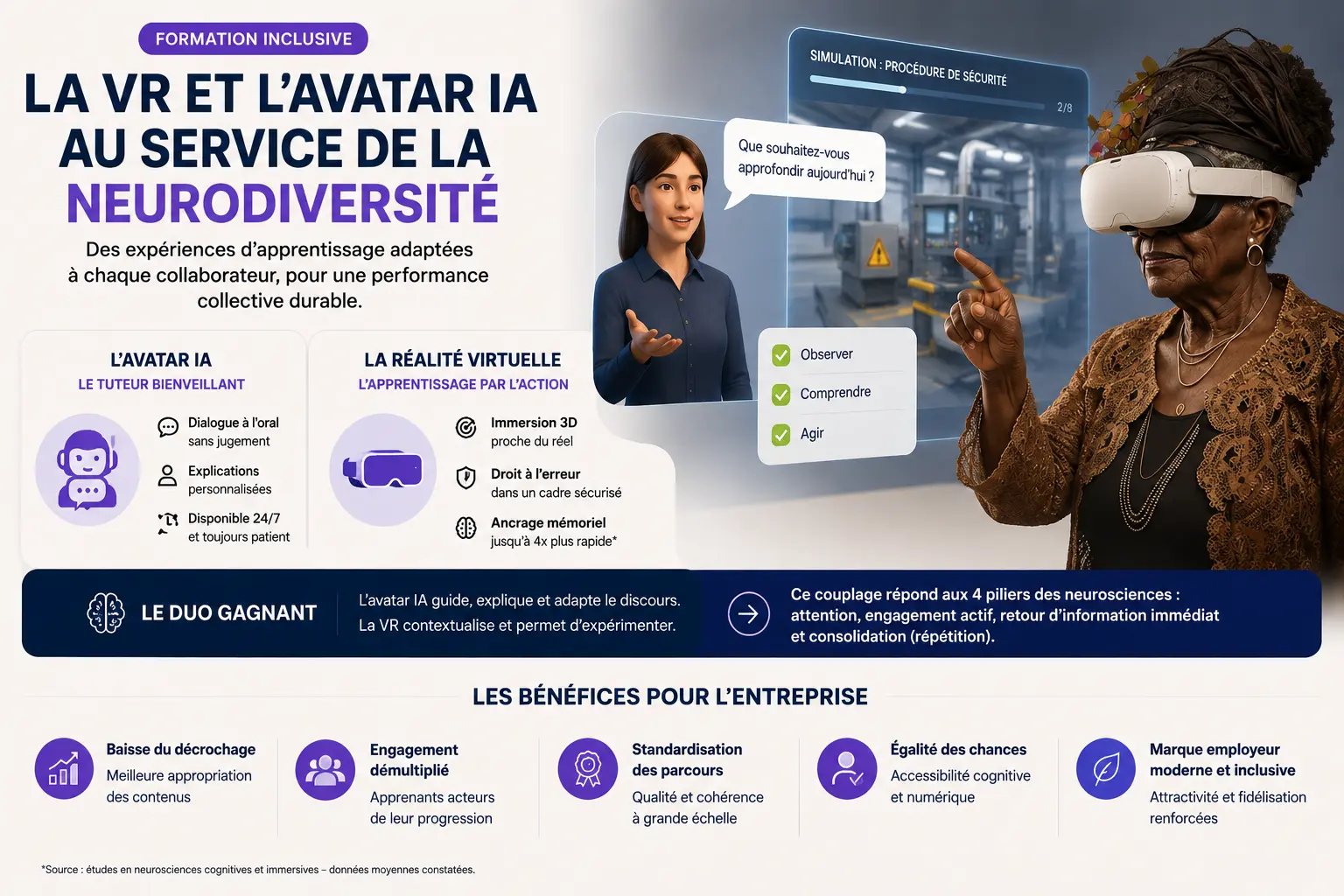
The conversational AI avatar brings an interactive dimension that makes training both human and pressure-free. The learner can ask a question aloud, hear a personalized response, reformulate, start over, as many times as needed — without ever feeling the group's gaze or the frustration of a hurried trainer.
Comparing the two approaches:
- Traditional program: pace imposed on the group → atypical profiles disengage or compensate with extra effort → increased fatigue, degraded memorization
- Program with AI avatar: individualized pace → benevolent repetition without judgment → progressive memory anchoring → restored confidence
This virtual tutor proves particularly valuable in three contexts:
- Onboarding and professional procedures: assimilating guidelines at one's own pace, returning to a point without embarrassment
- Soft skills and customer relations: practicing sensitive situations or managerial interviews in a safe space
- Reducing learning stress: a tutor available 24/7, in 62 languages, with absolute patience and consistency over time
What does virtual reality change for neurodiverse employees?
Virtual reality adds learning through action — the famous learning by doing. Instead of reading instructions or watching a static video, the learner is immersed in a 3D simulation close to reality. They observe, manipulate, make mistakes, and start over — without real consequences, without judgment.
The contribution of VR is concretely measurable across three axes:
- Memory anchoring: according to the PwC study conducted with 10,000 employees (2020), learners trained in VR master skills 4 times faster than in traditional classroom training, with a retention rate of 75% at one year versus 10% in a lecture-based format
- Safe right to make mistakes: ideal for technical gestures, workplace safety (HSE/EHS), or complex scenarios where real-world errors would be costly or dangerous
- Cognitive accessibility: VR transforms theoretical concepts into concrete actions — which greatly helps pragmatic profiles, dyslexic learners, or those with high reading load
The VR and AI avatar synergy: four learning pillars activated simultaneously
The strength of this combination lies in its complementarity: the AI avatar guides, explains, and adapts its discourse in real time, while VR contextualizes and enables experimentation. Together, they simultaneously activate the four conditions that neuroscience identifies as fundamental for lasting learning:
- Attention: VR immersion captures and sustains concentration well beyond a conventional presentation
- Active engagement: the learner acts, decides, makes mistakes — they are not a spectator
- Immediate feedback: the AI avatar signals errors and explains in real time, without waiting for the end of the session
- Consolidation: repetition of scenarios, at one's own pace and without pressure, anchors reflexes durably
For Training teams, this is a paradigm shift: the goal is no longer to adapt the employee to the format, but the format to the employee.
CSR and HR impact: inclusion and performance are not opposites
Making training inclusive is not only an accessibility or compliance initiative — it is a measurable operational efficiency lever.
| Operational benefit | HR and pedagogical impact | CSR signal |
|---|---|---|
| Reduced dropout rate | Better content appropriation | Valuing team diversity |
| Multiplied engagement | Learners as agents of their own progress | Digital and cognitive accessibility |
| Standardized pathways | Equal opportunity for skill development | Modern and inclusive employer brand |
For HR, Training, and CSR teams, designing more flexible programs concretely demonstrates that the company takes into account the real diversity of its workforce. Training thus becomes a performance tool as much as an inclusion lever — two objectives that reinforce each other.
How do you design truly inclusive training?
Inclusive training is not simply adding a technology layer onto existing content. It must be designed from the outset with an adaptive learning philosophy:
- Diversify modalities: allow the choice between oral, action, immersion, demonstration, or review depending on the profile and the moment
- Enable modularity: offer multi-device support (PC, tablet, VR headset) to adapt to time, attention, and equipment constraints
- Simplify access to repetition: the more a system allows easy return to unmastered concepts, the more naturally it includes all profiles — without overloading Training teams
This philosophy guides the design of VRAI Learning modules: each scenario is designed to be replayed, adapted, and enriched without requiring a complete overhaul.
In summary
The true value of VR and AI avatars lies in their capacity to make training more human, more accessible, and aligned with the real diversity of learners. By combining immersion, interaction, and personalization, companies can design inclusive programs without ever sacrificing operational effectiveness — and without multiplying versions or costs.
Want to evaluate whether this approach fits your use cases? Discover our immersive training solutions, the measurable benefits of VR in the enterprise, or contact us to build your first inclusive scenario.
Read also
Virtual reality training in the company: the complete guide →Methods, costs, use cases and results for deploying VR in your organization.

Christèle Simeoni
Co-founder VRAI Learning (2023) · CMO
Co-fondatrice de VRAI Learning, spécialiste de la formation immersive VR et des avatars IA conversationnels.
See immersive training in action
Personalised demo, no commitment. We show you what it looks like for your context.
Book a demoExplore our solutions