Christèle Simeoni
10 min min read
Training people with disabilities: Immersive learning for inclusion
CS
Christèle Simeoni
Co-founder & CMO, VRAI Learning
In France, over 12 million people live with a recognized disability. Of these, only 36% are in employment — a gap with the rest of the working population that is partly explained by barriers to professional training. Access to knowledge and skills remains conditional, for many people with disabilities, on physical, sensory, or cognitive constraints that traditional training programmes do not always know how to overcome.
Immersive learning — and virtual reality in particular — provides a structural response to these barriers. By creating fully adaptable learning environments, it opens professional training to everyone, regardless of the learner's profile.
What are the main barriers to training for people with disabilities?
People with disabilities face multiple cumulative barriers that severely limit their access to professional training. These obstacles first affect the physical accessibility of training venues, which are often non-compliant with reduced mobility requirements. They also concern the inadequacy of educational content: materials inaccessible to visually or hearing-impaired individuals, and uniform training paces that take no account of cognitive differences. Sensory barriers — the absence of subtitling, a lack of visual or auditory alternatives — silently exclude a proportion of learners. Cognitive challenges, such as information overload or an increased need for repetition, are not addressed by conventional formats. Finally, psychological barriers — fear of others' judgement, apprehension about failing in a group — represent a major and often underestimated obstacle. It is the cumulative effect of all these barriers that keeps the employment rate for people with disabilities at just 36% in France.
- Physical barriers: inaccessible premises, reduced mobility, inability to travel to a training or internship venue.
- Content adaptation: materials inaccessible to visually or hearing-impaired learners, unsuitable training pace.
- Sensory limitations: absence of subtitling, lack of visual or auditory alternatives.
- Cognitive challenges: information overload, difficulty maintaining attention over long periods, need for more frequent repetition.
- Psychological barriers: fear of others' judgement, lack of self-confidence, apprehension about failing in a group setting.
These obstacles accumulate to form a genuine wall between people with disabilities and professional training. Employers, subject to the obligation to employ 6% of workers with disabilities (French law of 10 July 1987), are actively seeking concrete solutions to integrate and develop these employees.
How does immersive learning revolutionise inclusive training?
Immersive learning fundamentally transforms access to training for people with disabilities by offering fully configurable virtual environments, with no additional cost or constraining physical adaptations. Unlike traditional training rooms, virtual reality adapts to each learner's profile: a person with reduced mobility can simulate professional tasks from home, a hearing-impaired person benefits from real-time integrated subtitles and haptic feedback, and a visually impaired person navigates through audio descriptions and high visual contrasts. This personalisation is automatic, scalable, and consistent — whereas a traditional classroom would require a dedicated facilitator for each learner. According to PwC (2020), learners trained in virtual reality display a level of confidence 275% higher than those trained through conventional methods — a particularly transformative benefit for individuals whose confidence has sometimes been diminished.
The immersive training approach addresses each of these barriers with a radically different method from traditional approaches. The virtual environment is inherently configurable: it can be adapted to each learner at no additional cost and without requiring any physical modifications.
Enhanced accessibility
Virtual reality creates interactive learning environments that adapt to the learner's needs. A person with reduced mobility can simulate complex professional tasks from home or a rehabilitation centre, without needing to travel to a training venue. Interfaces can be controlled by eye gaze, voice, or specially adapted controllers — eliminating traditional motor barriers.
For hearing-impaired individuals, real-time integrated subtitles and haptic feedback (vibrations) replace audio signals. For visually impaired individuals, detailed audio descriptions and high visual contrasts make environments independently navigable.
Personalisation of the learning experience
Every learner with a disability has a unique profile. Immersive learning makes it possible to precisely adjust the interface, scenarios, and difficulty level to match each individual's capabilities and specific needs. A learner with cognitive difficulties can progress at their own pace, repeat steps as many times as necessary, and receive feedback adapted to their way of processing information.
This granular personalisation is impossible to achieve in a conventional training room without deploying a dedicated facilitator for each learner. Virtual reality makes it automatic, scalable, and consistent.
Building self-confidence
One of the most significant benefits of immersive training for people with disabilities is the safe space it creates. In a virtual environment, mistakes carry no social consequences: there are no colleagues watching, no group pressure, no risk of stigmatisation. The learner can experiment, fail, and start again — until they have mastered the target skill.
According to PwC (2020), learners trained in virtual reality display a level of confidence 275% higher than those trained through conventional methods. For individuals whose self-confidence has sometimes been undermined by difficult educational or professional experiences, this gain is particularly transformative.
How do digital twins open new prospects for professional inclusion?
Digital twins — faithful virtual replicas of real-world environments — offer unprecedented possibilities for preparing and supporting the return to employment of people with disabilities. These simulated environments make it possible to identify and test the adaptations required for a workstation even before the physical return, thereby reducing risk and apprehension. For a person in rehabilitation following a workplace accident, simulating professional tasks in virtual reality accelerates the recovery of independence and builds confidence. Occupational therapists and employment advisers can test different workstation configurations without involving production teams. Furthermore, inclusive pedagogical avatars — which can reflect the learner's disability — produce a strong psychological impact: the learner sees themselves as a competent actor in their own journey. Finally, these simulations are used to raise awareness among management teams by having them experience a few minutes with partial vision or motor difficulties.
Personalised adaptation through avatars
Pedagogical avatars can reflect the learner's physical characteristics, including their disability. This inclusive representation has a strong psychological impact: the learner sees themselves in the virtual environment as a competent actor in their own training journey. Scenarios can also include characters with different types of disability, normalising diversity in learning situations.
Realistic simulations to prepare for return to employment
For a person in rehabilitation following a workplace accident, or someone returning to professional activity after a long-term absence, virtual reality makes it possible to simulate the tasks and situations of the workstation before the physical return. This progressive preparation reduces apprehension, identifies the necessary adaptations, and accelerates the recovery of independence.
Digital twins of professional environments also allow occupational therapists and employment advisers to test different workstation configurations and identify the most suitable one for each profile — without involving production teams.
Developing empathy and awareness
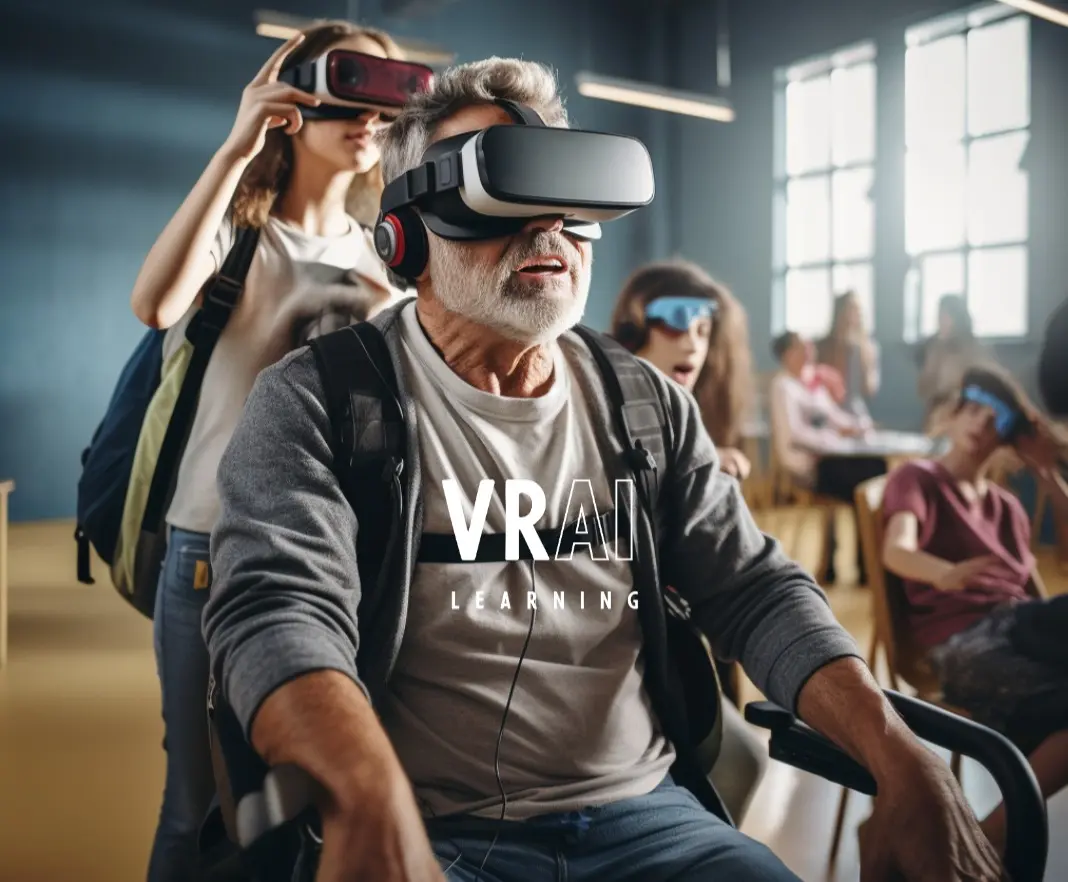
Virtual reality is also a powerful tool for raising awareness among management teams and colleagues about the realities of disability. Simulations allow people to spend a few minutes experiencing partial vision, reduced hearing, or motor difficulties — an experience that durably transforms the way colleagues with disabilities are perceived and fosters a genuine culture of inclusion.
Innovation in the service of inclusion: a concrete commitment
Integrating immersive learning into training programmes for people with disabilities is not merely a technological initiative: it is an ethical and social commitment. It is an acknowledgement that every learner deserves a training tool adapted to their needs, and that technology must serve equality of opportunity.
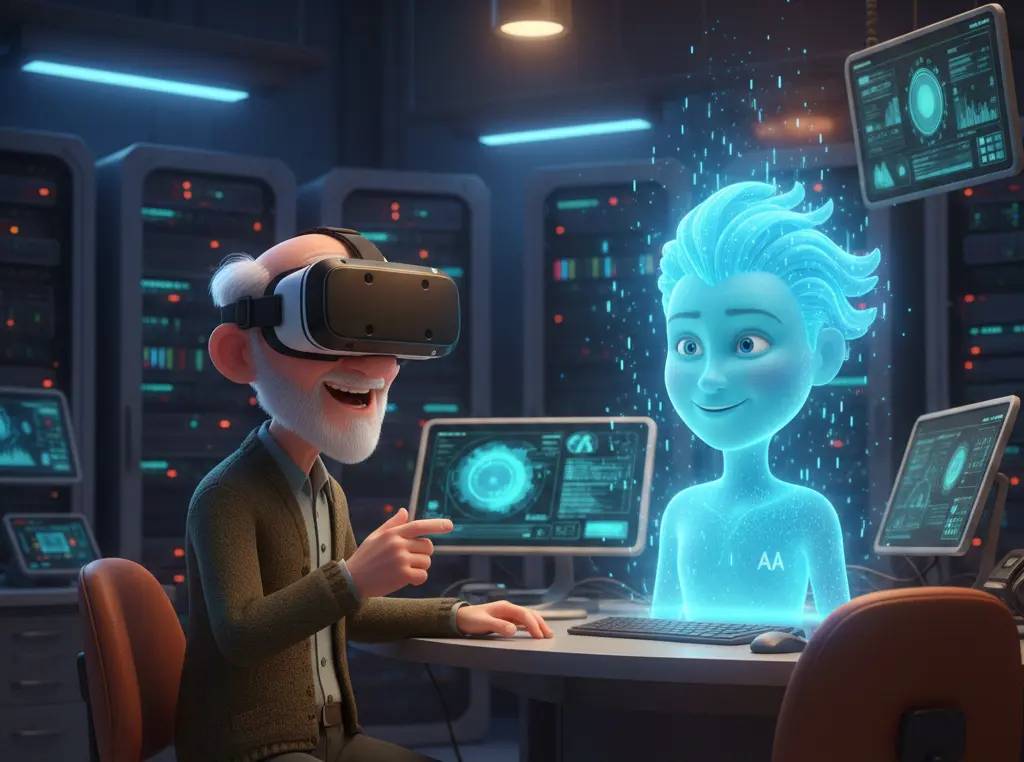
Organisations that invest in these solutions benefit not only from better integration of their employees with disabilities, but also from a stronger inclusive culture — an increasingly valuable asset for employer branding and talent retention. The Avatar Academy platform makes it possible to track each learner's progress and adapt learning pathways in real time, guaranteeing a truly personalised support experience.
The measurable benefits of virtual reality in inclusive training are well-documented: improved retention of learning outcomes, reduced time-to-competency, and increased learner engagement and satisfaction. These results confirm that immersive learning is not only more accessible, but also more effective.
Would you like to implement an inclusive immersive training programme within your organisation? Contact our team to explore together the solutions best suited to your employees with disabilities.
Frequently asked questions
Is virtual reality genuinely accessible to people with motor disabilities?
Yes, virtual reality is designed to adapt to people with motor disabilities through alternative control interfaces. Modern VR headsets can be operated by eye gaze (eye-tracking), voice, or controllers specially adapted to each learner's motor capabilities. A person with reduced mobility can thus follow a complete professional training programme from home or a rehabilitation centre, with no travel constraints. Pedagogical scenarios can be entirely replayed and repeated at will, without judgement or time pressure. This total flexibility transforms virtual reality into a powerful empowerment tool for individuals who previously did not have access to the same training opportunities as their able-bodied peers. Organisations can also personalise interfaces at the individual level, ensuring an optimal experience regardless of the learner's motor profile.
Which types of disability benefit most from immersive learning?
Immersive learning delivers significant benefits across a wide spectrum of disabilities, but certain profiles gain a particularly marked advantage. Individuals with cognitive impairments — such as learning disabilities (dyslexia, dyspraxia), ADHD, or mild intellectual disabilities — benefit from the ability to repeat scenarios as many times as needed, at their own pace, without social pressure. Hearing-impaired individuals benefit from integrated subtitles and haptic feedback. People with reduced mobility can practise professional tasks without physical constraints. Individuals experiencing social anxiety or phobias related to the professional environment find in the virtual setting a space for progressive and safe exposure. Finally, people in rehabilitation following a workplace accident use VR to retrain their movements and test adaptations to their future workstation — thereby accelerating their return to employment under better conditions.
How can immersive training programmes for employees with disabilities be funded?
Several funding mechanisms allow companies to deploy immersive training programmes for their employees with disabilities. In France, the AGEFIPH (Association for the Management of the Fund for the Professional Inclusion of People with Disabilities) offers direct grants to companies for adapting workstations and training tools. OPCOs (Operateurs de Competences — Skills Operators) fund qualifying and certifying training programmes, including those that incorporate innovative digital tools. Professional training funds (the skills development plan) can also cover all or part of the cost of an immersive programme. Furthermore, companies whose employment rate of workers with disabilities falls below 6% are subject to an annual contribution to AGEFIPH — a contribution that can be reduced by demonstrating investment in adapted training and inclusion programmes. Contacting a VRAI Learning expert allows you to quickly identify the most advantageous funding structure for your organisation.
What is the recommended session length for immersive training for a person with a disability?
The ideal length of an immersive training session for a person with a disability depends on the type of disability and the learner's cognitive profile, but best practice recommends short, repeated sessions rather than long continuous ones. For individuals with attention disorders or cognitive disabilities, sessions of 15 to 20 minutes optimise concentration and retention without causing mental fatigue. For people with motor difficulties, the duration can be adjusted according to the level of physical demand required by the scenarios. Immersive learning platforms such as Avatar Academy make it possible to precisely configure the duration, pace, and breaks for each session, adapting to the learner's progress tracking. Human support — a tutor or disability coordinator — remains recommended for the first sessions in order to identify the necessary adjustments.
Read also
Virtual reality training in the company: the complete guide →Methods, costs, use cases and results for deploying VR in your organisation.

Christèle Simeoni
Co-founder VRAI Learning (2023) · CMO
Co-fondatrice de VRAI Learning, spécialiste de la formation immersive VR et des avatars IA conversationnels.
See immersive training in action
Personalised demo, no commitment. We show you what it looks like for your context.
Book a demoExplore our solutions