Christèle Simeoni
10 min min read
Successfully navigating to immersive training: How to effectively manage change
CS
Christèle Simeoni
Co-founder & CMO, VRAI Learning
The decision to integrate virtual reality into your training program is a major strategic step. It goes beyond the training teams alone: it involves HR, IT, management, internal communications, and learners themselves. Like any transformation project, it succeeds or fails based on the quality of the change management that accompanies it. This article gives you a practical framework for navigating this transition with method.
Why is the transition to immersive training a transformation project?
The transition to immersive training is a full-fledged transformation project because it simultaneously changes pedagogical practices, trainer roles, technical infrastructure, and the organisation's learning culture. It is tempting to treat it as a simple tool change — moving from classroom training to VR, the way one switches from one software to another. This is a frequent and costly mistake. A TalentLMS study indicates that companies adopting innovative training modalities experienced a 50% increase in productivity — but this result does not happen spontaneously. It is the fruit of rigorous change management, which anticipates resistance, engages stakeholders from the design phase, and embeds the project in the long-term HR strategy. Treating immersive training as a transformation, rather than a technology purchase, is the first condition for a successful deployment.
Moving from classroom or e-learning training to immersive training fundamentally changes:
- The pedagogical relationship between trainer and learner
- Content design processes
- Technical infrastructure (headsets, software, network)
- Skills assessment and tracking metrics
- The organisation's learning culture
These changes are positive — that is precisely the goal — but they create natural resistance that must be anticipated and managed.
How to lay the groundwork before deploying immersive training?
Laying the groundwork before an immersive training deployment means establishing, upfront, a dedicated organisation and choosing a partner capable of supporting change management — not just delivering content. Preparation begins with forming a multidisciplinary steering committee (training, IT, HR, leadership) responsible for defining pedagogical objectives, identifying internal ambassadors, and setting success KPIs. It also includes an audit of the existing technical infrastructure, mapping of target populations, and an assessment of any regulatory constraints, particularly around data protection (GDPR). The more structured the preparation, the smoother the deployment and the more resistance is anticipated rather than endured. This phase is often underestimated by organisations that too quickly focus on choosing content or equipment, to the detriment of project governance.
Forming a multidisciplinary steering committee
The first step is organisational. A steering committee bringing together representatives from training, IT, HR, communications, and leadership is essential to:
- Define priority pedagogical objectives and target populations
- Align the project with the HR strategy and business objectives
- Identify change ambassadors among managers and trainers
- Set project success KPIs (completion rate, skills improvement, satisfaction, ROI)
- Coordinate technical and legal aspects (GDPR, learner data)
This committee is not a one-off approval body: it meets regularly throughout the deployment to adjust strategy based on field feedback.
Choosing a reliable technical partner
The quality of the immersive training partner largely determines the project's success. Beyond technical aspects (content quality, headset compatibility, data security), the partner must be capable of supporting change management — not just delivering content. Verify their ability to train your trainers, adapt scenarios to your specific business context, and support you over the long term.
Phase 2: Designing the learning experience
Define pedagogical objectives before content
A classic pitfall is wanting to "do VR" without first precisely defining which skills need to be acquired, in which context they will be applied, and how they will be assessed. Technology is a vehicle, not an end in itself.
For each module, define:
- The target competency (hard skill, soft skill, procedure)
- The professional situation in which this competency is applied
- The expected mastery level at the end of training
- The indicators used to verify acquisition
Build scenarios that reproduce reality
Storytelling in immersive training is not an aesthetic option — it is a central pedagogical lever. Scenarios rooted in real professional situations, with credible stakes and visible consequences, produce far more durable learning than a simple presentation of procedures.
The best scenarios incorporate:
- Realistic tension situations (emergencies, conflict, incidents)
- Branching paths that reproduce real-world dilemmas
- Immediate feedback on the consequences of each decision
- The ability to restart and internalise best practices
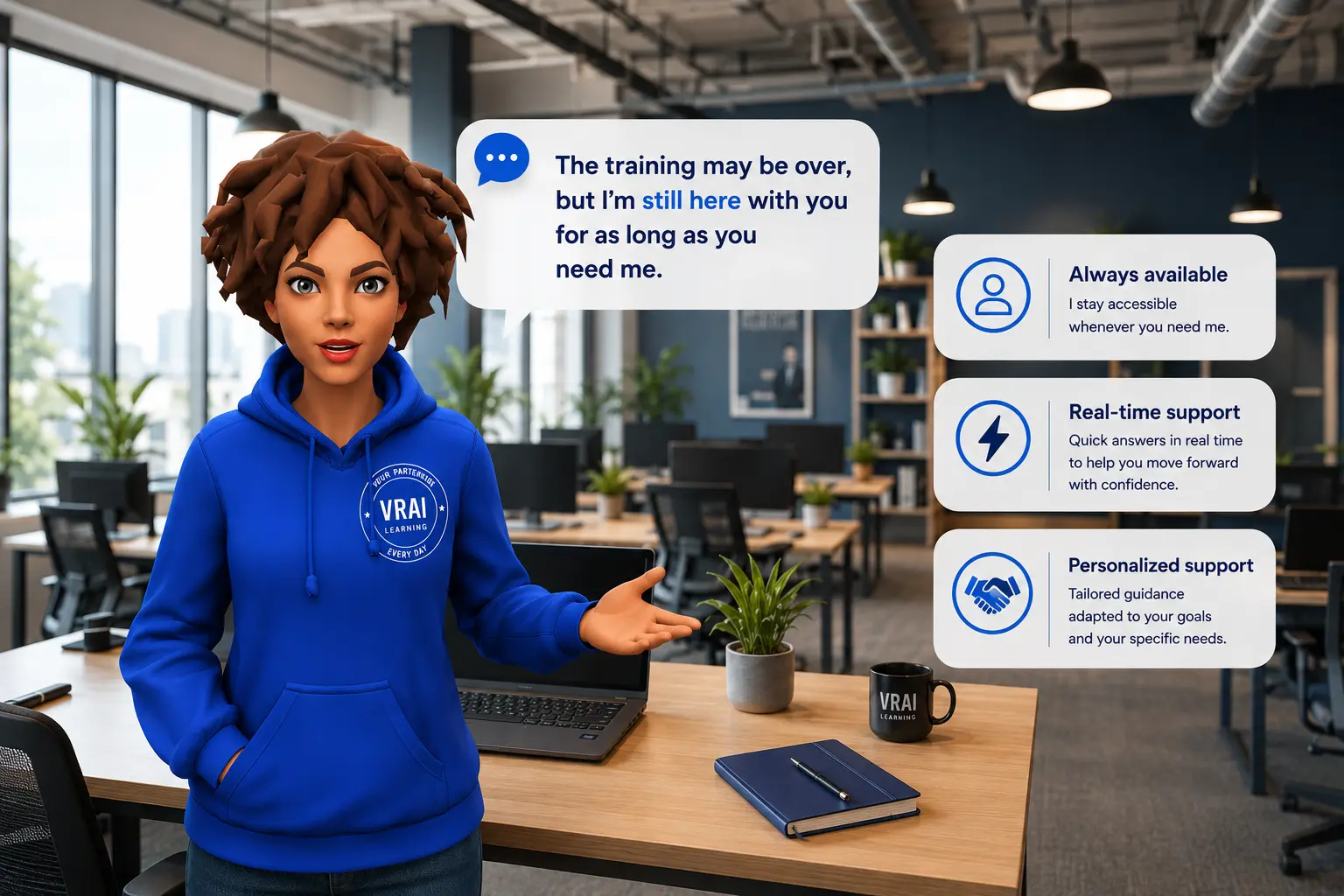
AI avatars enrich these scenarios by playing the role of reactive interlocutors — colleagues, clients, patients — who respond to the learner's actions in a coherent and pedagogically relevant way.
How to support trainers in their new role with immersive training?
The introduction of virtual reality profoundly transforms the trainer's role: from content facilitator, they become experience facilitator. This evolution is an opportunity, but it must be actively supported to prevent trainer resistance from becoming a barrier to deployment. Effective support includes technical training on VR equipment, pedagogical training on the specificities of post-immersion debriefing, time to experiment with content in real conditions before deployment to learners, and guidance during the first sessions. Trainers who embrace these new tools become natural project ambassadors within their teams. Their enthusiasm — or resistance — is often decisive in adoption rates. Investing in trainer upskilling is not an added cost: it is a condition for the project's return on investment.
The introduction of virtual reality does not replace trainers — it transforms their role. Rather than delivering content, they become experience facilitators: they prepare learners, debrief simulations, contextualise learning, and support individual progress.
This evolution must be supported by:
- Technical training on VR equipment use
- Pedagogical training on the specificities of post-immersion debriefing
- Time to experiment with content before deployment
- Guidance during the first sessions with learners
Phase 4: Deploy, measure, and continuously improve
Communicating with learners
Announcing a new training modality can generate apprehension, particularly among employees less familiar with digital technologies. A well-designed internal communication plan presents immersive training not as a technological constraint, but as a concrete benefit for the learner: more engaging, more grounded in real-world situations, more respectful of their time.
Highlighting learner benefits (not just HR benefits) is a golden rule of any change management initiative.
Validating learning outcomes and tracking progress
One of the distinctive advantages of immersive training is the richness of the behavioural data it produces. Each session generates precise information about learner behaviours: sticking points, decisions made, completion time, recurring errors. This data enables far more granular assessment than traditional multiple-choice tests.
The Avatar Academy platform centralises this data and provides HR and training teams with dashboards to validate acquired skills, identify reinforcement needs, and measure the real impact of training on operational indicators.
According to an Oculus for Business study, companies that adopted virtual reality in training observed a 60% increase in employee retention compared to traditional methods. This figure underscores that the impact goes beyond learning: quality training directly influences talent retention.
Measuring ROI and adjusting
Change management does not stop at deployment. Regular project monitoring — comparing results against the KPIs defined in phase 1, collecting learner and trainer feedback, analysing completion and acquisition data — makes it possible to identify necessary adjustments and demonstrate the project's value to decision-makers.
For further reading on the measurable benefits of virtual reality training, sector-specific data and concrete use cases are available.
In summary: the keys to a successful transition
A successful transition to immersive training rests on a few fundamental principles:
- Treat the project as an organisational transformation, not a simple tool change
- Form a multidisciplinary committee with identified ambassadors
- Start from pedagogical objectives, not technology
- Invest in supporting trainers
- Communicate the learner benefits
- Measure, analyse, and continuously improve
Conclusion
The transition to immersive training is an opportunity to profoundly modernise your approach to skills development. Well managed, it produces measurable results — in skills acquisition, employee engagement, and operational performance. Poorly managed, it generates resistance and an underexploited investment.
Would you like tailored support to manage this transition in your organisation? Contact the VRAI Learning team — we help you structure your project from end to end, from objective definition to deployment.
Frequently asked questions
How long does it take to deploy immersive training in a company?
The deployment timeline for immersive training in a company varies according to project complexity, but a realistic schedule generally spans three to six months, from the scoping phase to the first learner sessions. The preparation phase — forming the steering committee, defining pedagogical objectives, auditing the technical infrastructure — typically takes four to six weeks. Designing and developing the immersive scenarios is the longest phase, often two to three months. A pilot deployment with a limited group of learners then allows for adjustments before rolling out at scale. Organisations that attempt to compress these steps typically encounter stronger resistance and a lower adoption rate. An experienced partner can accelerate certain phases through existing content that can be adapted to your specific business context.
How do you manage employee resistance to virtual reality training?
Managing resistance to virtual reality training requires a proactive approach combining communication, experimentation, and individualised support. Resistance rarely stems from a rejection of the technology itself: it often expresses a legitimate concern — fear of not knowing how to use the equipment, the feeling that technology replaces human contact, or doubt about pedagogical relevance. The effective response is to offer no-pressure discovery sessions, where employees can experiment freely before being assessed. Identifying internal ambassadors — enthusiastic and credible employees among their peers — significantly accelerates adoption. Communications should highlight concrete learner benefits (time savings, grounding in real situations, the ability to restart without risk) rather than solely organisational benefits.
What KPIs should you measure to evaluate the success of an immersive training project?
Evaluating the success of an immersive training project requires combining adoption, learning, and operational impact indicators. Adoption KPIs include module completion rate, voluntary participation rate, and learner Net Promoter Score. Learning KPIs measure skills acquisition (before/after scores, reduction in real-world errors, time to procedure mastery). Operational impact KPIs are the most strategic: reduction in accidents or incidents, improvement in business performance indicators, reduction in training costs related to travel or classroom sessions. Immersive training produces highly granular behavioural data — every decision made in the simulation is tracked — making assessment far more precise than with traditional methods. This data can be centralised in a dedicated LMS platform.
Is immersive training suitable for all industries?
Immersive training is particularly well-suited to industries where real-world practice involves risk, high costs, or significant logistical constraints: manufacturing, healthcare, construction, security, retail, customer service, and management. In these contexts, immersive simulation allows learners to experience situations that would be difficult, costly, or dangerous to encounter in traditional training — a medical emergency, a safety incident, a challenging commercial negotiation. It is, on the other hand, less relevant for purely theoretical or regulatory training with no strong behavioural component. The question is less about whether your industry is compatible with VR, and more about identifying which competencies in your skills framework would benefit most from immersive practice-based learning. A preliminary pedagogical audit answers this question with precision.
Read also
Virtual reality training in the company: the complete guide →Methods, costs, use cases and results for deploying VR in your organisation.

Christèle Simeoni
Co-founder VRAI Learning (2023) · CMO
Co-fondatrice de VRAI Learning, spécialiste de la formation immersive VR et des avatars IA conversationnels.
See immersive training in action
Personalised demo, no commitment. We show you what it looks like for your context.
Book a demoExplore our solutions