Christèle Simeoni
4 min min read
Immersive vs Traditional Training: A Comparison
Professional training is at a crossroads. On one side, traditional formats—face-to-face, e-learning, slideshows—which have structured knowledge transfer for decades. On the other, immersive training in virtual reality (VR), placing the learner at the heart of the experience. But which is truly more effective? Scientific studies weigh in.
What is immersive training?
Immersive training refers to any educational approach that immerses the learner in an interactive simulated environment. It includes three complementary technologies:
- Virtual Reality (VR): complete immersion via a headset, placing the learner entirely in a simulated 3D environment.
- Augmented Reality (AR): overlaying virtual elements onto the real environment via a tablet or smart glasses.
- Mixed Reality (MR): virtual objects physically interact with the learner's real space.
The fundamental difference from traditional training: the learner acts rather than passively receives content. They make decisions, make mistakes without real consequences, and learn through lived experiences.
Traditional training: real strengths and limitations
Face-to-face training and e-learning are not without merit. They remain relevant for collective theoretical transmission, exchanges between experienced professionals, and short regulatory content.
But their limitations are documented:
- Ebbinghaus Forgetting Curve: without repetition, 80% of information learned in the classroom is forgotten in 30 days.
- Impossible to replicate rare, dangerous, or costly situations (crisis management, surgical procedures, industrial accidents).
- Dependence on trainer quality — experience varies greatly from one session to another.
- Zero personalization — each learner receives the same content at the same pace.
Key figures: what the studies say
Scientific data and field studies converge on the superior effectiveness of immersive training:
- Learning speed: learners trained in VR progress up to 4 times faster than their peers in face-to-face training (Source: PwC, VR Soft Skills Training Efficacy Study, 2020).
- Confidence in skills: VR learners show 275% higher confidence in applying their new skills (Source: PwC, 2020).
- Engagement: VR training generates a concentration and engagement rate 30% higher than traditional e-learning formats (Source: PwC, 2020).
- Long-term retention: learners in immersive environments retain up to +275% of confidence to act compared to traditional training formats (Source: PwC, 2020).
- Problem-solving: improvement of 28% in complex problem-solving abilities in VR environments (Source: Stanford University).
 Immersive vs traditional training: what scientific studies say — Ebbinghaus forgetting curve vs VR retention curve, PwC 2020 data.
Comparative table: VR training vs traditional training
| Criterion | Traditional Training | Immersive VR Training |
|---|---|---|
| 30-day Retention | ~20% (Ebbinghaus curve) | Up to 80% |
| Learning Speed | Reference | 4x faster (PwC) |
| Engagement | Variable, often passive | +30% vs e-learning (PwC) |
| Personalization | Low — uniform content | Real-time, adaptive |
| Risk Situations | Impossible to replicate | Simulatable without danger |
| Availability | Time and location constraints | 24/7, multi-platform |
| Cost at Scale | Increases with staff | Decreases with staff |
| Result Measurement | Difficult, subjective | Precise data per learner |
Which approach to choose according to your context?
Immersive training is not universal; like any educational tool, its effectiveness depends on the context of use.
VR training is ideal for:
- Repetitive or risky technical work (surgery, industrial maintenance, HSE safety).
- Communication and management situations (interviews, conflict management, customer relations).
- Large-scale onboarding with geographically dispersed teams.
- Behavioral awareness (diversity, inclusion, harassment).
Traditional training remains relevant for:
- Collective theoretical transmission in face-to-face with peer exchanges.
- Short regulatory content requiring legal validation.
- Expert to expert training, centered on debate and co-construction.
The hybrid approach: the best of both worlds
The opposition of VR training vs traditional training is a false debate. The most successful organizations adopt a complementary logic: traditional training for theoretical basics, immersive training for practice and memory anchoring.
At VRAI Learning, we design VR training based on scientific learning data:
- Active scenarios with the right to make mistakes: the learner acts, makes mistakes, corrects — without real consequences.
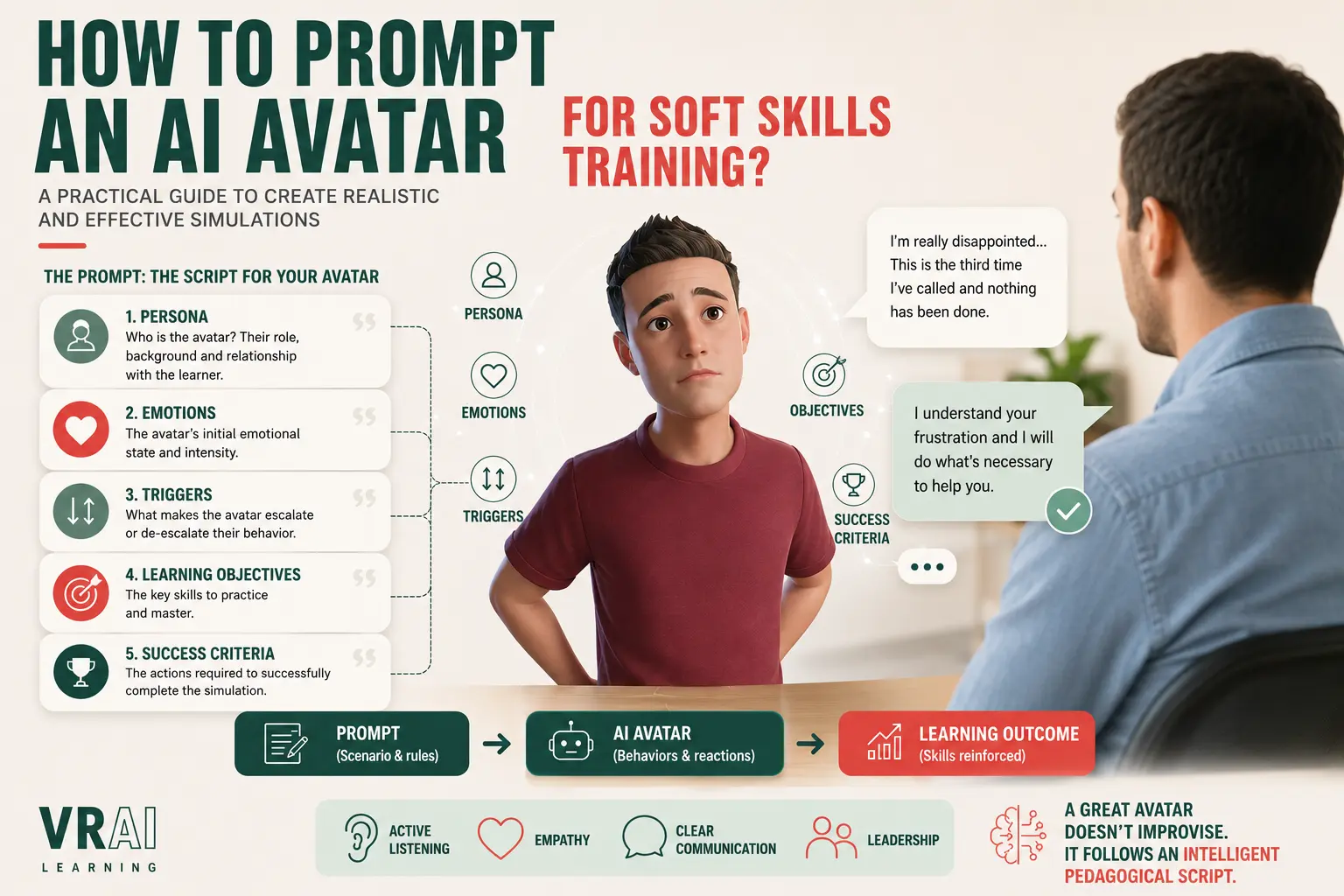
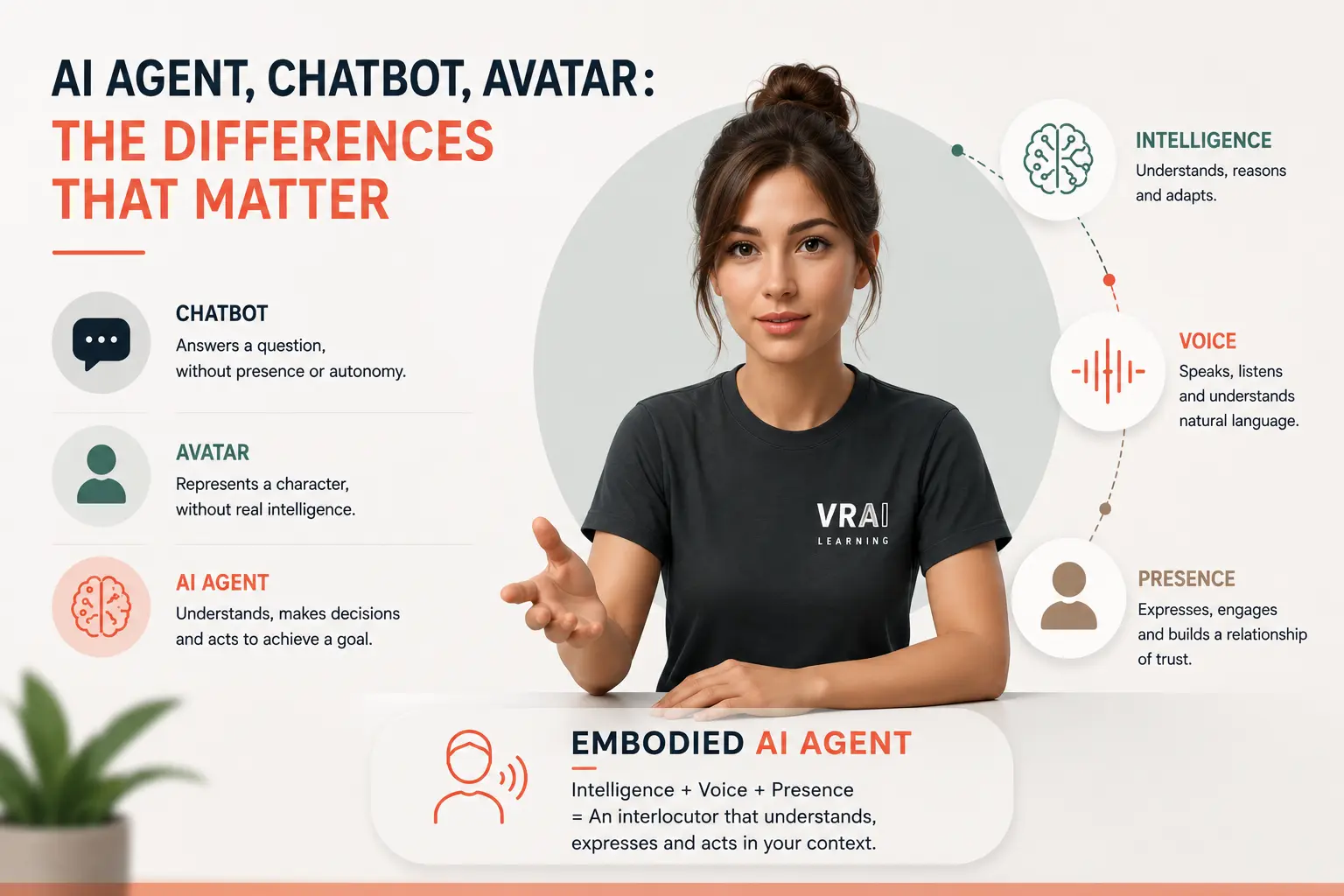
- AI conversational avatars: to simulate complex human interactions in real-time (difficult client, demanding manager, crisis situation).
- Avatar Academy: our monitoring platform tracks each learner's progress in real-time and calculates training ROI.
- LMS integration: the VR modules integrate with your existing tools (Moodle, 360Learning, Cornerstone).
Frequently asked questions about immersive vs traditional training
Is VR training really more effective than classroom training?
Yes, according to available studies. PwC (2020), involving 10,000 learners, shows VR training is 4 times faster and generates 275% more confidence in applying skills. The effect is particularly marked for soft skills, technical gestures, and risky situations.
Is immersive training suitable for all sectors?
Yes — industry, health, retail, banking, construction, hospitality, public sector. VR is particularly effective in sectors where field practice is difficult, dangerous, or costly to organize. See our examples by sector.
Should traditional training be replaced by VR?
No. The optimal approach is hybrid: traditional training for collective theoretical input, VR training for practice and memory anchoring. The two approaches complement rather than replace each other.
What is the cost of immersive VR training?
The initial cost is higher than a traditional e-learning module, but the cost per learner decreases rapidly at scale. For large-scale repetitive training (onboarding, HSE, sales), ROI is generally positive within the first year. Request an estimate for your context.
Read also
Virtual Reality Training in Business: The Complete Guide →
Methods, costs, use cases, and results for deploying VR in your organization.

Christèle Simeoni
Co-founder VRAI Learning (2023) · CMO
15+ years of expertise in digital marketing and EdTech. International career: Québecor (TVA), Adviso Montreal, Marketing Director at Holberton School. On this blog, she unpacks the best marketing and communications strategies to maximise the ROI of immersive learning and AI avatars.
See immersive training in action
Personalised demo, no commitment. We show you what it looks like for your context.
Book a demoExplore our solutions