CS
Christèle Simeoni
Co-founder & CMO, VRAI Learning
Does the perfect alliance between technology and pedagogy exist?
The perfect alliance between technology and pedagogy exists in immersive training — provided that virtual reality serves a clear pedagogical intention and not the other way around. VR is not a magic tool: it is the quality of instructional design that determines the effectiveness of an immersive programme. Studies show that learners trained in VR gain 275% more confidence in applying their skills (PwC, 2020) — but only when scenarios are built by subject-matter experts who understand the critical situations to simulate. Trainers are not replaced by technology: they move from passive transmission to course design, data-driven management, and targeted coaching. Technology is only as valuable as the pedagogy that underpins it.
VR is not designed to replace trainers. On the contrary, immersive tools complement, support, and enhance learning by opening up new pedagogical possibilities. Technology is only as valuable as the pedagogy that underpins it.
Immersive learning: a revolution in training?
Immersive learning is a revolution in professional training because it makes it possible to recreate real-world work situations that cannot be reproduced in a classroom — dangerous, costly, rare, or geographically constrained scenarios. Unlike traditional methods, virtual reality training produces 75% retention after one year, compared to only 10% for lecture-based instruction. Learners progress four times faster towards skill mastery (PwC, 2020) and report 90% satisfaction (IDC). This effectiveness comes from active practice: the learner manipulates, tests, fails, and tries again in a safe environment. That is precisely where the trainer reclaims full value — by designing scenarios, guiding the learner, and interpreting the data generated by the platform.
The data confirms the effectiveness of the method:
- +275% confidence in applying skills for VR-trained learners versus traditional e-learning (PwC, 2020)
- 4× faster to achieve skill mastery (PwC, 2020)
- 90% satisfaction among learners who used VR or AR in their training (IDC)
- 75% retention after one year, versus 10% for traditional lecture-based instruction
Immersive learning proves particularly beneficial in fields where hands-on practice is difficult to reproduce, costly, or dangerous — and that is precisely where the trainer reclaims full value: designing scenarios, guiding learners, and interpreting the data.
Pedagogy and the challenges of professional training
The effectiveness of immersive training rests above all on the quality of instructional design. Trainers can integrate gamification into their course materials and recreate work environments where learners manipulate, test, and fail — all while being guided.
Assessment of learning outcomes
Immersive learning makes it possible to assess outcomes throughout the journey: immediate evaluations at the end of a scenario, delayed evaluations at Day 7 or Day 30, points systems, and badges. The trainer can observe and assess learner competencies under conditions close to reality — without waiting for on-the-job feedback to identify gaps.
The role of instructional designers and trainers
Trainers possess the experience and expertise needed to design learning programmes tailored to the specific needs of learners. Their role does not disappear with VR — it evolves. They move from passive transmission to course design, data-driven management, and targeted coaching for struggling learners.
The human dimension of learning
Learning is not limited to the acquisition of knowledge and skills. It encompasses the human dimension, social interaction, and adaptation to individual needs. Training professionals are essential to support learners throughout their journey — interpreting the data VR produces, adjusting learning paths, and facilitating post-immersion debriefs.
What VR changes in a trainer's day-to-day work
In practice, virtual reality transforms three aspects of the trainer's role:
- Content design: the trainer co-designs immersive scenarios with technical teams. They bring subject-matter expertise — the critical situations to simulate, common errors to reproduce, and a progressive difficulty curve. VR gives tangible form to their field knowledge.
- Session facilitation: instead of delivering a lecture, the trainer orchestrates the experience. They observe behaviours in real time, identify blockages, and intervene at the right moment. Their role becomes that of a coach rather than an information broadcaster.
- Assessment and tracking: VR generates objective data — reaction times, choices made, errors committed, progress between attempts. The trainer has precise indicators to personalise the support given to each learner.
The importance of personalisation
VR combined with AI offers unprecedented personalisation capabilities — but it cannot replace trainers' ability to adapt to the individual needs of learners. The data produced by the platform is a tool in service of the trainer's pedagogical judgement, not a substitute for it.
It is the combination of the two — objective platform data and the trainer's human expertise — that produces the best learning outcomes.
How do AI avatars become a partner for the trainer?
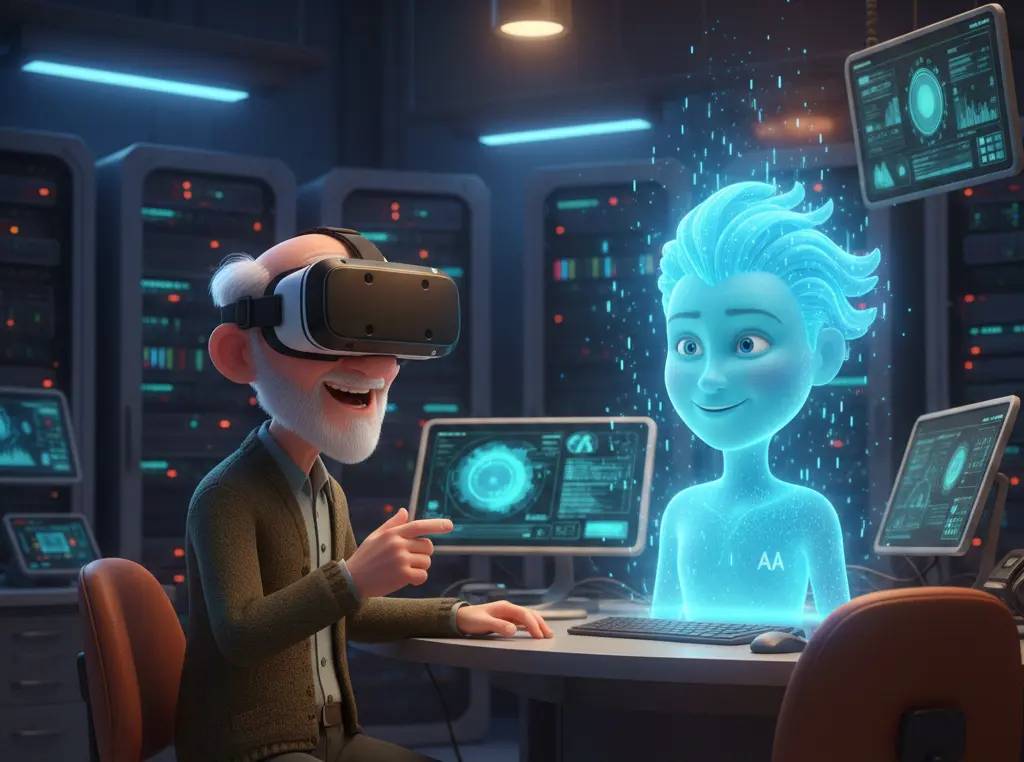
Conversational AI avatars become a key partner for the trainer by handling repetitive interactions and freeing up time for high-value coaching. Integrated into VR scenarios, they play the role of realistic interlocutors — a difficult client, a demanding manager, a distressed colleague — making it possible to simulate complex interpersonal situations that traditional role-playing exercises struggle to reproduce at scale. Available 24/7 in 62 languages, they allow learners to practise between formal sessions without involving the trainer. Each interaction generates data that the trainer can analyse to refine learning paths and identify individual sticking points. The AI avatar is not a competitor to the trainer: it is a capacity multiplier that extends their pedagogical reach beyond time and geographic constraints.
For the trainer, the AI avatar is a capacity multiplier:
- It handles repetitive interactions (frequent questions, standardised feedback) and frees up time for high-value coaching.
- It is available 24/7, in 62 languages, across all devices — allowing learners to practise between formal sessions.
- It collects data on every interaction, which the trainer can analyse to refine learning paths.
Concrete examples of VR in professional training
Virtual reality is now deployed across many sectors. Here are five areas where trainers use it with measurable results:
- Medical and surgical training: students simulate complex procedures — sutures, intubations, emergency protocols — with no risk to patients. Trainers design progressive clinical cases and observe decisions made under pressure.
- Industrial safety training: in the oil, gas, chemical, and nuclear sectors, workers train to manage emergency situations (gas leaks, explosions, fires) in a virtual environment. The trainer can replay the scenario as many times as needed, with different variables.
- Language training in context: instead of abstract grammar exercises, learners practise a foreign language in immersive environments (airport, international meeting, customer reception) with an AI avatar as a native-speaker interlocutor.
- Management and leadership training: simulation of difficult meetings, performance review conversations, and strategic decision-making under time pressure. The trainer can analyse the choices made and work through postures and reflexes in a debrief.
- Sales and customer relations training: simulation of interactions with virtual customers of varying profiles — aggressive, indecisive, rushed — to develop communication, negotiation, and objection-handling skills.
Frequently asked questions
Can virtual reality really replace trainers in the workplace?
No, virtual reality does not replace trainers — it transforms their role. VR handles repeated practice in simulated environments, but it cannot substitute for human pedagogical judgement. The trainer remains indispensable for designing scenarios that reflect the real critical situations of a given role, interpreting the behavioural data collected by the platform, and facilitating post-immersion debriefs that consolidate learning. What changes is that the trainer moves from an information-transmitter role to that of a course designer and coach. Their subject-matter expertise becomes more valuable, not less — because it is what gives meaning to the simulations. Organisations that achieve the best VR deployment outcomes are those that involve their trainers from the scenario design phase, not just in session facilitation.
In which sectors is virtual reality training most effective?
Virtual reality training is particularly effective in sectors where hands-on practice is dangerous, costly, or difficult to organise. At the top of the list: industrial safety (petrochemicals, nuclear, construction), where training for emergency situations in a real environment is impossible; healthcare, where students simulate technical procedures with no risk to patients; and sales and customer relations training, where VR scenarios allow soft-skills development against avatars with varied profiles. Management and leadership also represent a strong application area — simulating difficult conversations and high-pressure decision-making. Finally, professional language training benefits greatly from immersive environments featuring conversational AI avatars. In all these cases, VR produces retention rates above 70% after one year, compared to less than 20% for passive methods.
How do you measure the effectiveness of virtual reality training?
The effectiveness of VR training is measured at several levels. During training: completion time, error rates, number of attempts required to complete a scenario, reaction times — all these indicators are collected automatically by the platform. Immediately after the session: assessment of learner satisfaction and perceived confidence. At Day 7 or Day 30: retention quizzes, field observation, or situational assessments. Over the long term: impact on business indicators (accident reduction, improved conversion rates, on-the-job performance). The real value of modern immersive tools lies in this capacity to combine objective behavioural data with qualitative assessments — giving the trainer a complete, individualised view of each learner's progress.
What budget should you plan for integrating VR into a professional training programme?
The budget for integrating VR into professional training varies widely depending on the level of content customisation and the scale of deployment. A turnkey solution with existing modules is accessible from a few thousand euros. A bespoke scenario represents a more significant investment — but it amortises quickly if the content is used across large cohorts or recurring training programmes. The most advanced solutions, integrating multilingual conversational AI avatars and pedagogical dashboards, fit into a global platform logic. Return-on-investment calculations must factor in avoided costs: eliminated travel, reduced accidents, and shorter time-to-competency. PwC estimates that VR training can be up to 52% less expensive than in-person training at scale.
Conclusion
Immersive training is revolutionising the world of professional development by offering unprecedented pedagogical possibilities. But it is crucial to remember that these tools will not replace training professionals. Virtual reality is a powerful instrument — one that only reaches its full potential when wielded by a trainer who understands their learners, masters their pedagogical objectives, and knows how to interpret what the data is telling them.
Are you a trainer looking to integrate VR or AI avatars into your programmes? Explore our immersive training solutions, the Avatar Academy management platform, and the measurable benefits — or contact us to build your first scenario.
Read also
Virtual reality training in the workplace: the complete guide →Methods, costs, use cases and results for deploying VR in your organisation.

Christèle Simeoni
Co-founder VRAI Learning (2023) · CMO
Co-fondatrice de VRAI Learning, spécialiste de la formation immersive VR et des avatars IA conversationnels.
See immersive training in action
Personalised demo, no commitment. We show you what it looks like for your context.
Book a demoExplore our solutions