Christèle Simeoni
6 min min read
Deepfakes, AI Avatars: European Obligations
CS
Christèle Simeoni
Co-founder & CMO, VRAI Learning
Key takeaways
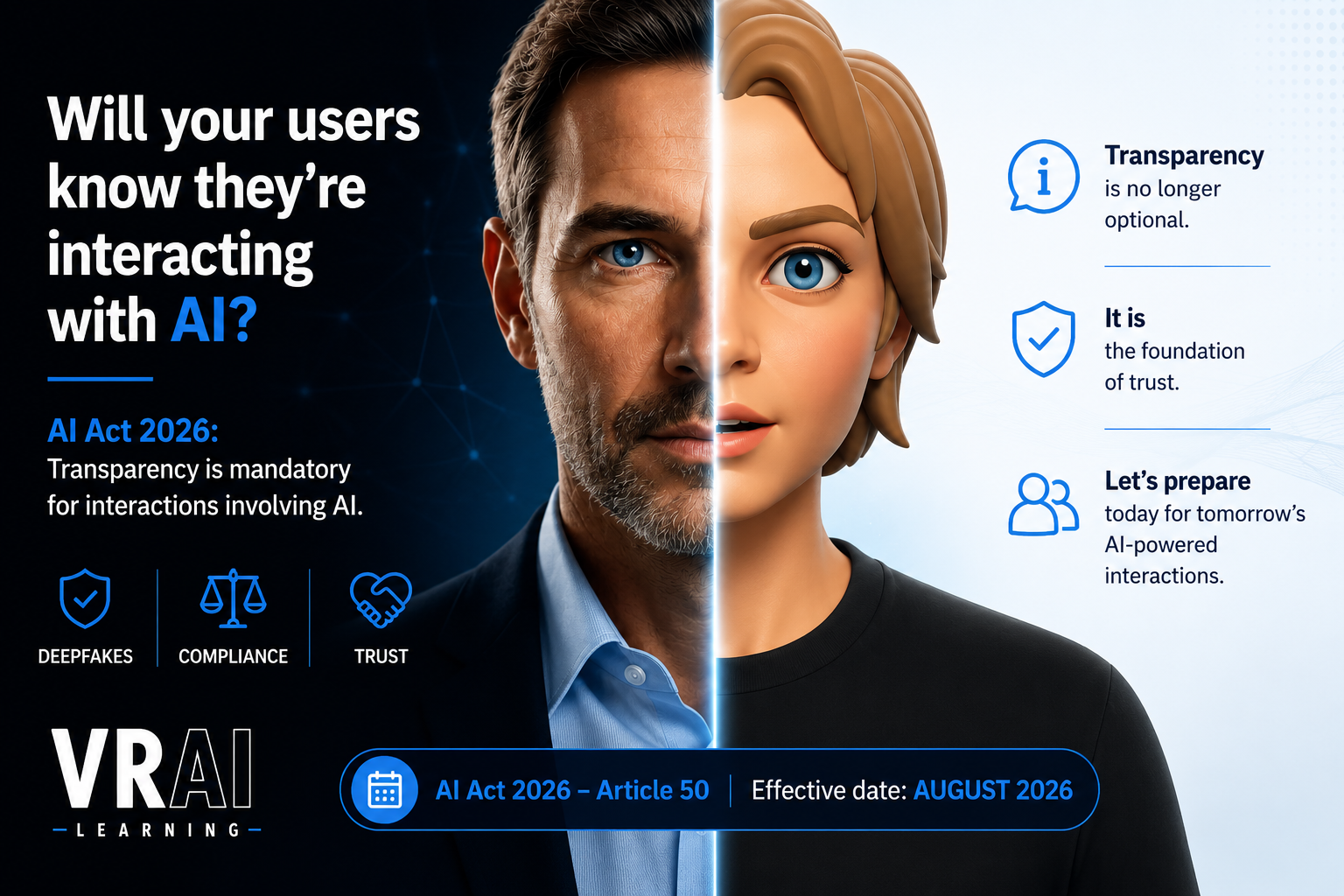
- Article 50 of the AI Act requires companies to explicitly inform their users when they are interacting with an AI. Entry into force: August 2026.
- In 2024, a Hong Kong-based company wired $25 million to fraudsters after a fake video conference entirely generated by deepfake.
- The more human-like an avatar looks, the higher the reputational, legal, and regulatory risks climb. Absolute realism is not a neutral goal.
- At VRAI Learning, we chose semi-realism. Not for aesthetic reasons. For strategic ones.
"Hello, I'm your advisor."
In a few years, this sentence could be spoken by an AI avatar at a bank, a training organization, a public service, or a Fortune 500 company.
The question is: will your users know?
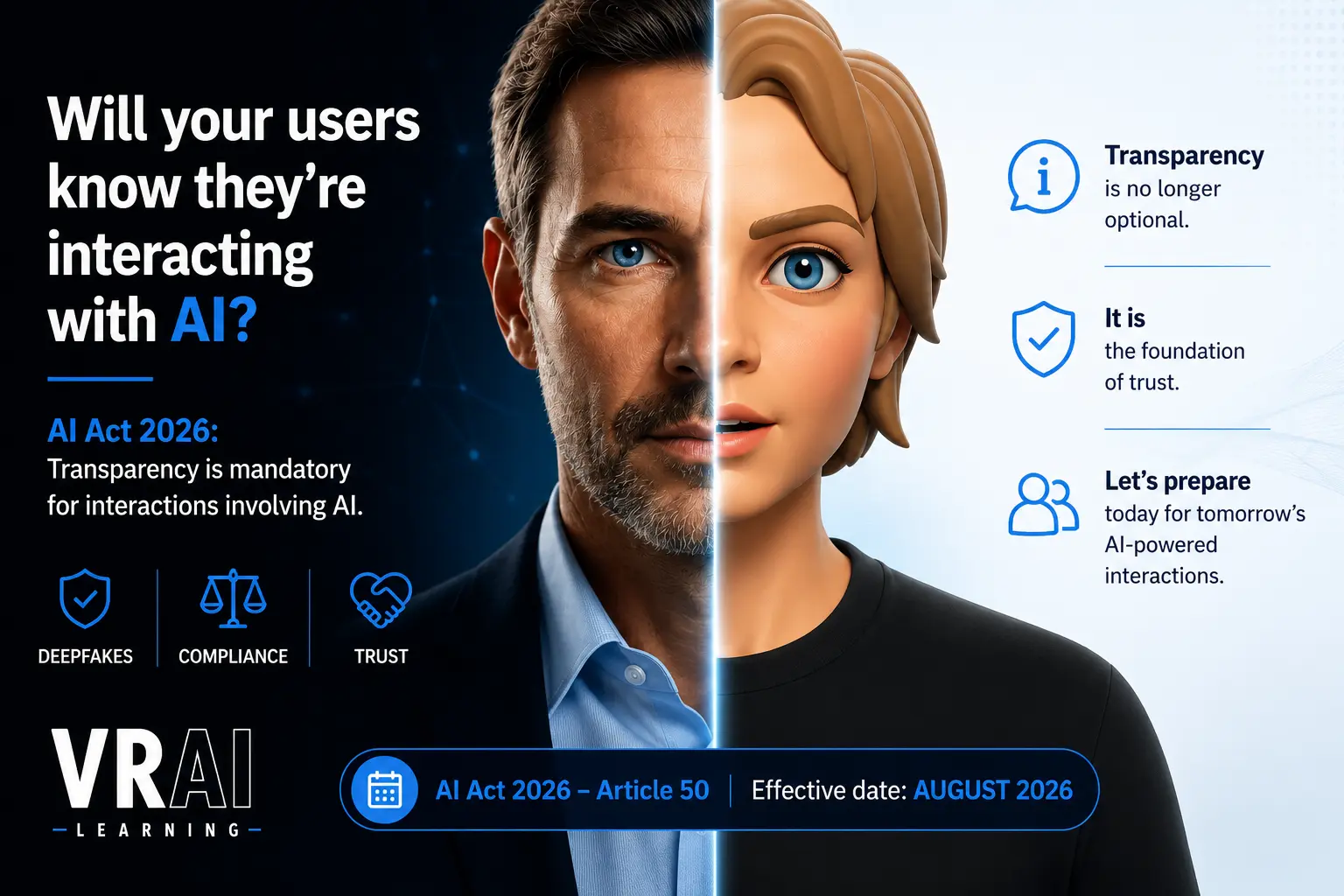
Because Europe has already started to answer. Undeploying AI systems will have to meet newtransparency obligations. Among them: clearly informing users when they are interacting with an AI, and flagging content that hbeen artificially generated or manipulated, particutaken for reality.
This shift is arriving in a very particular contfakes.
Deepfakes are no longer a science-fiction topic
For a long time, deepfakes seemed like a technolity of 2024 is something else entirely.
Earlier that year, a Hong Kong-based company felt well-documented frauds to date. An employee in the finance department was convinced to transfer $25 million after a fake video conference. The CFO, several colleagues visible on screen: all deepfakes. The entire meeting was a sce artificial intelligence.
This case is not isolated. Deepfake-based fraud between 2023 and 2024 across European financial and HR sectors. Voice cloning of executives, synthetic videos indistinguishable to the naked eye, real-time identity spoofing during video calls.
The question is no longer whether it's possible.intain trust in a world where anything can lookreal.
This concern is especially strong among younger generations. People under 30 now rank deepfakes among the top risks associated with artificial intelligence, ahead of algorithmic companies addressing these audiences, that's asignal too risky to ignore.
Absolute realism isn't always a good idea
Faced with these technological advances, many organizations assume the ultimate goal is to build avatars indistinguishable from a human being. That ambition deserves to be qu
At what point does an avatar become deceptive? Her understands they're talking to a machine? How doyou prevent an interaction from being taken out of context to create confusion? How do you protect a brand's image if an avatar is perceived as manipulative?
There's also a phenomenon that cognitive psychold for decades: the uncanny valley. The closer anartificial character gets to human without fully reaching it, the more negative the emotional reaction becomes. Unease. Distrust. Rejection. In a training context, this effect has dner who feels uncomfortable learns lesseffectively.
The more human-like an avatar looks, the blurrier the line becomes. And the higher the regulatory, legal, and reputational stakes climb.
What the AI Act concretely requires
Europe isn't trying to slow down innovation. It'amework of trust. With a precise timeline.
Article 50 of the AI Act is the central provisioAI avatars or synthetic content. It requiresexplicitly informing users that they are interacting with an artificial intelligence, unless this is obvious given the context. It also requires clearly flagging any content generwhenever it could be mistaken for authenticcontent.
| Obligation | Entry into force |
|---|---|
| Prohibited AI practices | February 2025 |
| Obligations for general-purpose AI models | August 2025 |
| Article 50 — Transparency of AI interacti | August 2026 |
Tomorrow, the question will no longer be just "Ing?" It will also be "Is our avatar transparentenough to be compliant?"
A responsibility that also concerns the companies using the technology
It's often assumed that these obligations only apply to technology vendors. That's not what the text says.
The AI Act distinguishes between providers, who develop the systems, and deployers — the companies that integrate these technologies into their services. Deployers have thing transparency mechanisms are active in their useof the system, training their teams, and keeping a usage log for high-risk systems.
In other words, integrating an AI avatar into a training program, a customer reception desk, or an HR process is no longer just a technology decision. It's a governance decisny's liability.
Why we chose semi-realism
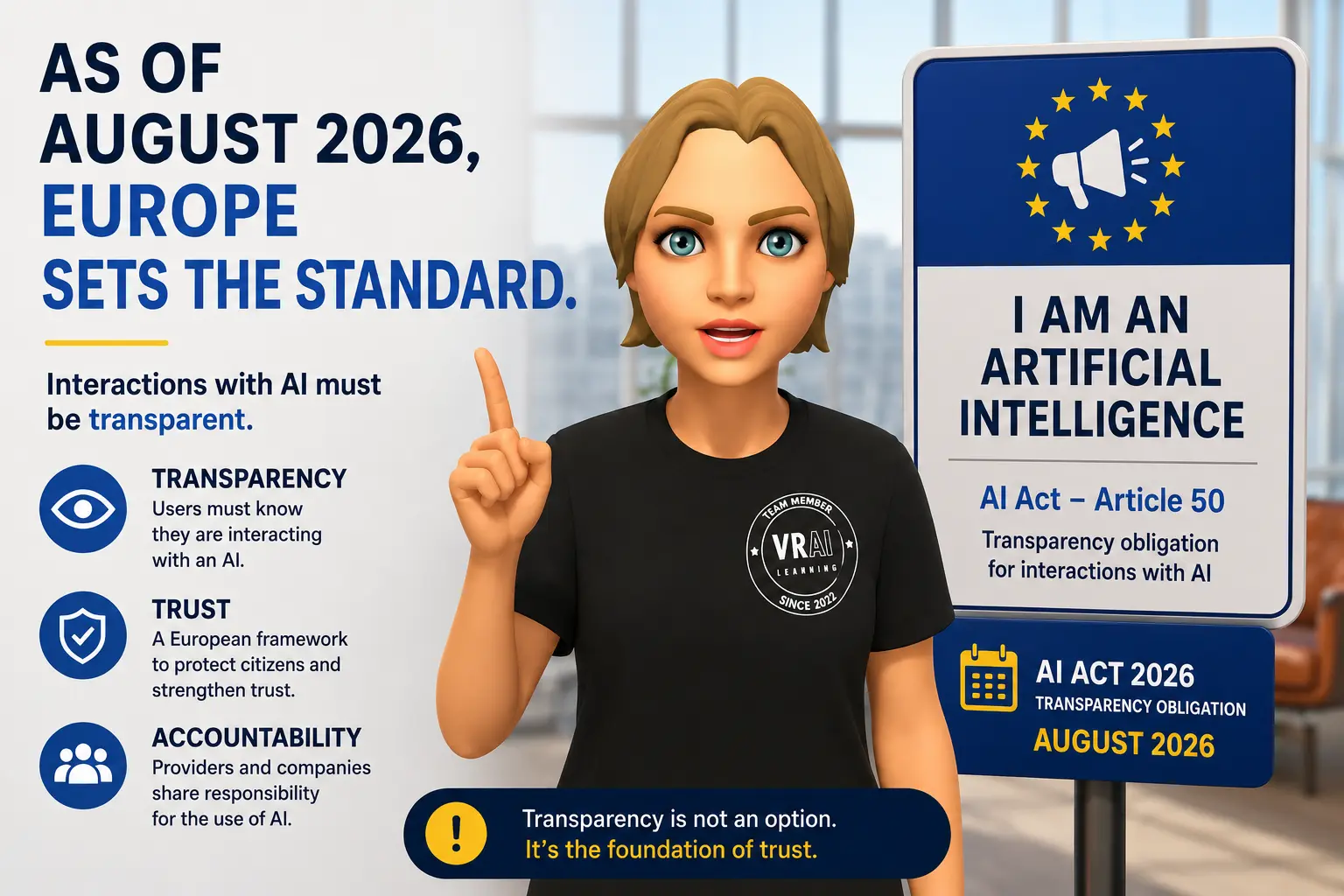
At VRAI Learning, we know how to build extremely most projects, we make a different choice:semi-realism.
This choice is often seen as an aesthetic one. It's actually strategic.
A semi-realistic avatar retains the full richness of human interaction without creating any ambiguity about its artificial nature. The user immediately understands they're insparency is built into the design, not tacked on asa legal disclaimer at the bottom of the page. Regulatory risk is reduced at the source.
It also reduces the effects of the uncanny valley. The learner can engage freely with the interaction, without part of their cognitive resources being spent trying to "categorit's also lighter technically, easier to deployacross different devices, and impossible to mistake for real footage.
| Criterion | Hyper-realistic avatar | Semi-realistic avatar |
|---|---|---|
| Uncanny valley effect | High risk | Low risk |
| AI Act transparency | Must be explicitly guaranteed | Perceived naturally |
| Reputational risk | High if reused out of context | Limited |
| Learner engagement | Variable | High |
| Deployment complexity | High | Moderate |
We're not trying to make people believe a machino build tools that expand human capability.
The real stake: trust
The history of technology shows that innovationshe most spectacular ones. They're the ones userscome to trust.
The future of AI avatars won't depend solely on how realistic they look. It will depend on their ability to be useful, understandable, secure, and transparent. In a worldasingly hard to tell real from fake, trust may wellbecome the single most important feature of all.
What if the future of AI avatars wasn't about looking more human — but about helping humans better understand who, or what, they're interacting with?
Are you deploying, or considering integrating, Azation? Let's talk about your project.
FAQ
Does the AI Act apply to my company if it's not/h3>
Yes. The AI Act also applies to companies that deploy AI systems developed by third parties. As soon as you use an AI avatar or synthetic content in your training programs, cusmmunications, you have your own transparencyobligations toward your users.
When do the transparency obligations actually take effect?
Article 50 enters into force in August 2026. Nowdapting systems that are already deployed under time pressure costs far more than designing them to be compliant from the start.
Does my AI avatar fall under these obligations?
As soon as an avatar interacts with human users (training, customer reception, HR, public services), the answer is yes. The baseline rule: the user must know they are interacting with an AI, unless this is obvious given the context.
Is a semi-realistic avatar less effective pedag
No. Engagement and retention depend primarily on the quality of the interaction and the scenario, not the level of graphical realism. A well-designed semi-realistic avatar regurealistic one that triggers unease or distrust.
Christèle Simeoni
Co-founder VRAI Learning (2023) · CMO
15+ years of expertise in digital marketing and EdTech. International career: Québecor (TVA), Adviso Montreal, Marketing Director at Holberton School. On this blog, she unpacks the best marketing and communications strategies to maximise the ROI of immersive learning and AI avatars.
See immersive training in action
Personalised demo, no commitment. We show you what it looks like for your context.
Book a demoExplore our solutions