CS
Christèle Simeoni
Co-founder & CMO, VRAI Learning
Artificial intelligence is profoundly transforming the way we create learning content. In immersive training, AI avatars open up new possibilities: presenting information, guiding learners, simulating professional situations, or embodying virtual experts.
But behind these innovations lies an increasingly important question: what is the environmental impact of these technologies?
At VRAI Learning, we use AI to enrich VR and XR training experiences. We believe in its potential, but we also think it is essential to account for the energy footprint of these tools and to make responsible choices — and since we receive many requests for CSR education support, we might as well be consistent! :)
Generative AI: a powerful technology… but an energy-hungry one
We know it: generating content with artificial intelligence requires computing power. Every image, animation, or video generated mobilises servers and GPUs.
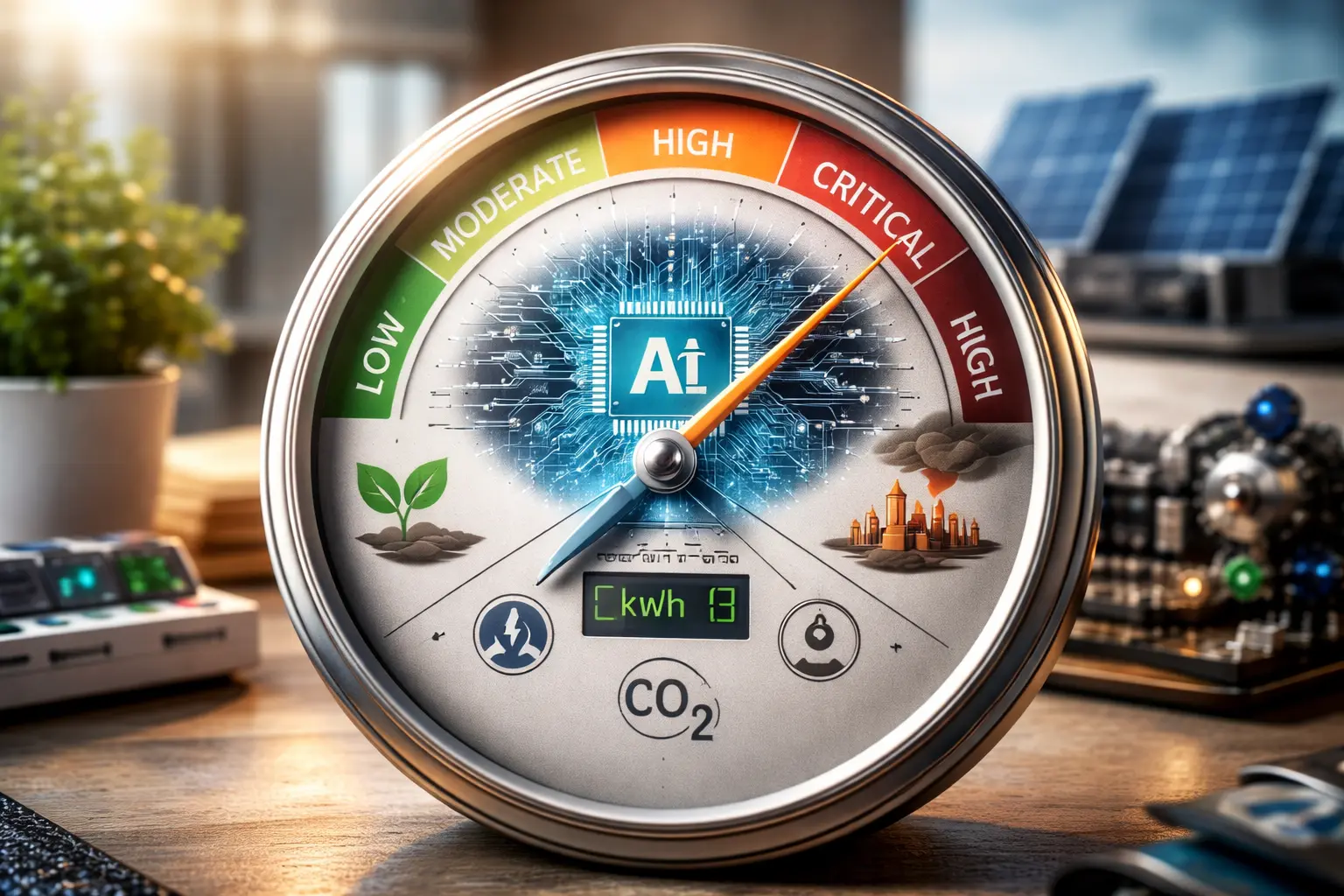
As an example, some estimates suggest that generating an image with AI consumes on average a few watt-hours of energy — modest at small scale, but significant as volumes grow.
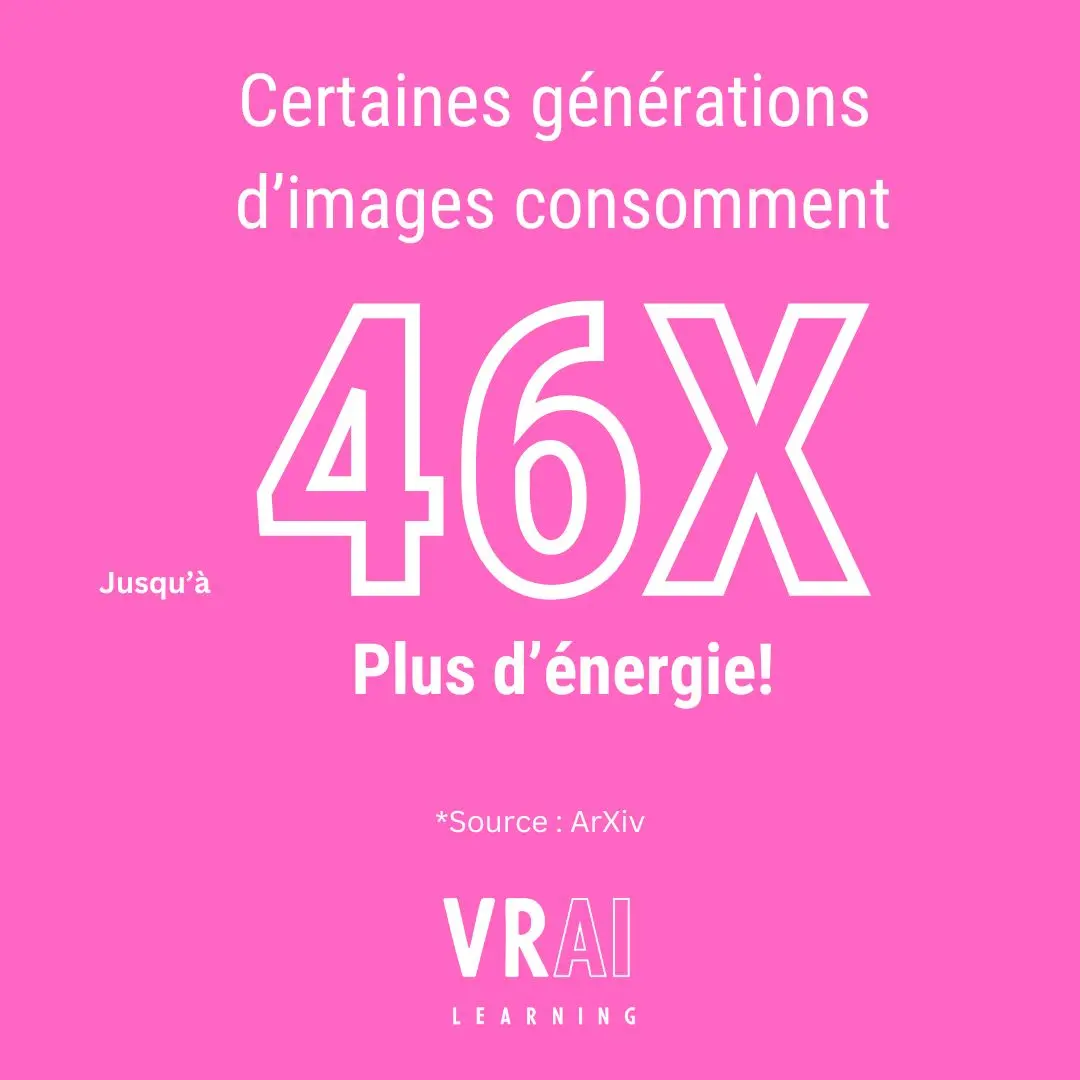
Recent research also shows that some image-generation models can consume up to 46 times more energy than others to produce a comparable result*.
Not all AIs are equal when it comes to energy consumption...
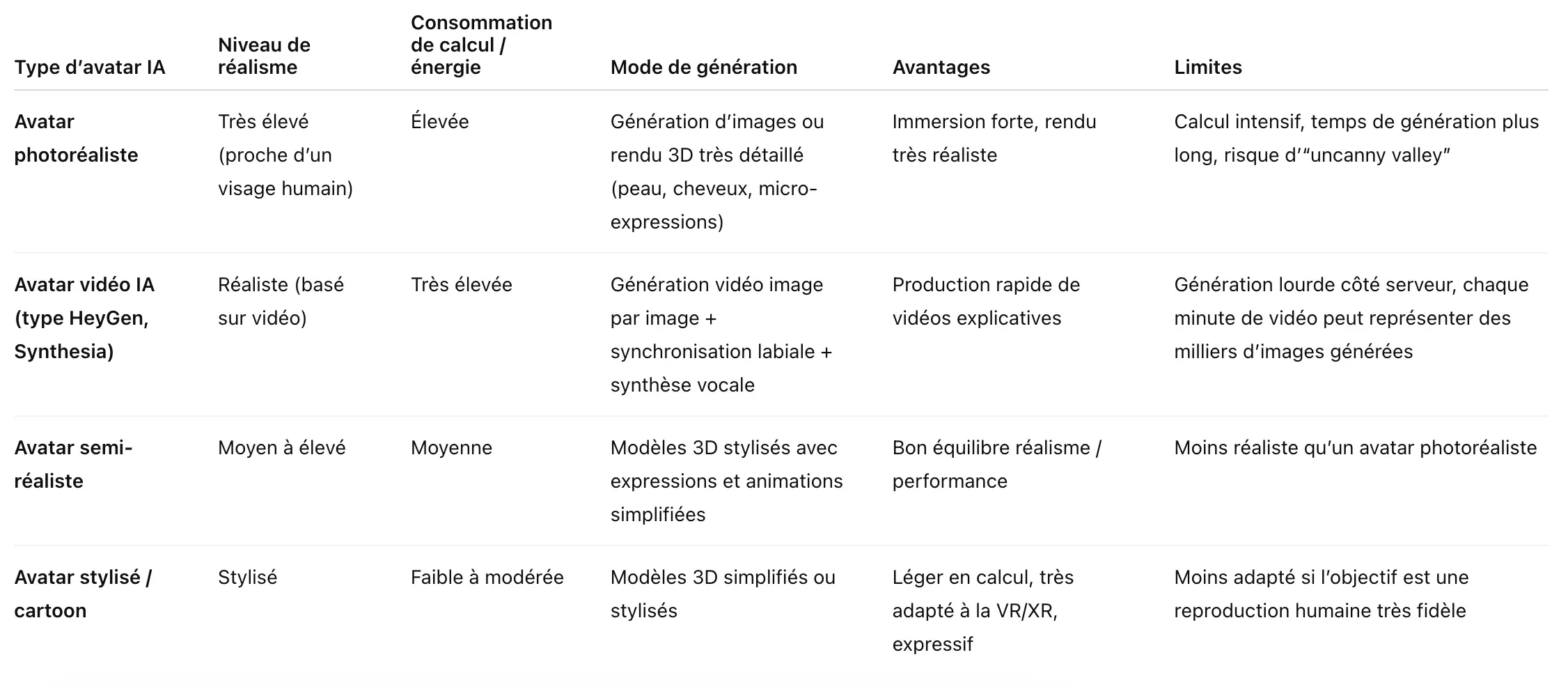
Photorealistic, stylised, or video avatars: different impacts
Not all AI avatars require the same level of computation.
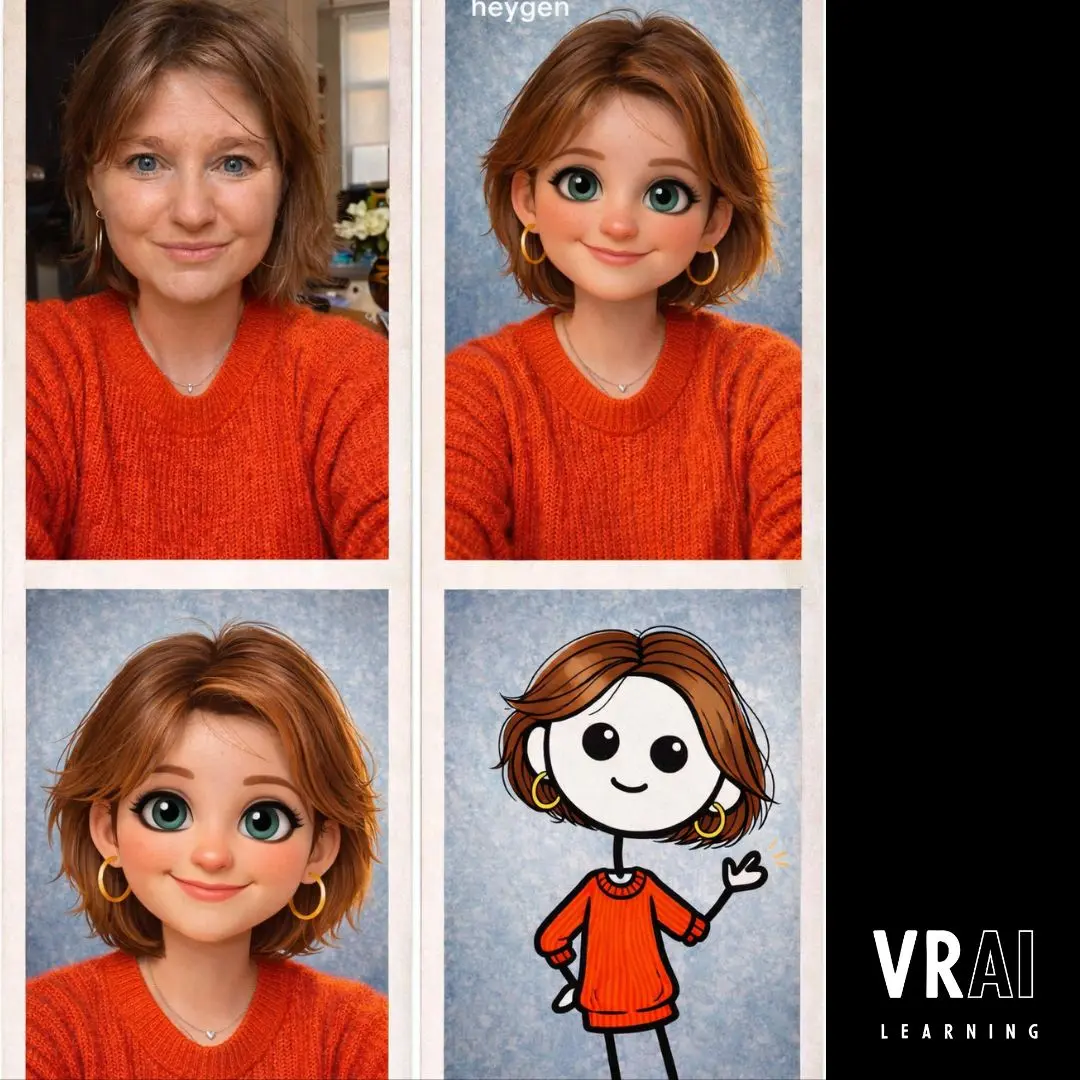
Photorealistic avatars aim to reproduce the human face with a very high level of detail: skin texture, hair rendering, micro-expressions, realistic lighting. This level of precision increases the computing power required.
Some platforms also offer AI-generated video avatars, where the system produces a complete video from a text prompt. In this case, the AI generates a large number of images to create the animation. A single minute of video can represent thousands of generated images.
By contrast, stylised or semi-realistic avatars generally require fewer resources. They remain expressive and effective at conveying a message, while being lighter to produce and deploy.
In immersive environments such as VR or XR, this choice can also improve technical performance and the accessibility of experiences.
Our choice: efficient and responsible avatars
At VRAI Learning, even though we know how to build photorealistic models, we make a clear choice: favouring cartoon or semi-realistic avatars over fully photorealistic ones.
This choice is driven by several reasons:
First, these avatars are better suited to immersive environments such as VR or XR. They are more legible, more expressive, and often better accepted by users.
But there is also an environmental reason!
Stylised avatars require less computation, fewer graphical resources, and less energy than ultra-realistic avatars. In projects deployed to large numbers of learners, this difference matters.
We are fully aware that AI remains an energy-intensive technology. The goal is not to claim it is environmentally neutral, but to make choices that limit its impact wherever possible.
Innovating without forgetting responsibility
The question is not whether to abandon AI. It brings considerable benefits to training: personalisation, interactivity, accessible content, and new pedagogical formats.
The real question is: how do we use these technologies responsibly?
At VRAI Learning, this translates into several principles:
choosing technologies suited to their intended use, avoiding unnecessary computation, favouring efficient designs over technological one-upmanship, and gradually integrating environmental considerations into our design decisions.
Innovation should not only be spectacular. It should also be sustainable and relevant.
And sometimes, a slightly less realistic avatar can create equally engaging experiences… with a more controlled environmental impact 😃
Source * ARXIV-Cornell University
\n\n
How much energy does an AI avatar consume in training compared to in-person training?
\n
The comparison between in-person training and AI avatar-based training must account for all emission sources. A day of in-person training generates on average between 10 and 50 kg of CO₂ per participant, depending on distance travelled, accommodation, and catering. Travel typically represents 70 to 80% of that total.
\n
By contrast, an online training session using an AI avatar mainly consumes electricity: on the user side (device, network) and on the server side (model inference, 3D rendering). For a cartoon or semi-realistic avatar, inference is significantly lighter than for a real-time photorealistic avatar. Consumption is estimated at a few watt-hours per 30-minute session.
\n
By eliminating travel, digital training with AI avatars can reduce the carbon footprint per learner by 60 to 90%. This environmental gain is real — provided you choose technologies designed for efficiency, not for maximum visual effect.
\n\n
How does VRAI Learning measure the carbon footprint of its AI solutions?
\n
VRAI Learning integrates environmental considerations from the design phase of its modules. Several criteria are systematically evaluated: the type of avatar used (cartoon vs photorealistic), the frequency of calls to generative AI models, the size of 3D assets, and the deployment mode (shared cloud, on-premise, or standalone headset).
\n
On the technical side, the cartoon and semi-realistic avatars selected by VRAI Learning require less computing power at inference than real-time photorealistic avatars. This saving translates into a reduction in GPU resources mobilised and, ultimately, in electricity consumption per session.
\n
VRAI Learning also relies on hosting providers whose data centres are powered by renewable energy, and optimises the size of experiences to limit bandwidth usage. These choices are documented and can be shared with the CSR teams of clients who request it.
\n\n
Can VR and AI training be done in an eco-responsible way?
\n
Yes — provided you do not confuse technological innovation with digital excess. Immersive VR and AI training is eco-responsible when every technical choice is justified by the pedagogical value it produces, not by the "wow" effect.
\n
In practice, this means: choosing avatars whose visual style matches the content (cartoon for soft skills simulations, semi-realistic for technical gestures), avoiding ultra-high-definition real-time rendering when lower quality suffices, optimising assets to reduce loading times and bandwidth, and deploying on lean devices (standalone headsets, WebGL browser) rather than energy-intensive workstations.
\n
VRAI Learning has made these trade-offs a guiding principle of its product development. The goal: to deliver engaging immersive experiences — for learners as well as enterprise and SMB clients — without compromising on a credible and measurable CSR approach.
\n\n
FAQ — AI Avatars, VR and carbon footprint
\n\n
Is the carbon footprint of AI training really lower than that of in-person training?
\n
In the vast majority of cases, yes. In-person training generates significant emissions from travel (70 to 80% of the carbon footprint), accommodation, and physical infrastructure. Digital training with AI avatars eliminates these sources. Its consumption is limited to the electricity used by servers and user devices. For optimised avatars such as those used by VRAI Learning, this consumption is low per session. The carbon saving per learner can reach 60 to 90%, depending on the travel scenario being replaced. Remote training is not without impact, but it remains significantly leaner than its in-person equivalent whenever the distances involved are substantial.
\n\n
What is the energy consumption difference between a photorealistic and a stylised avatar?
\n
A photorealistic avatar animated in real time mobilises considerable computing resources: high-resolution rendering, facial expression simulation via deep learning models, synchronised voice generation, and sometimes on-the-fly video compression. The inference of these models requires powerful GPUs, which translates into high electricity consumption per session. A stylised avatar (cartoon, semi-realistic) relies on lighter 3D geometries and less complex animation models. The GPU load is reduced, computation times are shorter, and consumption per interaction is significantly lower. This reasoning guided VRAI Learning's design choices: prioritising pedagogical effectiveness with a controlled environmental impact.
\n\n
What is VRAI Learning's concrete CSR commitment on its AI and VR solutions?
\n
VRAI Learning translates its CSR commitment into documented technical decisions. First pillar: the deliberate choice of cartoon and semi-realistic avatars, less energy-intensive than photorealistic avatars, without compromising on learner engagement. Second pillar: the systematic optimisation of 3D assets and AI model calls to reduce consumption per session. Third pillar: deployment on cloud infrastructure with a controlled carbon footprint. These choices are consistent with the CSR policies of the large enterprises and SMBs that work with VRAI Learning, and can be formalised in their clients' sustainability reports on request. The ambition is clear: immersive innovation must be sustainable, not just spectacular.
\n

Christèle Simeoni
Co-founder VRAI Learning (2023) · CMO
Co-fondatrice de VRAI Learning, spécialiste de la formation immersive VR et des avatars IA conversationnels.
See immersive training in action
Personalised demo, no commitment. We show you what it looks like for your context.
Book a demoExplore our solutions