CS
Christèle Simeoni
Co-founder & CMO, VRAI Learning
Last updated: March 2026 | By VRAI Learning | Reading time: 12 min
Introduction: why AI avatars are changing the game in training
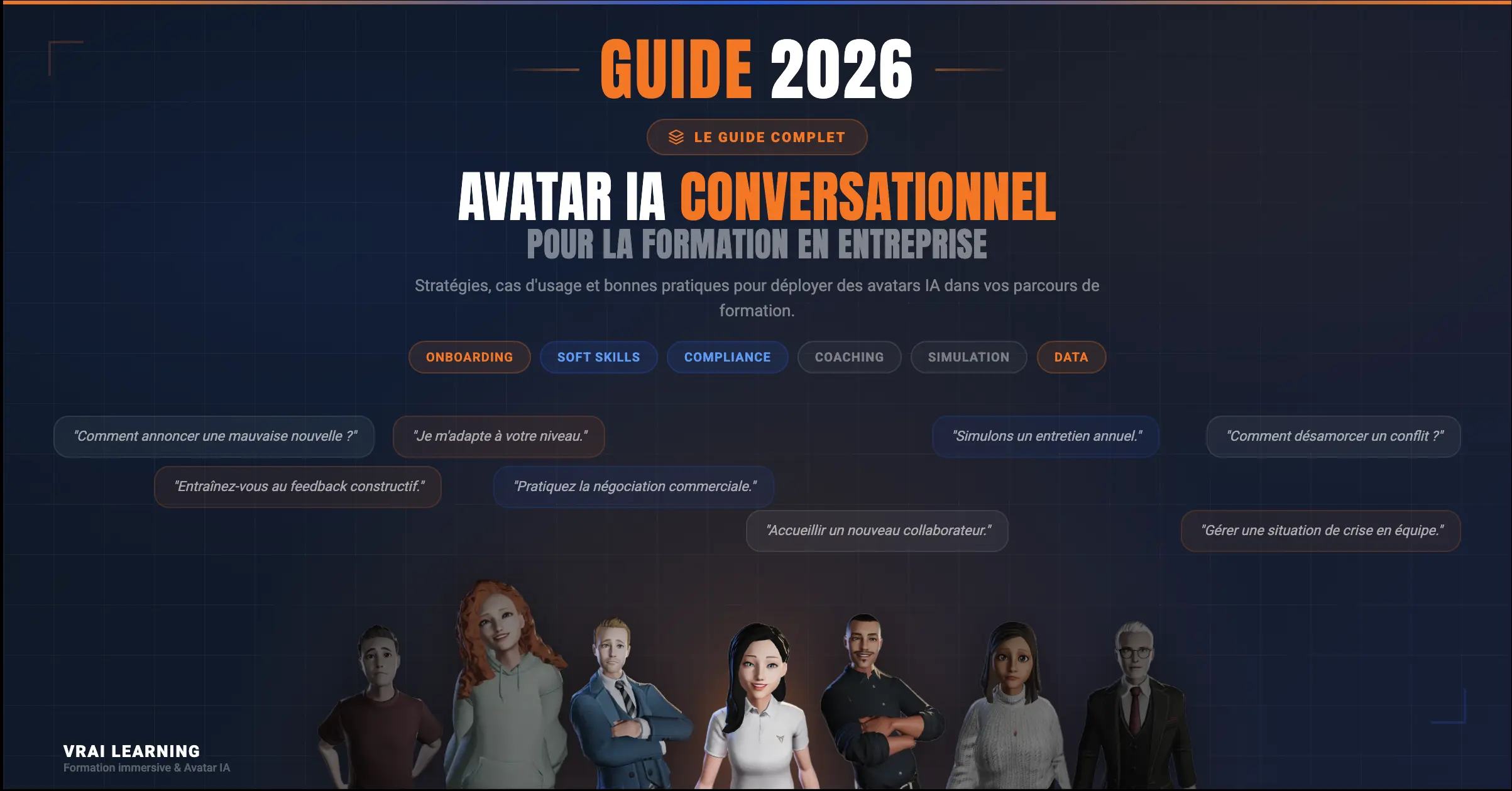
Professional training is going through a deep transformation. Traditional methods — classroom sessions, static e-learning, fixed videos — are showing their limits against more demanding learners, dispersed teams, and organisations that need to train fast, well and at scale.
Conversational AI avatars (these agents rely on advances in generative artificial intelligence to adapt their responses to each learner in real time) are now establishing themselves as a concrete answer to these challenges.
Not as a technological gimmick, but as a genuine instructional tool that changes the relationship between the learner and their training journey.
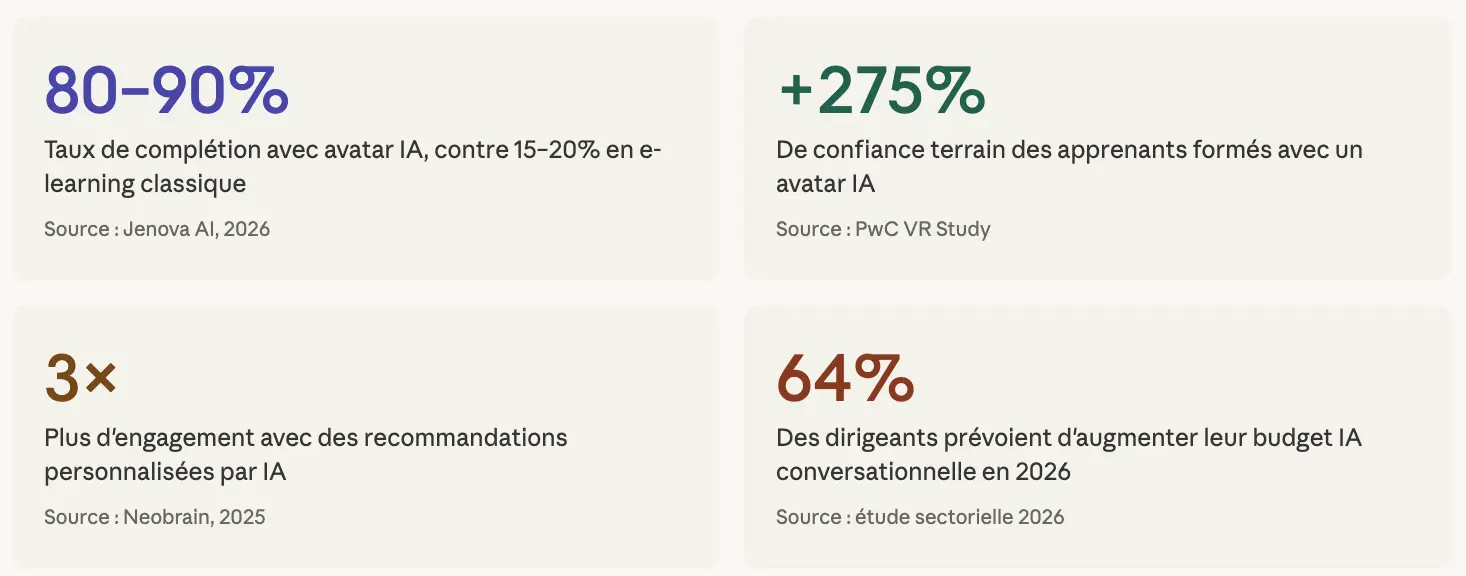
In 2026, the numbers speak for themselves:
- Training programmes using AI avatars reach completion rates of 80 to 90%, compared with 15 to 20% for traditional e-learning (Jenova AI, 2026)
- Practising with an AI avatar makes learners up to 275% more confident in applying their skills (PwC VR Study)
- 64% of executives plan to increase their conversational AI budgets in 2026 (industry study)
- AI-personalised recommendations generate 3x higher engagement than traditional training (Neobrain, 2025)
This guide is for training managers, HR directors, innovation directors and managers who want to understand what an instructional AI avatar actually is, how it works, where it delivers real value, and how to deploy one in their organisation!
Table of contents
- What is a conversational AI avatar?
- Information AI avatar vs. training AI avatar: the essential distinction
- How does an instructional AI avatar work?
- The most effective use cases in business
- The measurable benefits for your organisation
- How to choose your training AI avatar
- Deployment: where to start?
- Frequently asked questions
1. What is a conversational AI avatar?
A conversational AI avatar is a virtual character — in 2D or 3D — animated in real time by generative artificial intelligence. Unlike a video or a text-based chatbot, it combines:
- A visual presence: a face, expressions, gestures, a natural voice
- Adaptive intelligence: it listens, understands, responds and adjusts to the learner's profile
- Conversational memory: it remembers previous exchanges and evolves the learning path accordingly
The avatar doesn't read from a script. It has a dialogue. It asks questions, corrects mistakes, adjusts difficulty, and gives immediate, personalised feedback. It's this real-time interaction capability that fundamentally sets it apart from every existing e-learning format.
Key takeaway: a conversational AI avatar is not an interactive video, nor an upgraded chatbot. It's an instructional agent capable of holding a genuine dialogue with the learner, adapting its behaviour, and measuring progress.
2. Information AI avatar vs. training AI avatar: the essential distinction
The AI avatar market today is structured around two broad families that many businesses confuse — to the detriment of their ROI.
The information avatar
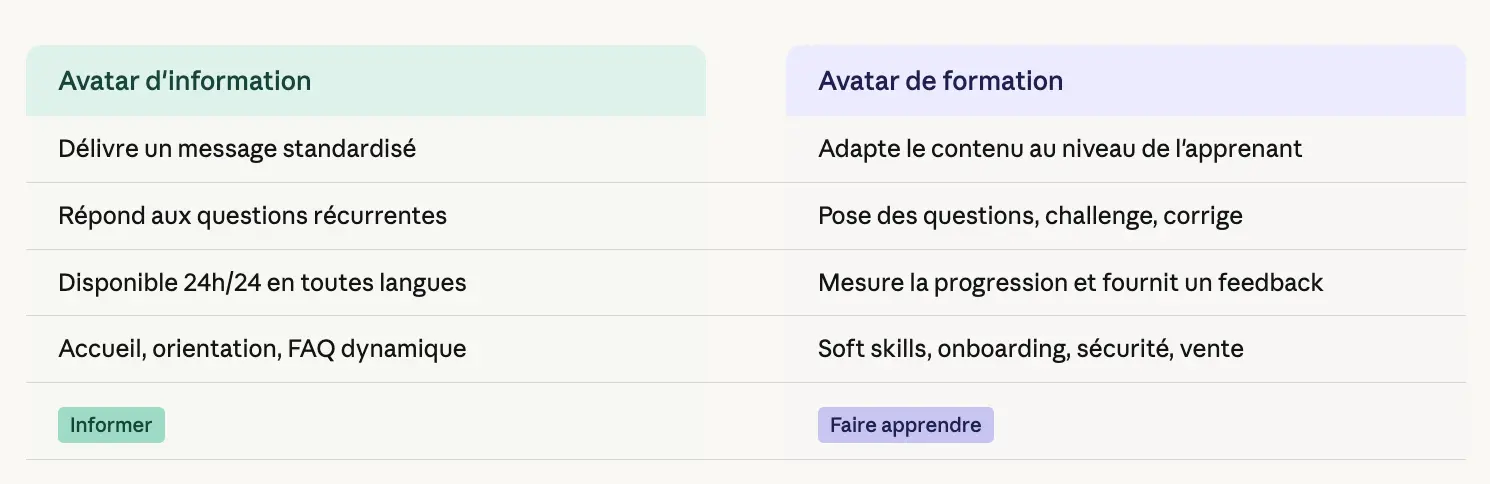
It delivers a standardised message that's smooth and scalable. It guides, directs, and answers recurring questions. It doesn't deeply adapt to the person it's talking to. This is the reception avatar in a government office, the virtual assistant at a train station, the guide in a showroom.
Strengths: fast deployment, controlled cost, available 24/7 in every language Limitation: it doesn't learn, doesn't challenge, and doesn't measure progress
The training avatar
It interacts, corrects, adjusts to the learner's level, and measures their progress. It analyses answers, identifies gaps, and adapts difficulty in real time. It can play a difficult customer, a demanding manager, an expert technician. This is the one that "teaches", not just informs.
Strengths: measurable instructional impact, deep personalisation, unlimited repetition without tying up a human trainer Who it's for: training managers, training organisations, companies with large-scale upskilling needs
The classic mistake: buying an AI avatar "because it's trendy" without defining the instructional objective. An information avatar doesn't replace a training avatar — and vice versa. Confusing the two means investing in the wrong tool for the wrong use case.
3. How does an instructional AI avatar work?
The technology stack
A training AI avatar relies on several interlocking layers of technology:
1. The conversational engine (LLM) A large language model (GPT, Claude, Mistral…) processes what the learner says and generates a contextual, instructionally appropriate response.
2. The RAG system (Retrieval-Augmented Generation) The avatar doesn't answer "from memory" with generic information. It relies on the documents, procedures and content supplied by the organisation — product sheets, safety protocols, sales scripts, role frameworks. No hallucination is possible: the avatar only says what it has learned from your sources.
3. The real-time 3D animation engine It synchronises lip movements, facial expressions and gestures with the generated voice. This is what gives the avatar its "alive" quality and creates a sense of human presence.
4. The instructional management platform It lets the trainer define scenarios, follow conversations in real time, analyse KPIs, and adjust content. This is the "cockpit" of the experience.
What the learner sees
The learner has a natural conversation — by voice or in writing — with an avatar that asks them questions, puts them in role-play situations, challenges their answers, and gives them immediate feedback. Progression is adaptive: if the learner has mastered a topic, the avatar speeds up. If gaps appear, it slows down, re-explains, and offers additional exercises.
Available devices
Instructional AI avatars are accessible on:
- VR headset — for 360° immersive experiences, particularly effective for high-risk training or complex role-play scenarios
- Browser-based computer access — for simple integration into existing LMS platforms
- Tablet and smartphone — for mobile, flexible learning
- Interactive kiosk — for physical training spaces, reception halls or corporate training corners
This multi-device accessibility is a decisive advantage for organisations training geographically dispersed teams.
4. The most effective use cases in business
AI roleplay: design, practise, debrief
Roleplay is the core mechanism that makes an AI avatar genuinely effective at training, rather than just a scripted chatbot. Unlike a traditional e-learning module, roleplay puts the learner in the situation: they have to react in real time to a counterpart with their own personality, objections and emotional reactions. The methodology unfolds in three stages.
1. Design the scenario: the trainer or subject-matter expert defines the avatar's persona (role, tone, difficulty level), the context of the situation (a sales negotiation, a difficult annual review, conflict management), and the precise instructional objectives to be assessed. With a no-code authoring tool like Avatar Academy, this step requires no technical skills at all: the scenario is built by describing it in natural language, with no code involved.
2. Practise under real conditions: the learner talks with the avatar by voice or text, as many times as needed, with no judgment or social pressure. The avatar adapts to answers in real time: it can toughen its stance, introduce an unexpected objection, or, conversely, reward a good answer — exactly as a real counterpart would.
3. Debrief with concrete data: every session generates a behavioural analysis (confidence, stress, assertiveness, empathy) and a detailed score. The manager or trainer then has objective data to guide the debrief, rather than relying on a general impression.
This structured approach sets AI roleplay apart from a simple "AI-assisted role-play game": it's a repeatable, measurable process that can be tailored to any role, any sector and any seniority level.
Soft skills and customer relations
This is the most documented and most effective use case. The avatar plays a difficult customer, a hesitant prospect, a confrontational counterpart. The learner has to handle the situation in real time, facing a counterpart that reacts authentically.
Concrete example: a banking network trained 420 advisors on managing demanding customers. The avatar "Sophie" embodies a range of profiles. Measured result: +275% real-world confidence, 76% of advisors prefer training with the avatar over a human trainer.
Onboarding new employees
The avatar guides new hires through procedures, company culture, and internal tools — at their own pace, without tying up HR staff or a manager. It can answer questions continuously, 24/7, and check understanding at every step.
Measured result: -42% procedural stress during onboarding, faster upskilling in the first few weeks.
Training on technical gestures and safety
The avatar guides the learner step by step through critical procedures. In a VR environment, it can simulate dangerous situations with no real risk. In AR (augmented reality), it supports the technician directly at their workstation.
Measured result: 95% retention of safety procedures compared with 62% for e-learning, and -73% training time.
Management and leadership
The avatar plays the role of a struggling employee, a conflict-ridden team, or a demanding manager. The manager learns to give difficult feedback, conduct a hard conversation, and manage a crisis — in a safe environment where mistakes cost nothing.
Regulatory and compliance training
GDPR, fire safety, workplace harassment, code of conduct… The avatar makes sure every employee has properly understood and absorbed their legal obligations, with a conversational quiz and an automated certificate.
Institutional reception and welcome
Government offices, universities, train stations, town halls: the avatar welcomes the public, answers recurring questions in several languages, and redirects visitors to the right person. Measured result in one government office: -52% questions to staff, +41% user satisfaction.
5. The measurable benefits for your organisation
Instructional impact
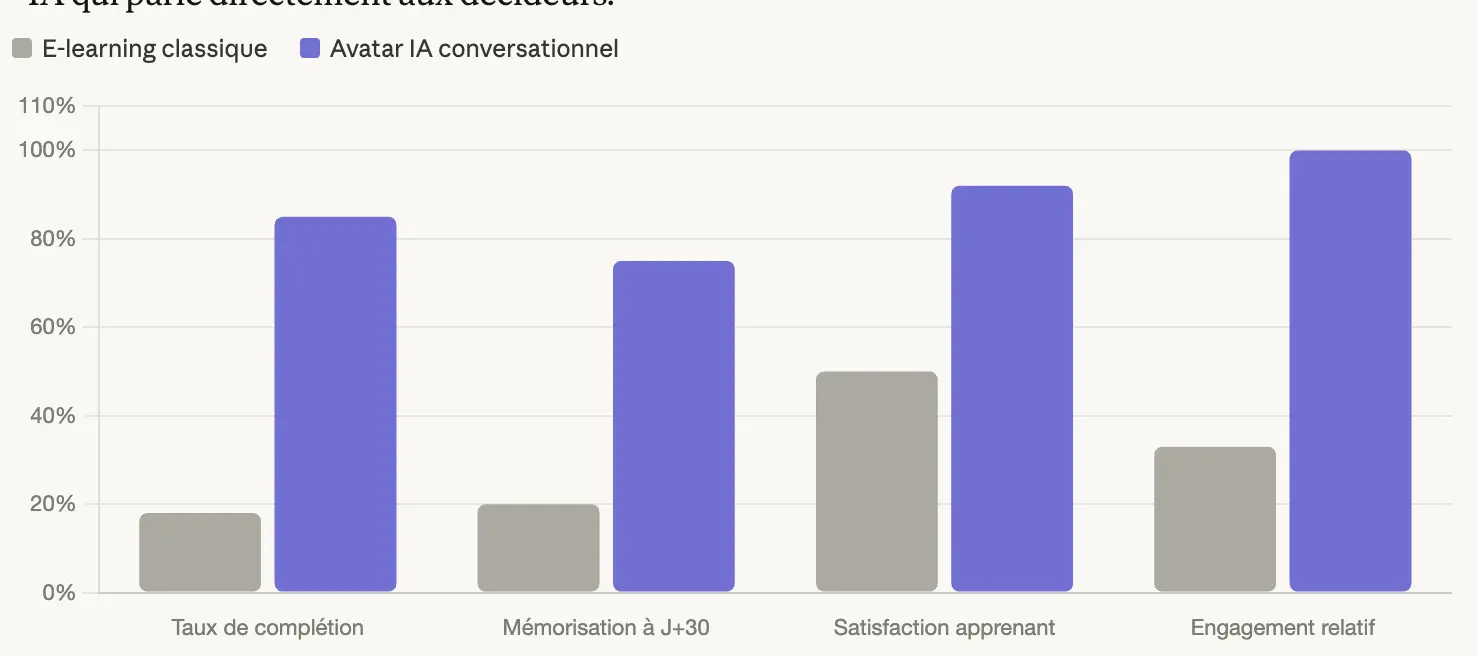
Indicator
Traditional e-learning
Training with AI avatar
Completion rate
15–20%
80–90%
Retention at day 30
~20%
70–80%
Real-world confidence
Baseline
+275%
Learner satisfaction
~50%
>90%
Engagement
Baseline
3x higher
Sources: PwC VR Study, Jenova AI 2026, Neobrain 2025, VRAI Learning client data
Operational impact
Scalability: an avatar can train hundreds of employees simultaneously, across every site, with no scheduling or travel constraints. A single experience, once built, can be deployed infinitely.
Standardisation: every employee receives exactly the same baseline training, regardless of location. Best practices are transmitted identically everywhere.
Availability: the avatar is available 24/7, in every language. It doesn't get tired, doesn't judge, and starts again as many times as needed.
Measurement: unlike in-person training, every interaction is tracked. Organisations get precise data on progression, areas of difficulty, time spent, and error patterns.
Financial impact
The ROI of deploying AI avatars for training is built on several levers:
- Reduced logistics costs (travel, venue hire, mobilising trainers)
- Reduced training time (-73% in some field cases)
- Fewer errors and accidents linked to insufficient training
- Large-scale standardisation with no additional marginal cost per learner
Organisations that have deployed conversational AI solutions for training report an ROI of 300 to 500% in the first year (2026 industry data).
6. How to choose your training AI avatar
The 5 essential criteria
1. The provider's instructional design expertise Technology is secondary if pedagogy is missing. A good training avatar is designed by instructional designers, not just developers. Check that the provider has a genuine culture of professional training.
2. Real customisation Appearance, voice, role, personality, tone, injected content — everything should be customisable to fit your world, your procedures and your objectives. Be wary of overly generic "turnkey" solutions.
3. RAG technology The avatar should rely on your own documents and resources, not on generic data from the internet. RAG guarantees the relevance and confidentiality of exchanges.
4. Steering and measurement tools A management platform should let you follow learning paths in real time, access conversation transcripts, and analyse both classic KPIs (completion, scores) and emotional ones (areas of confusion, detected stress).
5. GDPR compliance Conversation data is sensitive. Check that data is hosted in Europe, that the provider is GDPR-compliant, and that conversations aren't used to train third-party models.
Questions to ask a provider
- What's your track record in professional training (not just generic avatars)?
- How does RAG work, and where is the data hosted?
- Can the avatar be integrated into our existing LMS?
- How long does it take to build a first scenario?
- How does follow-up and optimisation work after deployment?
- What's your instructional approach to designing scenarios?
7. Deployment: where to start?
Step 1 — Define the precise instructional objective
First and foremost, clarify: what behaviour or skill do you want the learner to develop? "Train on soft skills" is too vague. "Train advisors to handle a customer disputing their bill" is actionable.
Step 2 — Choose the pilot use case
Start with a single use case, on a limited scope (one team, one site), with clear, measurable objectives. Onboarding or customer relations training are generally good first pilots: results come quickly and are easy to measure.
Step 3 — Co-build the scenario with subject-matter experts
The avatar plays a role defined by your trainers, managers and experts. Designing the scenario is a critical step: the lines, the situations, the expected mistakes and the feedback need to be crafted by training professionals, not generated automatically.
Step 4 — Deploy, measure, iterate
Launch the pilot, collect data (completion rate, scores, conversation transcripts), identify areas for improvement, and adjust the scenario. An AI avatar improves over time — it's a living tool, not fixed content.
Step 5 — Extend to other modules and audiences
Once the pilot is validated, gradually roll out to other use cases, other teams, other sites. Scalability is precisely the solution's main advantage.
8. Frequently asked questions
Can an AI avatar replace a human trainer?
No, and that isn't the goal. The AI avatar complements the human trainer: it standardises content, allows unlimited practice without tying up an expert, and frees the trainer up for high-value interactions — individual coaching, group facilitation, managing complex situations. The two are complementary, not competing.
How long does it take to create a training avatar?
For a simple module with a defined scenario, a few weeks is enough. For a full learning path with complex scenarios and deep customisation, plan for 2 to 3 months. In every case, the instructional design phase takes longer than the technical phase.
Are AI avatars reserved for large companies?
No. While large companies were the first to adopt the technology, today's solutions are also aimed at SMEs and mid-sized companies. The pilot-based approach lets you start with a controlled budget and expand based on results.
How do you measure the effectiveness of an AI avatar in training?
Key indicators include: the completion rate of the learning path, the average assessment score, time spent per module, the rate of recurring errors, and the progression of real-world confidence measured in actual situations. Advanced platforms also let you analyse conversation content to detect areas of confusion or resistance.
Does the avatar comply with GDPR?
Yes, provided you choose a provider that hosts data in Europe and uses RAG technology (exchanges rely on your documents, not on stored personal data). Always check the terms for processing conversational data.
Can an avatar be integrated into an existing LMS?
Yes. Instructional AI avatars integrate with most LMS platforms on the market via standard formats (SCORM, xAPI, LTI). The learner accesses the experience directly from their usual learning path, with no need to switch environments.
What does a training AI avatar cost?
It varies depending on the level of customisation, the number of scenarios, learner volumes, and the steering features required. ROI is built on reduced training logistics costs, large-scale standardisation, and measured gains in field performance. Most organisations reach the break-even point before the end of the first year.
Conclusion
Conversational AI avatars are no longer an experimental technology. They have become a mature, measurable answer to the challenges of modern professional training: declining engagement, rising costs, dispersed teams, and the need for large-scale standardisation.
The key to success isn't the sophistication of the technology, but the quality of the instructional design process behind it. A good training avatar is, above all, a good scenario — designed by experts who understand both the business challenges and the mechanics of learning.
At VRAI Learning, we combine 20 years of instructional design expertise with the latest technologies in AI avatars and virtual reality. We support organisations from A to Z — from defining objectives through to deployment and impact tracking.
Want to explore how an AI avatar could transform your training programme? Request a demo →
Sources: PwC VR Soft Skills Training Efficacy Study (store.pwc.fr) · Jenova AI Conversational Role-Playing AI Report 2026 (jenova.ai) · Neobrain AI in HR Statistics 2025 (neobrain.io) · Focus AI Statistiques IA en entreprise 2026 (focus-ai.fr) · VRAI Learning client data · Learning Technologies France 2026 (learningtechnologiesfrance.com) · Cegos Learning Technologies 2026 (cegos.fr), SavoirIA

Christèle Simeoni
Co-founder VRAI Learning (2023) · CMO
Co-founder of VRAI Learning, specialist in immersive VR training and conversational AI avatars.
See immersive training in action
Personalised demo, no commitment. We show you what it looks like for your context.
Book a demoExplore our solutions