
CS
Christèle Simeoni
Co-founder & CMO, VRAI Learning
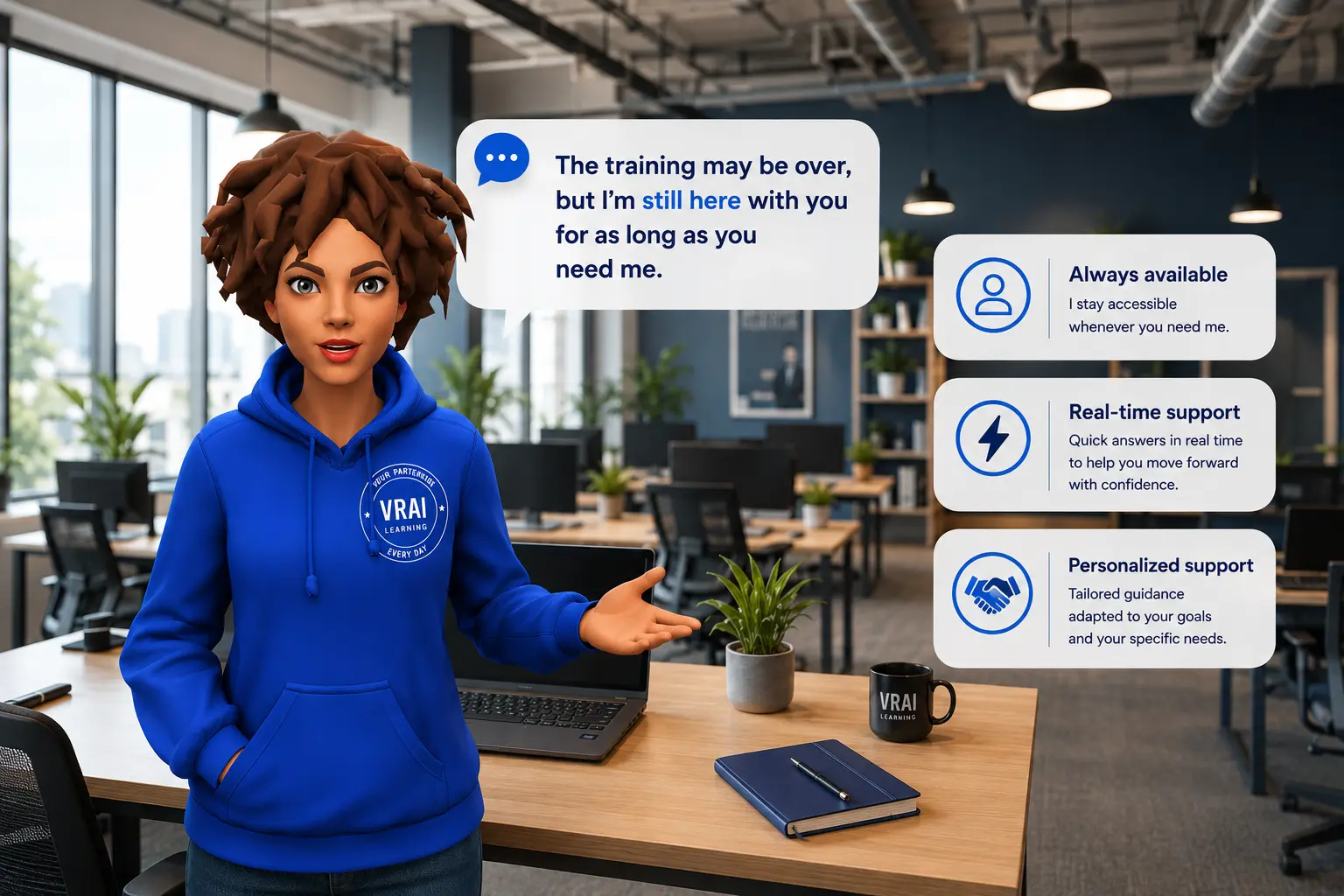
With an avatar, do you feel less alone when learning? The concept of felt presence with a conversational avatar — a new dimension of user engagement. But how do you turn a conversational AI avatar into an interactive companion?
One of the most fascinating innovations of recent years is the emergence of conversational avatars: genuine digital humans capable of simulating rich, immersive interactions with users. This concept goes far beyond a simple technological tool — it's an experience that redefines the relationship between human and machine, creating a genuine sense of presence and engagement.
The conversational avatar: a digital companion for interaction
A conversational avatar is far more than a classic user interface. It can resemble a "human" — in appearance and behaviour — and react in real time to questions, expressions or needs of its interlocutor. This balance between humanisation and technology offers a unique immersive experience: users feel like they're talking to a real person!
This feeling is reinforced by the conversational avatars' ability to simulate emotions, personalise interactions and adapt to varied contexts. These digital companions don't just provide answers — they become virtual companions that create an engaging, stimulating environment.
An interactive presence to transform digital interactions
One of the most remarkable effects of conversational avatars is their ability to reduce the loneliness often associated with digital experiences. Whether at a computer or in an immersive environment like VR, the presence of a connected conversational avatar transforms the experience.
In online training, users can interact with an avatar that not only delivers content but also listens, motivates and personalises learning according to individual needs. The goal is to create a dynamic close to that of an in-person trainer — making learning more engaging and less isolating.
In immersive environments like medical simulations or serious games, the avatar plays a key role as a human reference point, facilitating decision-making and increasing user confidence. This real presence amplifies the overall experience, reinforcing engagement and interaction effectiveness.
Creating value for clients and users
The adoption of conversational avatars generates significant value for organisations and users:
- Improved engagement: human-like avatar interactions increase user interest and attention. More interactive and personalised experiences make users more likely to stay involved.
- Optimised learning: in training, conversational avatars can adapt their pedagogy to user needs, improving knowledge retention and satisfaction.
- Cost reduction: for organisations, a conversational avatar can play the role of guide, trainer or client assistant — reducing human resource needs while ensuring quality service.
- Creating a memorable experience: by bringing a human touch to automated processes, conversational avatars contribute to creating positive memories, reinforcing client loyalty.
A small revolution in progress?
Perhaps! The concept of a conversational avatar's presence embodies a genuine revolution in our interactions with technology. By humanising digital experiences, these digital humans reduce the distance between user and machine, creating deep and authentic connections.
Whether in training, customer support or creating immersive experiences, conversational avatars redefine what's possible with technology. They bring unique added value — not just meeting users' functional needs but enriching the human aspect of every interaction. The future of digital interactions is already here, and it's surprisingly human.
Concrete examples?
In online training, a conversational avatar can take several concrete forms:
- Personalised tutoring: the avatar acts as a virtual coach adapting content and exercises to the learner's progress, providing immediate feedback and encouraging at every step.
- Interactive sessions: in language training, the avatar can simulate real-time dialogues to practise a language, correcting pronunciation or grammar errors supportively.
- Support in complex scenarios: in medical training, the avatar can play the role of a virtual patient presenting symptoms to analyse, letting learners practise safely.
Why is loneliness a failure factor in digital training?
Loneliness is one of the first barriers to online course completion. Without an interlocutor, without immediate feedback, the learner quickly loses motivational thread. Studies on e-learning show that over 70% of enrolees don't reach the end of an autonomous path. This abandonment rate is largely explained by the feeling of isolation: learning alone in front of a screen, without human validation, without encouragement or real-time redirection, generates cognitive and emotional fatigue that discourages perseverance.
This is not a lack of willpower — it's a natural response to an environment that doesn't respond. The human brain is wired to learn in social interaction: the presence of another, even simulated, activates mechanisms of attention and engagement far more powerful than simple passive reading or viewing. Integrating a conversational avatar into a digital path is precisely about restoring to the learner the feeling of being accompanied — and therefore of continuing.
Can a conversational avatar truly create an emotional bond with the learner?
Yes — and this is where the essential value of an embodied AI avatar lies. Unlike video content or an automatic quiz, a conversational avatar generates non-verbal signals — gaze, micro-expressions, intonations, gestures — that trigger a real emotional response in humans. This phenomenon, documented in social psychology, is called the social presence effect: it's enough to perceive an entity as responsive and attentive for our brain to integrate it as a legitimate interlocutor.
At VRAI Learning, AI avatars are designed to go beyond the script. Generative interaction — unplanned, built in real time according to what the learner says — creates a sense of authenticity difficult to obtain otherwise. The learner doesn't perceive a pre-recorded response; they perceive attentiveness. This nuance changes everything: it transforms a pedagogical tool into a learning companion, and the act of learning into a memorable experience rather than an obligation to fulfil.
What is the difference between a conversational AI avatar and a simple chatbot?
A chatbot responds. A conversational AI avatar interacts. The distinction is fundamental. A chatbot is a rule-based or keyword-recognition system: it selects a response from a decision tree and displays it as text. It has no face, no body, no temporality. It doesn't perceive your hesitation, doesn't notice you rephrased the same question twice.
A conversational AI avatar, by contrast, mobilises several technological layers simultaneously: natural language understanding, contextual response generation, expressive voice synthesis, synchronised facial and body animation. The result is an entity that speaks, looks, reacts and adapts in real time. For training, this difference is decisive: the avatar can detect that a learner hasn't understood, follow up with a reformulation, congratulate a good answer with a smile. It creates a living pedagogical dynamic, where the chatbot merely delivers information. VRAI Learning deploys these avatars in 62 languages, on VR, PC, tablet and smartphone.
Frequently asked questions about conversational avatars in training
Is the sense of presence with an AI avatar real or illusory?
The sense of presence felt facing a conversational AI avatar is neurologically real, even though the interlocutor is digital. Neuroscience and social psychology research shows that the human brain activates the same zones involved in social interaction as soon as an entity responds coherently, looks in its direction and modulates its expression. This is not an illusion in the deceptive sense: it's an adaptive response.
The VRAI Learning avatar, through its non-verbal signals (intonations, gaze, gestures) and generative non-scripted responses, triggers this presence effect sustainably. Result: the learner engages more, retains better, and completes their path. The feeling is constructed — but its effects on learning are concrete and measurable.
What is the engagement rate of an AI trainer avatar compared to classic e-learning?
Training courses integrating a conversational AI avatar show significantly higher engagement and completion rates than classic e-learning modules (slides, videos, quizzes). Indicatively, paths with avatar achieve completion rates 30–50% higher than asynchronous formats without interaction. The explanation is simple: the learner cannot skip an interlocutor who challenges, reformulates and awaits their response.
The conversational dynamic creates a soft obligation to participate. Add real-time personalisation mechanisms — the avatar adapts pace, difficulty and tone to responses — keeping the learner in an optimal learning zone. For organisations, this translates to better training ROI and reduced need for catch-up or re-training sessions.
In which languages can a VRAI Learning trainer avatar interact?
VRAI Learning conversational avatars are available in 62 languages, covering all major European, Asian, African and American languages. This multilingual coverage is particularly strategic for internationally-focused organisations wanting to deploy uniform training at global scale, without multiplying versions or local trainers. Each avatar speaks the learner's language with natural voice synthesis and adapted expressions — no robotic accent.
Interactions remain generative in each language: the avatar understands and responds in real time, regardless of the chosen language. A single training content can thus be deployed simultaneously in French, English, Spanish, Mandarin, Arabic or Portuguese — with a homogeneous, quality learner experience in each of these languages.

Christèle Simeoni
Co-founder VRAI Learning (2023) · CMO
Co-fondatrice de VRAI Learning, spécialiste de la formation immersive VR et des avatars IA conversationnels.
See immersive training in action
Personalised demo, no commitment. We show you what it looks like for your context.
Book a demoExplore our solutions