Christèle Simeoni
9 min min read
Captivating, learning, succeeding: How to combine image quality and storytelling for trainings
CS
Christèle Simeoni
Co-founder & CMO, VRAI Learning
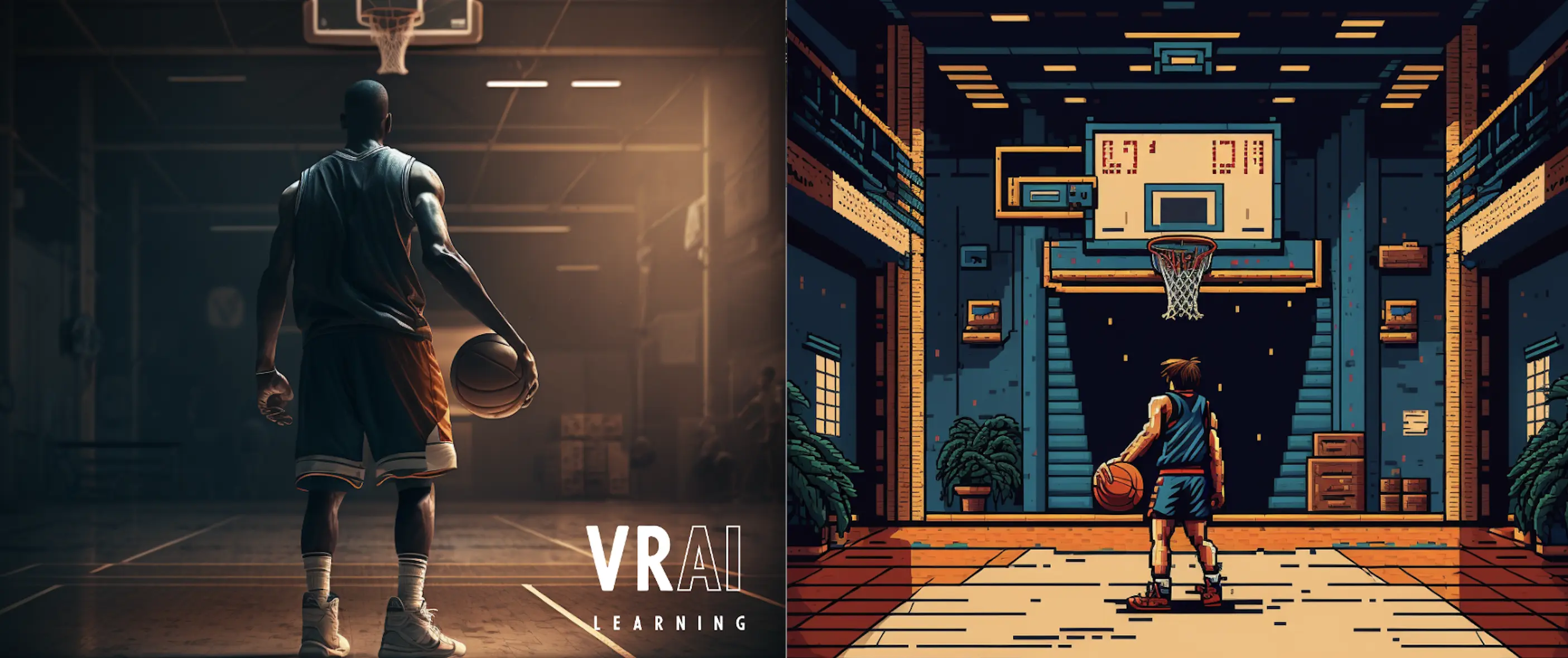
In virtual reality training, two factors largely determine pedagogical effectiveness: the visual quality of the environment and the strength of the narrative that structures the experience. Poor imagery breaks immersion before learning even begins; a scenario lacking narrative coherence leaves the learner as a passive spectator rather than an engaged participant. Understanding how to articulate these two dimensions means giving yourself the tools to design training programmes that captivate, teach, and deliver lasting results.
Why is image quality a determining factor in immersive training?
Image quality is a determining factor in immersive training because it conditions the sense of presence — that is, the brain's ability to accept the simulated environment as real. Without this sense of presence, learning is compromised: the learner remains a spectator instead of engaging. Insufficient resolution (below 1080p per eye), dull colours, or optical distortions immediately signal the brain that the environment is artificial. Conversely, high-quality imagery — a minimum of 90 fps, accurate colours, corrected aberrations — allows the learner to focus on the pedagogical situation rather than on visual imperfections. In demanding sectors such as medical, industrial, or safety training, visual precision is not a luxury: it is a prerequisite for transferring skills to real-world contexts.
The visual parameters to master
Designing a high-quality virtual reality training rests on four fundamental visual parameters:
- Resolution per eye: 1080p per eye is the minimum acceptable threshold for consumer use. Professional applications — medical training, industry, safety — require higher resolutions to guarantee the legibility of technical details and the credibility of simulated environments.
- Frame rate: 90 fps is the recommended threshold for avoiding cybersickness. High-end headsets now reach 120 fps, delivering a fluidity that further reinforces the sense of presence and reduces fatigue.
- Colour accuracy: Vibrant colours that are faithful to reality reinforce realism. In an industrial simulation, the colour of a warning signal or a piece of protective equipment can carry a precise pedagogical meaning — it must therefore be reproduced with accuracy.
- Optical aberration correction: VR headset lenses naturally introduce slight distortions. Software and optical correction work reduces these effects to deliver natural, comfortable vision over extended use.
These parameters are not merely technical considerations: they directly condition learner engagement and, consequently, the quality of learning. A learner who is uncomfortable or distracted by poor image quality cannot be fully present within the pedagogical scenario.
How does storytelling transform training content into a memorable experience?
Storytelling transforms training content into a memorable experience by activating cognitive and emotional mechanisms that a straightforward lecture cannot trigger. When a learner follows a structured narrative — with an identifiable character, a clear stake, and decisions to make — their brain lives the situation rather than processing it passively. Mirror neurons activate, narrative emotion consolidates memory, and information learned within a strong narrative context is retained up to four times better than information presented out of context. In immersive VR training, this dimension is amplified tenfold: the learner is physically inside the scene, their decisions have visible consequences, and resolving the scenario generates a sense of accomplishment rooted in lived experience rather than a mere score.
How the brain processes narratives
The neuroscience of storytelling shows that when we follow a story, our brain does not merely process information — it lives it. Mirror neurons fire as if we ourselves were actors in the situation. The emotion generated by the narrative reinforces memory consolidation — information associated with narrative tension, a stake, or a resolution is retained far better than information presented without context.
The ingredients of an effective pedagogical scenario
A good immersive training scenario shares the characteristics of compelling narratives:
- An identifiable character or situation: The learner must be able to project themselves into the proposed situation. The closer the context is to their professional reality, the more natural the skills transfer will be.
- A clear stake: Why does this skill matter? What is at risk if it fails? The stake gives value to learning and sustains attention.
- Choices and consequences: As in the classic "Choose Your Own Adventure" books, branching scenarios allow the learner to make decisions and observe their effects. This narrative structure transforms the learner into a responsible actor, which reinforces engagement and experiential learning.
- A meaningful resolution: The conclusion of the scenario must deliver a sense of accomplishment or a moment of realisation — not just a score or a badge, but a genuine new understanding of the situation.
Image quality and storytelling: two levers that reinforce each other
These two dimensions are not independent: they amplify each other. A realistic visual environment makes the scenario credible; a compelling scenario gives the learner the desire to explore the environment with genuine attention. The combination of the two produces what learning specialists call pedagogical "flow": a state of total engagement in which the learner progresses naturally, without friction or drop-off.
AI avatars play an increasingly important role in this dynamic: they embody the characters of the scenario, respond to the learner's decisions in real time, and personalise the narrative according to each user's profile. This level of narrative interactivity was impossible with traditional e-learning formats.
What measurable results can be expected from VR training that combines image quality and storytelling?
VR training combining visual quality and storytelling delivers measurable results that are significantly superior to traditional learning formats. According to the PwC study (2020), learners trained in virtual reality are 4 times more focused than their counterparts in standard e-learning, demonstrate 275% greater confidence in applying skills, and show a 75% higher retention rate. These figures are explained precisely by the combination of an immersive visual experience — which sustains attention without cybersickness — and a narrative that gives meaning to every decision made during training. For organisations, these gains translate into reduced training time, improved procedural compliance, and accelerated skills development for complex technical tasks.
To explore the measurable benefits of virtual reality training, you will find additional data on performance, retention, and learner satisfaction indicators.
Best practices for designing your immersive training
Whether you are an instructional designer, a training manager, or a chief human resources officer, here are the key principles for combining visual quality and storytelling:
- Define the pedagogical objectives first, then build the scenario to serve them — not the other way around
- Choose a technical partner capable of guaranteeing the visual standards required by your sector
- Involve subject-matter experts in the construction of scenarios to ensure fidelity to real-world situations
- Test the training with a representative panel of learners before deployment
- Measure engagement (completion time, drop-off points) and retention to continuously optimise
The Avatar Academy platform lets you track these indicators in real time and drive the continuous improvement of your immersive content.
Conclusion
Captivating, teaching, and ensuring success: these three objectives cannot be achieved in isolation. They are the product of a design approach that takes visual experience quality as seriously as the strength of the pedagogical narrative. In virtual reality, every detail matters — because every detail either contributes to or detracts from the immersion that makes learning possible.
Looking to design an immersive training programme that combines visual excellence with compelling storytelling? Contact the VRAI Learning team to discuss your project.
Frequently asked questions
What is the sense of presence in virtual reality, and why does it matter for training?
The sense of presence is the cognitive state in which the learner perceives the virtual environment as real and behaves accordingly. It is the central mechanism that distinguishes VR training from all other digital formats. When this state is achieved, the learner is no longer watching a simulation — they are living a situation. Their reactions — stress, focus, decisions — are analogous to what they would be in reality, which makes the transfer of skills to the workplace far more effective. This sense of presence depends on visual factors (resolution, fluidity, field of view), auditory factors (spatial sound), and interactive factors (haptic feedback, element responsiveness). A degradation on any one of these axes is enough to break immersion and reduce the training to a simple 360° video, stripped of the cognitive benefits of presence.
How is the pedagogical effectiveness of virtual reality training measured?
The pedagogical effectiveness of VR training is measured at several complementary levels. At the engagement level, analysts examine completion time, drop-off points within the scenario, and the number of voluntary replays — a strong indicator of perceived value. At the retention level, tests administered immediately after training and at intervals (30 and 90 days later) measure what has been genuinely memorised. At the transfer level, real-world behaviours are observed: procedural compliance, error reduction, adherence to safety procedures. Finally, at the confidence level, before/after self-assessments quantify the perceived gain reported by the learner. The Avatar Academy platform centralises these data and generates dashboards that training managers can act on directly.
What is the difference between a linear pedagogical scenario and a branching scenario in VR?
A linear scenario guides the learner from one step to the next without any opportunity to choose: they observe, listen, or answer questions, but do not make decisions. This format suits the transmission of factual knowledge, but it limits engagement and the transfer of behavioural skills. A branching scenario, by contrast, places the learner in situations where their decisions have visible consequences within the virtual environment. If they choose the wrong safety procedure, they see the effects; if they handle a difficult conversation well, the relationship evolves positively. This narrative structure activates experiential learning mechanisms more effectively, reinforces memorisation, and better prepares learners for the complexity of real-world situations. For behavioural, managerial, or safety skills, branching scenarios are systematically recommended.
How do you choose the right partner for immersive VR training that combines visual quality and storytelling?
Choosing the right immersive VR training partner requires simultaneously evaluating their technical mastery and pedagogical competence. On the technical side, verify the resolutions offered per headset, the guaranteed frame rates, and the optical correction capabilities. Request references in your sector and test existing productions before committing. On the pedagogical side, assess the scenario design methodology: does the partner involve subject-matter experts? Do they offer branching scenarios? Do they measure outcomes after deployment? A strong VR partner must be as much an instructional designer as a 3D developer. VRAI Learning has combined both areas of expertise since its founding, offering custom immersive training with performance indicator tracking via the Avatar Academy platform.
Read also
Virtual reality training in the company: the complete guide →Methods, costs, use cases, and results for deploying VR in your organisation.

Christèle Simeoni
Co-founder VRAI Learning (2023) · CMO
Co-fondatrice de VRAI Learning, spécialiste de la formation immersive VR et des avatars IA conversationnels.
See immersive training in action
Personalised demo, no commitment. We show you what it looks like for your context.
Book a demoExplore our solutions