Christèle Simeoni
9 min min read
Virtual reality for training: the example of automobile brands
CS
Christèle Simeoni
Co-founder & CMO, VRAI Learning
Automotive manufacturers are among the pioneers of professional virtual reality training. Volkswagen, BMW and PSA (now Stellantis) have invested heavily in immersive learning programmes to train their workforces — from assembly lines to customer services, through logistics and safety. Their experience offers valuable insight into what virtual reality can concretely bring to corporate training.
Why did the automotive sector adopt virtual reality for training?
The automotive sector adopted virtual reality for training because its constraints are among the hardest to solve with traditional methods. Manufacturing processes are highly technical, safety procedures are strict, and high turnover in certain roles — particularly in logistics and assembly — requires rapidly training new employees in precise procedures. On-the-job training exposes organisations to costly errors on high-value components. Recreating crisis or incident scenarios without interrupting production is impossible. And for multi-site groups, ensuring consistent training across countries proves extremely difficult. Virtual reality resolves these challenges by recreating faithful workplace environments, accessible at any time and perfectly reproducible anywhere in the world, without risk or additional logistical cost.
Traditional on-the-job training presents several limitations:
- Risk of costly errors on high-value components during the learning phase
- Inability to reproduce certain safety or crisis scenarios without halting production
- High logistical costs for groups with production sites across multiple countries
- Disparity in training quality between sites, depending on the availability of experienced trainers
Virtual reality addresses these constraints by recreating faithful workplace environments, accessible at any time and perfectly reproducible across all sites.
How does Volkswagen use virtual reality to train its logistics teams?
Volkswagen developed a virtual environment faithfully reproducing one of its logistics centres, allowing learners to practise their job tasks before ever setting foot on the factory floor. In this interactive simulation, employees perform goods receipt operations, flow management and quality control, at progressively increasing levels of difficulty. The key feature of the programme: scenarios can be repeated indefinitely until the expected result is achieved. This repetition-based training, in a risk-free environment with no production pressure, enables learners to reach a solid level of proficiency before taking up their actual role. Learners also gain an understanding of logistics flows in their entirety — not only their portion of the chain — which improves their ability to anticipate incidents.
One of the programme's major strengths: the ability to repeat scenarios indefinitely until the expected outcome is achieved. This repetition-based training, in a risk-free environment, allows learners to reach a solid level of mastery before starting their real role.
What this changes for learners
- Understanding of logistics flows in their entirety, not only their portion of the chain
- Assimilation of quality control procedures in conditions close to the real environment
- Greater confidence at role start-up through prior familiarisation with the environment
- Personalised learning pace, with no pressure from ongoing production
BMW: multi-role simulations covering the full range of job functions
BMW deployed an extensive range of virtual reality simulations covering three major job families:
- Assembly and production: hyper-realistic simulations of workstations on the assembly line, reproducing technical gestures, tooling and assembly procedures
- Customer service and commercial relations: sales role-play scenarios, complaint handling, vehicle and technology presentations
- Safety and risk management: evacuation procedures, incident management, electrical and chemical risk certifications
BMW's training programmes are structured around three complementary learning zones: a workstation planning zone, a knowledge acquisition zone, and a component design data comparison zone. This three-stage architecture enables a progressive and verifiable build-up of competencies.
A documented impact on retention
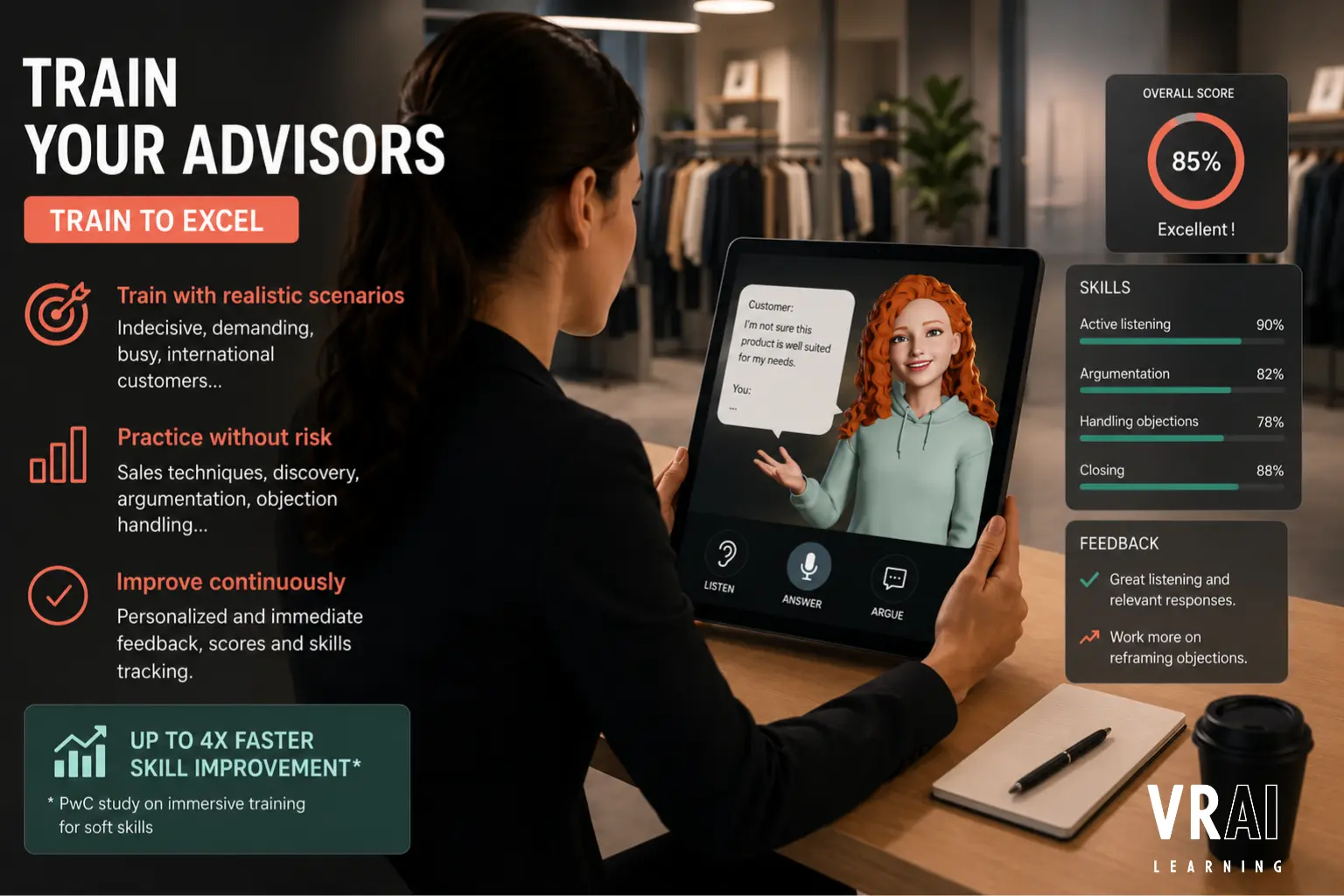
Data collected by BMW confirms what academic studies show at scale. According to a PwC (2020) study covering several thousand learners, people trained in virtual reality learn 4 times faster than in classroom training, and display 275% greater confidence in their skills. Long-term retention reaches 75%, compared to less than 10% for traditional lecture-based training.
How does PSA / Stellantis develop soft skills through virtual reality?
PSA chose to extend virtual reality beyond technical skills to also develop the behavioural competencies of its employees. Through immersive simulations, teams work on communication in multicultural contexts, conflict management, leadership under pressure and decision-making in the face of production incidents. This approach rests on a straightforward observation: a technician who has perfect mastery of procedures but cannot communicate under stress remains a source of risk. Virtual reality makes it possible to simulate these high-tension situations in a controlled way, within a safe framework where mistakes are part of the learning. PSA demonstrates that VR is not limited to technical training — it is equally relevant for transforming professional behaviours and strengthening team cohesion.
- Communication and conflict management in multicultural teams
- Leadership and decision-making under pressure
- Priority management and problem-solving on the production floor
- Understanding of processes and their impact on the overall chain
This approach recognises that professional effectiveness is not reducible to technical gestures alone. A technician who has perfect mastery of procedures but cannot communicate under stress remains a source of risk. Virtual reality makes it possible to simulate these high-tension situations in a controlled way, within a safe framework where mistakes become learning opportunities.
Using VR beyond internal training: the customer experience
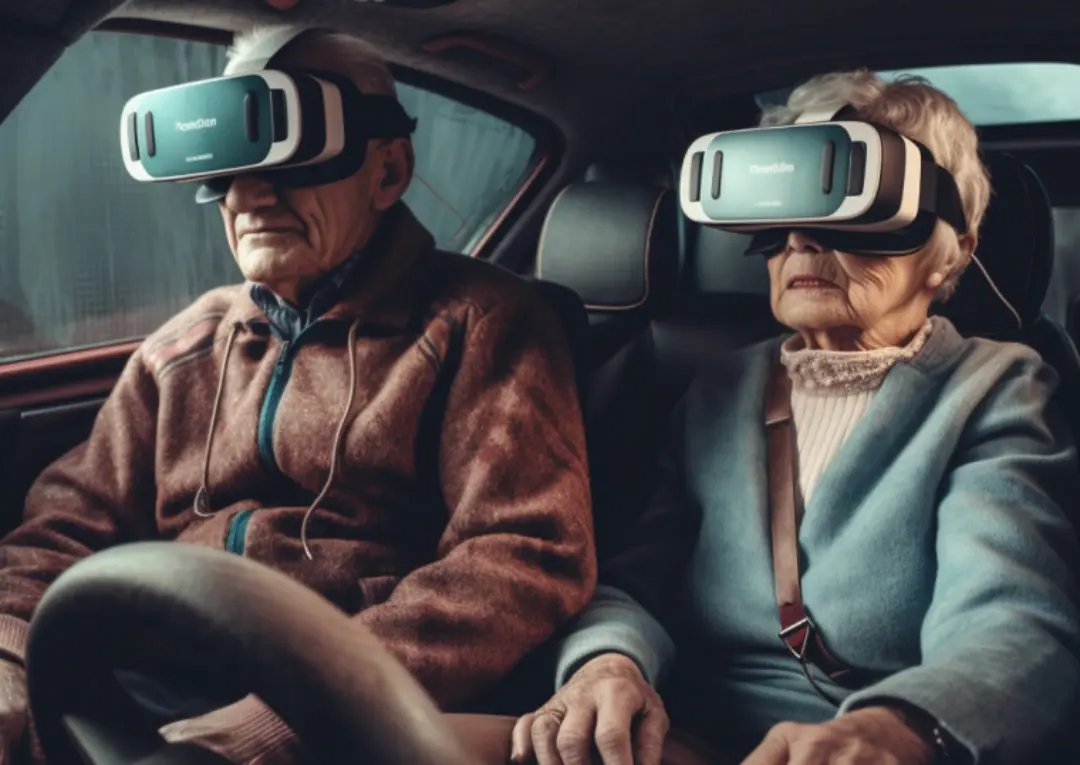
Automotive brands have also explored the use of virtual reality in customer relations. Immersive driving simulators allow potential buyers to discover a new model, test its advanced features, or understand the embedded technologies — without requiring a physical vehicle to be available at the dealership.
This dual use — internal training and customer experience — illustrates the versatility of virtual reality as a communication and engagement tool, well beyond the educational domain alone.
Lessons for organisations outside the automotive sector
The automotive manufacturers' experience demonstrates several principles applicable to any organisation wishing to deploy virtual reality for training:
- Environmental fidelity matters: the closer the simulation resembles the actual workplace, the better the skill transfer
- Level-based progression accelerates learning: breaking training into steps with increasing levels of difficulty supports skill development without discouragement
- Soft skills are equally simulable: VR is not reserved for technical gestures — interpersonal situations and decision-making scenarios can be simulated just as effectively
- Standardisation is a key advantage for multi-site groups: all learners experience exactly the same training, regardless of their location
VRAI Learning supports your immersive training project
At VRAI Learning, we design bespoke virtual reality training programmes for organisations across all sectors. Our modules combine 3D environments faithful to your workspaces, conversational AI avatars for communication simulations, and our Avatar Academy tracking platform to measure each learner's progress.
Like Volkswagen, BMW or PSA, you can train your teams faster, with measurable results and standardised deployment across all your sites. Visit our measurable benefits of VR training page to discover the data that supports this approach.
Would you like to discuss your project? Contact us for an initial conversation.
Frequently asked questions
What is the return on investment of virtual reality training in the automotive industry?
The return on investment of virtual reality training in the automotive industry can be measured at several levels. First, the reduction of production errors: a learner trained in VR arrives at their workstation with already-acquired procedural mastery, limiting costly rework and scrap. Second, learning speed: according to the PwC (2020) study, people trained in virtual reality learn 4 times faster than with conventional training. Long-term retention of 75% also reduces the need for refresher training. Finally, for multi-site groups, deploying a standardised VR module eliminates trainer travel costs and guarantees consistent quality everywhere. The initial development cost is recouped once the volume of learners is sufficient, generally from a few hundred sessions onwards.
Can VR training genuinely develop behavioural competencies (soft skills)?
Yes, virtual reality training is particularly effective for developing soft skills, and the PSA example provides concrete proof. VR immerses the learner in realistic social and emotional situations — a disagreement with a colleague, a difficult announcement to a client, a decision to make under pressure — and allows them to observe and correct their reactions in real time. Unlike in-person role play, VR simulation offers a neutral and reproducible environment, free from the stress of peer observation. The learner can replay the scene until they adopt the expected behaviour. Motion sensors also enable analysis of posture, gaze and gestures, opening the door to objective feedback on competencies that are usually difficult to assess. For managers, sales teams or roles with high interpersonal interaction, VR is a highly effective behavioural development tool.
How do you choose a VR training provider for an industrial company?
Choosing a VR training provider for an industrial company rests on several key criteria. First, the ability to faithfully model your real work environments: the quality of skill transfer depends directly on the resemblance between the simulation and the actual workstation. Second, sector experience: a provider who has already worked in industry understands the production, safety and turnover constraints that shape instructional design. Third, compatibility with your existing LMS or tracking system: VR training without progression data has little value for the training manager. Fourth, the ability to deploy across multiple sites with identical content. Finally, check client references and request measurable pilots before any large-scale rollout to validate the real impact on your teams.
Is virtual reality suitable for all learner profiles in industry?
Virtual reality is suitable for the vast majority of learner profiles in industry, including those who are less accustomed to digital tools. Studies conducted in the automotive sector show that assembly line employees, many of whom do not have a technophile profile, adapt quickly to VR headsets when the onboarding is well supported. The key factor is the quality of onboarding: a short familiarisation session with the hardware is generally sufficient to overcome apprehensions. People suffering from vestibular disorders or motion sensitivity may sometimes experience discomfort — adaptation protocols exist for these cases. Seated VR formats or those with limited movement are preferable for older learners. In summary, VR is inclusive provided the programme is designed with these constraints in mind from the outset.
Read also
Virtual reality training in the workplace: the complete guide →
Methods, costs, use cases and results for deploying VR across your organisation.

Christèle Simeoni
Co-founder VRAI Learning (2023) · CMO
Co-fondatrice de VRAI Learning, spécialiste de la formation immersive VR et des avatars IA conversationnels.
See immersive training in action
Personalised demo, no commitment. We show you what it looks like for your context.
Book a demoExplore our solutions