Christèle Simeoni
6 min min read
The valley of the strange (uncanny valley): this discomfort created by (almost) human avatars
CS
Christèle Simeoni
Co-founder & CMO, VRAI Learning
AI avatars and the uncanny valley: how far should we push realism?
AI avatars are becoming key interlocutors in training, customer service, and organizational support. But as their appearance, voice, and behavior grow closer to human, one essential question emerges: how far should we push realism? Between ethics, user experience, trust, and environmental impact, the line is thin. And at the center of this debate lies a determining concept: the uncanny valley.
Why do we keep trying to make AI avatars more human?
AI avatars are today taking an increasingly important place in our professional uses: immersive training, onboarding, user support, change management, coaching or mediation, customer relations...
They are often designed to resemble real digital colleagues: an expressive face, a natural voice, fluid behavior. The objective is simple: create interaction that is more intuitive, more spontaneous, more human.
But a fundamental question arises: at what point does realism become counter-productive? Wanting to imitate the human too closely can... go wrong. This is where the notion of the uncanny valley enters the picture.
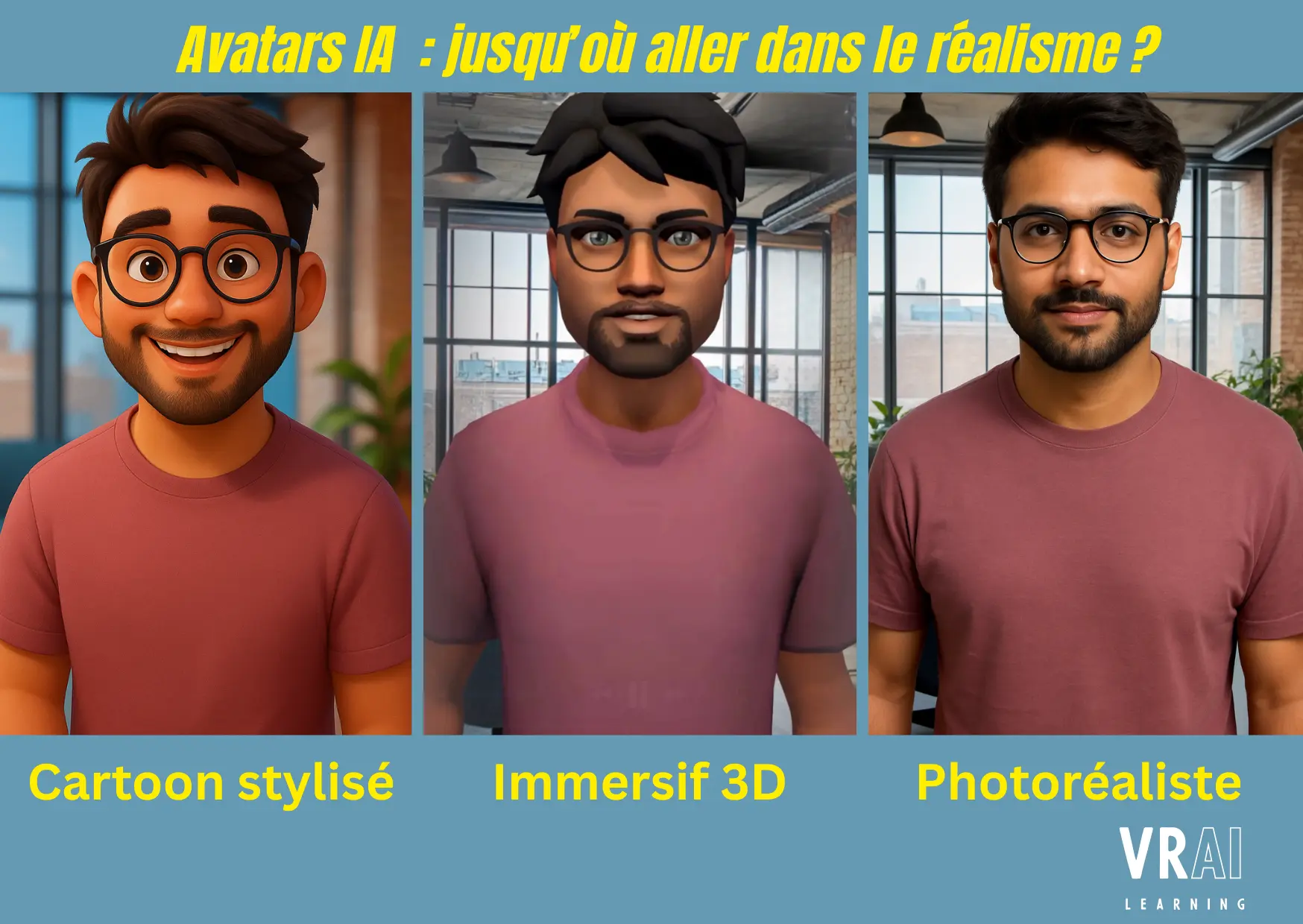
What exactly is the uncanny valley?
The uncanny valley is a concept that originated in robotics and cognitive sciences. It designates the following phenomenon:
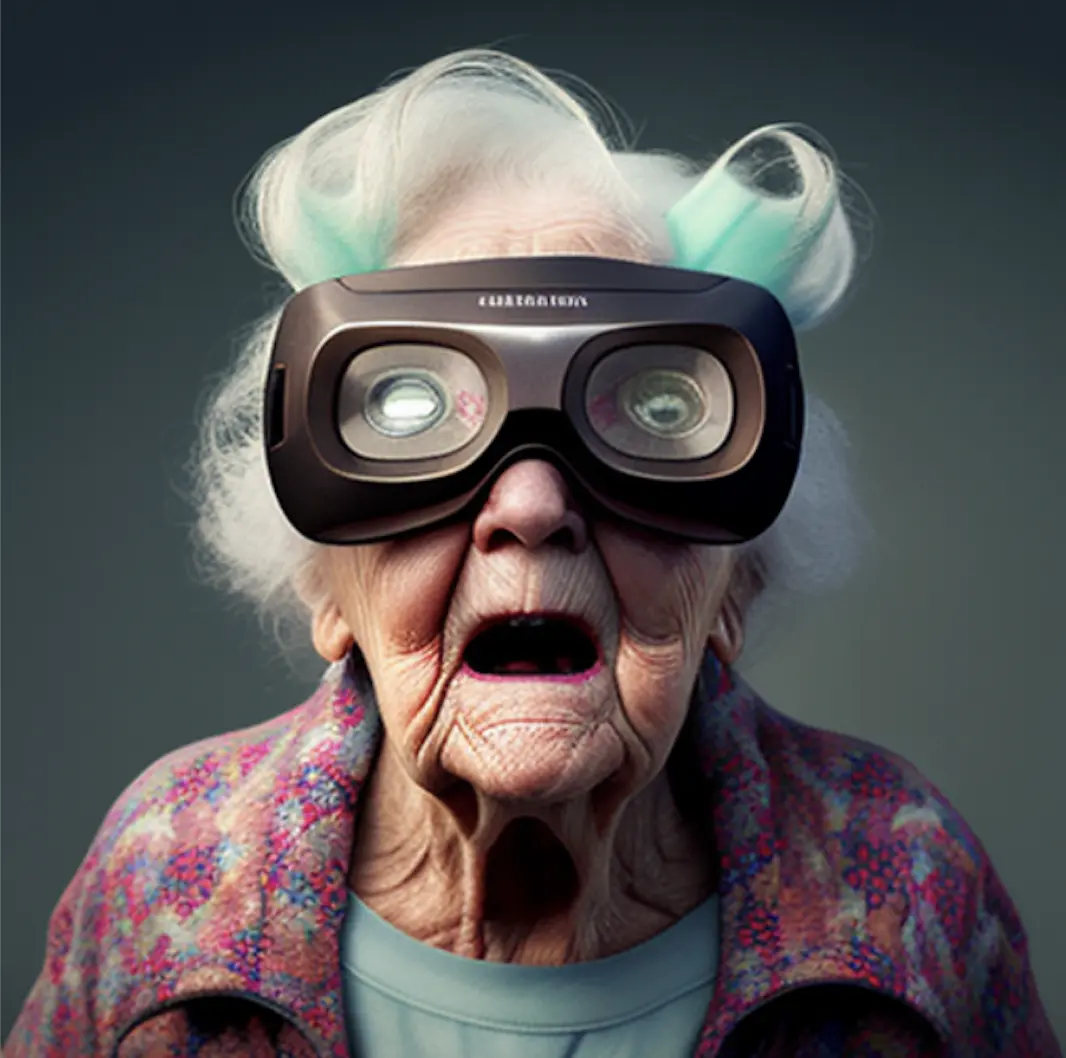
The more an avatar or robot resembles a human, the more familiar it seems to us... until the moment it becomes almost human, but not quite. And that is when everything shifts. Our brain detects something slightly "off": a smile that is too fixed, a blink that is too slow, lip-sync that is out of step, a posture that is too rigid, an empty gaze...
And this small incoherence is enough to create cognitive dissonance. Instead of engaging, the avatar creates a subtle unease, a strange feeling — sometimes even rejection.
Too human to be fictional. Not human enough to be credible. The result: disconnection.
In everyday uses (training, support, coaching), this effect is particularly problematic: it diverts attention, disrupts learning, and erodes trust.
Why is this a genuine ethical issue?
An overly realistic avatar can blur the user's frame of reference. This raises several essential questions:
Transparency: does the user clearly understand they are not speaking to a human? An ultra-realistic avatar can make people forget its artificial nature.
Consent: does the user accept that their emotions or reactions are being analyzed by an AI? A human-looking avatar can give the impression of an authentic relationship that does not actually exist.
Manipulation: a very credible avatar naturally inspires more trust. But that trust can be exploited without the user being aware of it.
A deliberately stylized design, identifiable as non-human, protects the user. It guarantees a clear, ethical, and responsible relationship.
Creating responsible embodied AI also means reminding users that these systems have no consciousness, no emotions, no lived experience. They do not play a human role — they support, guide, accompany, and that is all.
What studies say: too much realism harms the experience
Extensive research in psychology, neuroscience, and UX design shows that ultra-realistic avatars are not the most effective. Less trust: users are more wary of an "almost human" avatar than a stylized or cartoon one. Less engagement: a strange appearance diverts attention and disrupts interaction. Less pedagogical effectiveness: in training, an overly realistic avatar captures attention — but focused on its strangeness, not the content.
In short: more realistic does NOT mean more effective. Often, it is quite the opposite.
What about stylized avatars?
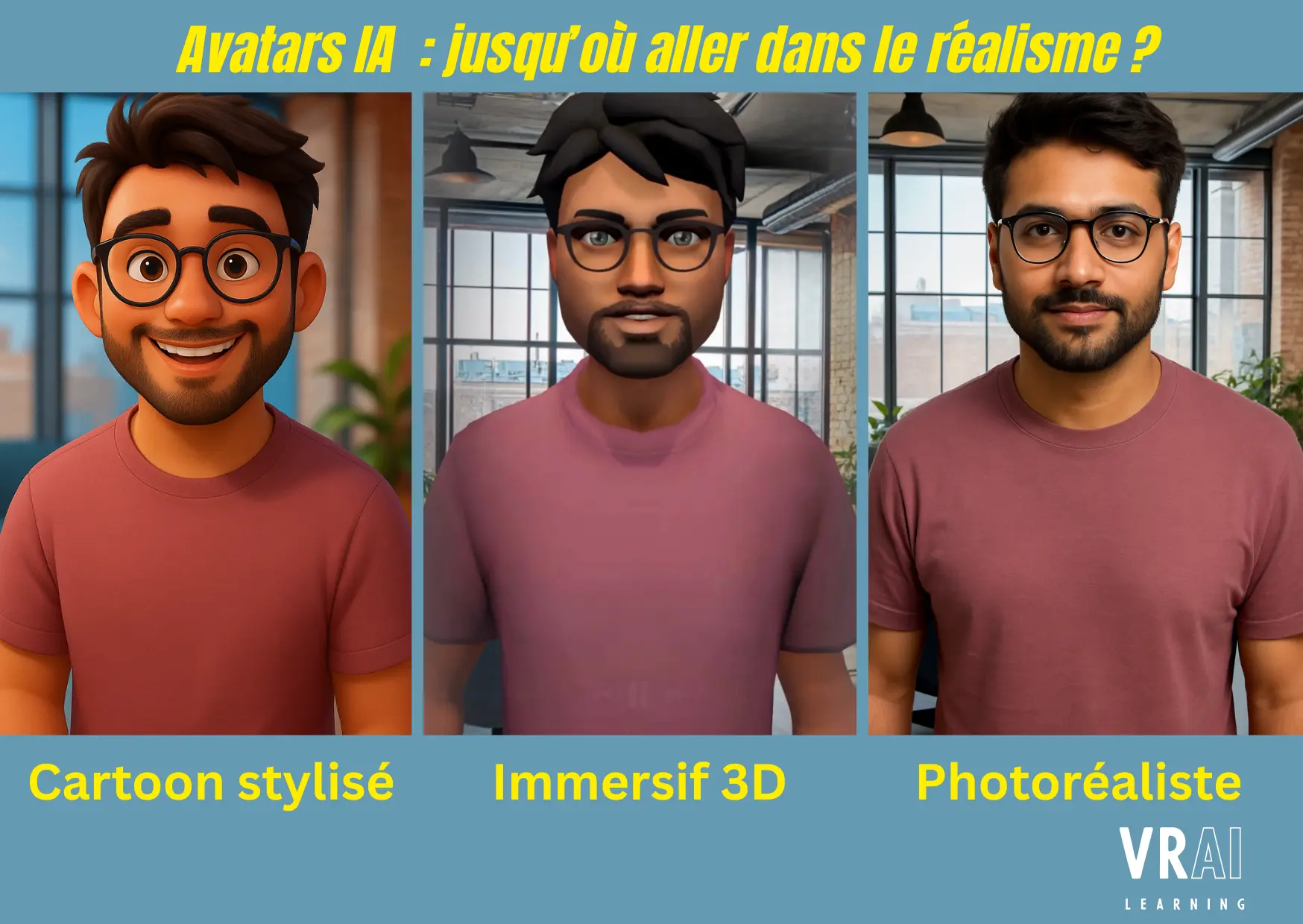
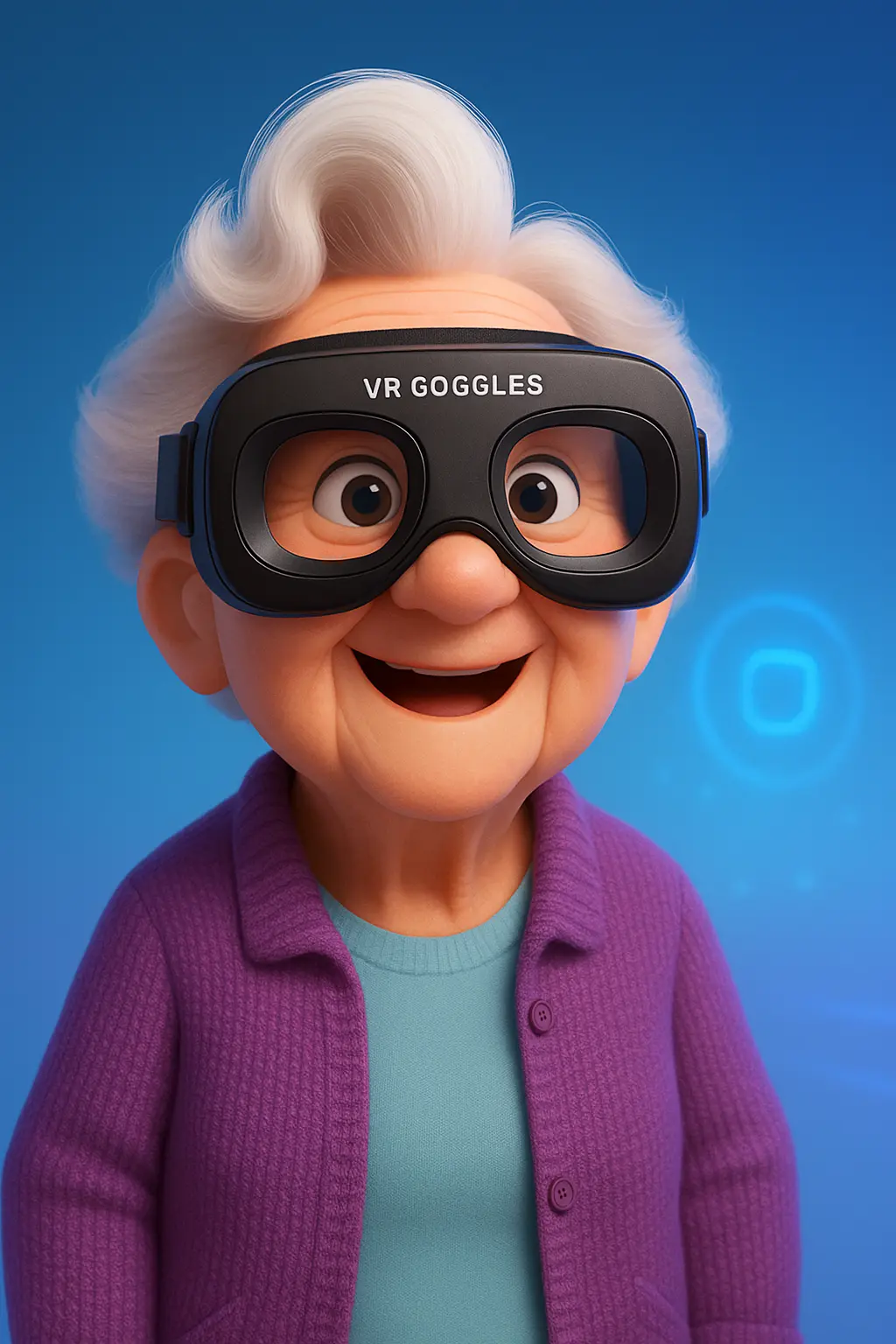
Stylized avatars — cartoon, semi-realistic, illustrated — avoid the uncanny valley. Why? Because they do not try to fool the brain. They are clearly artificial, but expressive, warm, and readable. And they offer several advantages: they facilitate identification (we project our emotions more easily onto a stylized avatar); they reinforce sympathy (they create a gentle, non-intrusive relationship); they leave more room for imagination (the user mentally completes what they see); and they create a safe interaction framework where no one feels deceived or misled.
This is why the largest animation studios, video game developers, and immersive learning companies favor deliberate visual styles over photorealism. The objective is not to copy the human. The objective is to create a comfortable, engaging, and memorable experience.
Impact comes through emotion, not illusion
When designing an AI avatar, what matters is not that it resembles a human. What matters is that it creates a relationship. An effective avatar is one whose voice is pleasant, whose expressions are coherent, whose behavior is natural, whose personality is clear, and who inspires trust. Realism is not an objective — emotion is.
VRAI Learning's approach: embodied, but not an illusion
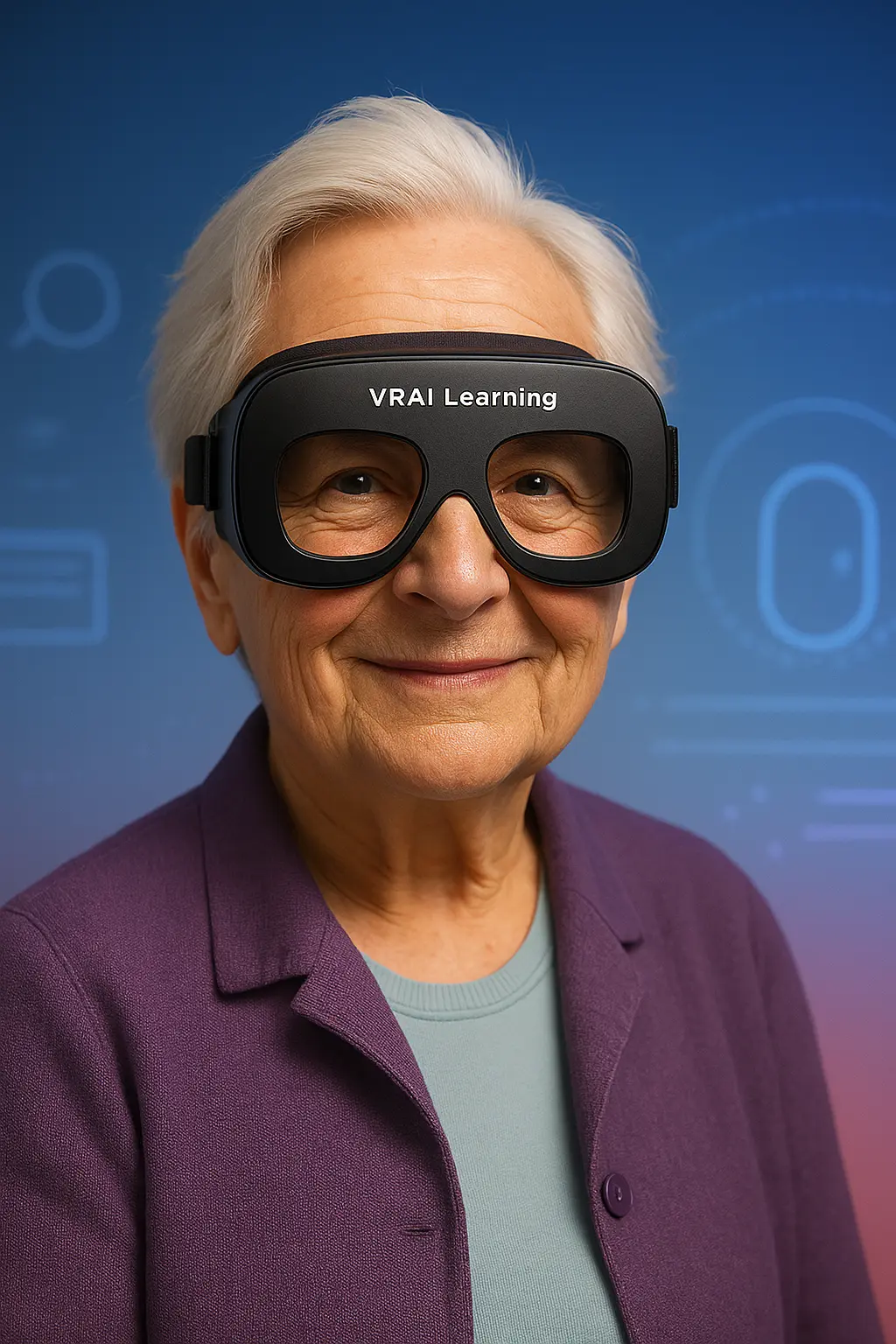
At VRAI Learning we can create photorealistic avatars, yet we have made the choice to prioritize: expressive avatars, identifiable ones, not "too human," capable of creating genuine connection.
Our goal is not to deceive the user — it is to engage them, reassure them, accompany them — the augmented human, not their replacement!
Depending on the context, we adapt the visual style: more realistic for specific professional situations; more stylized to facilitate learning or empathy; more expressive to boost engagement.
What matters is not the degree of realism. It is the fit between the avatar and the user's needs.
What about environmental impact? Realism has a cost.
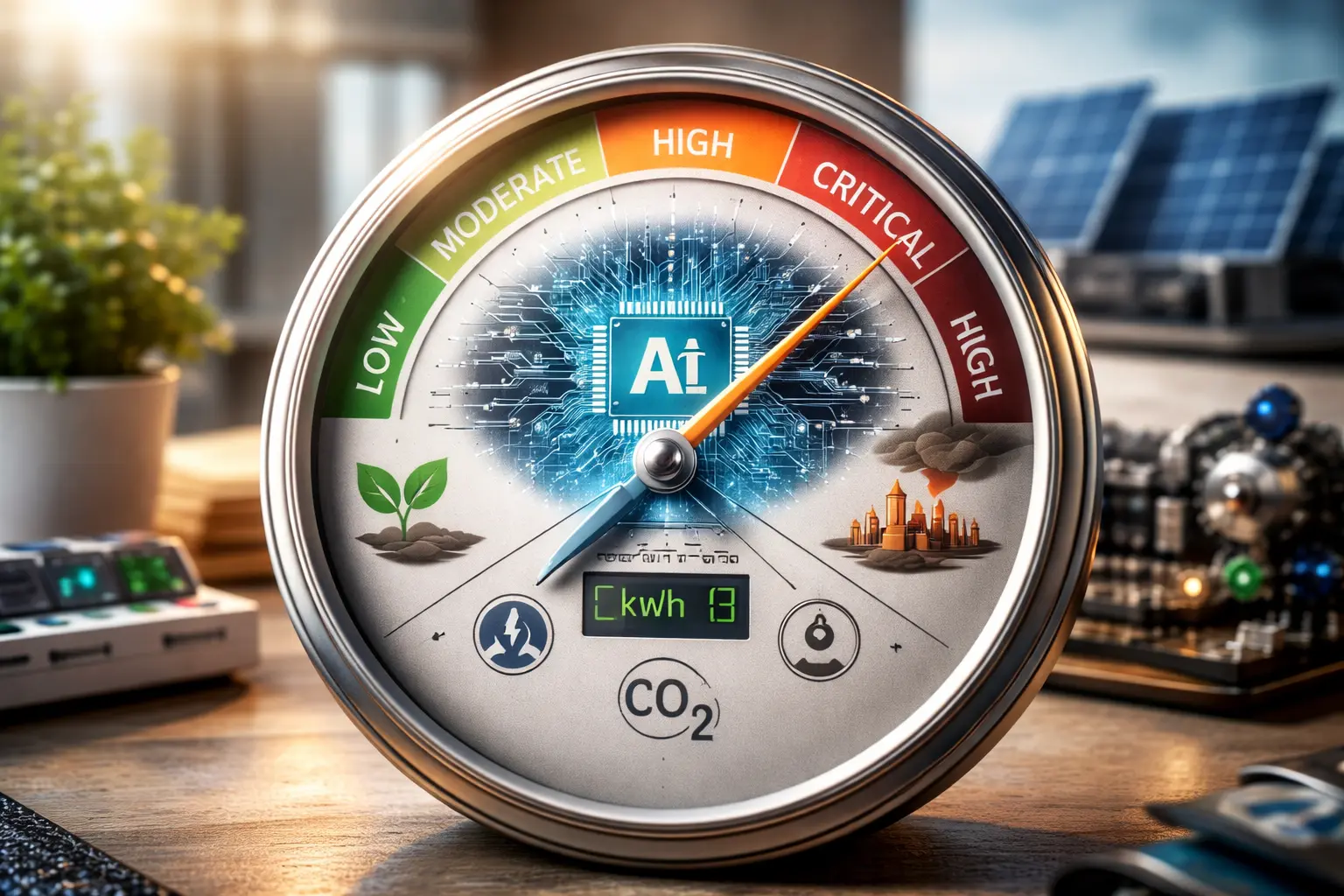
The visual style of an avatar influences its resource consumption — and this is not trivial. A photorealistic avatar requires very heavy textures, complex animations, computationally expensive rendering, more energy consumption, and a higher carbon footprint. A stylized avatar is lighter, faster to load, works on standard equipment, consumes fewer resources, is more accessible, and is more ecologically sober.
Let us be honest: AI is not a model of environmental sustainability. But we can make the best choices possible at every step: sobriety, efficiency, accessibility, coherence.
Conclusion: finding the right distance from the human
The question is not: should we make AI avatars photorealistic? The real question is: how far should we go with realism — without crossing the uncanny valley? An avatar that is too human worries. An artificial but expressive avatar reassures. A credible but non-deceptive avatar engages.
At VRAI Learning, we believe in a responsible, expressive, deliberate embodied AI. An AI that does not copy the human, but that accompanies the human. Because the objective is not illusion. The objective is relationship — and it is relationship that creates engagement, trust... and the success of the immersive experience.
SOURCES
Scoping review of the neural evidence on the uncanny valley — comparative study between human and artificial agents, reduced activation in the fusiform face area and ERP differences
Neural mechanisms for accepting/rejecting artificial social partners — fMRI showing an "valley" of activity in the ventromedial prefrontal cortex
Investigating the Uncanny Valley Phenomenon (IEEE paper) — EEG recording the uncomfortable experience with realistic avatars
Interactive Realistic Digital Avatars — Revisiting the Uncanny Valley — the importance of interaction in overcoming the "discomfort" effect
Scoping review of the neural evidence on the uncanny valley — meta-analysis of brain activations in response to artificial faces
Investigating the Uncanny Valley Phenomenon in Virtual Reality — EEG study on realistic avatars in an immersive context
Why Brains Get Creeped Out by Androids — accessible explanation based on neuroscientific data
The Uncanny Valley Is Real, and Science Can Prove It — field study on the perception of realism

Christèle Simeoni
Co-founder VRAI Learning (2023) · CMO
Co-fondatrice de VRAI Learning, spécialiste de la formation immersive VR et des avatars IA conversationnels.
See immersive training in action
Personalised demo, no commitment. We show you what it looks like for your context.
Book a demoExplore our solutions