Christèle Simeoni
7 min min read
Smart Avatars at Stations and Airports: Enhancing Reception Without Replacing Humans
CS
Christèle Simeoni
Co-founder & CMO, VRAI Learning
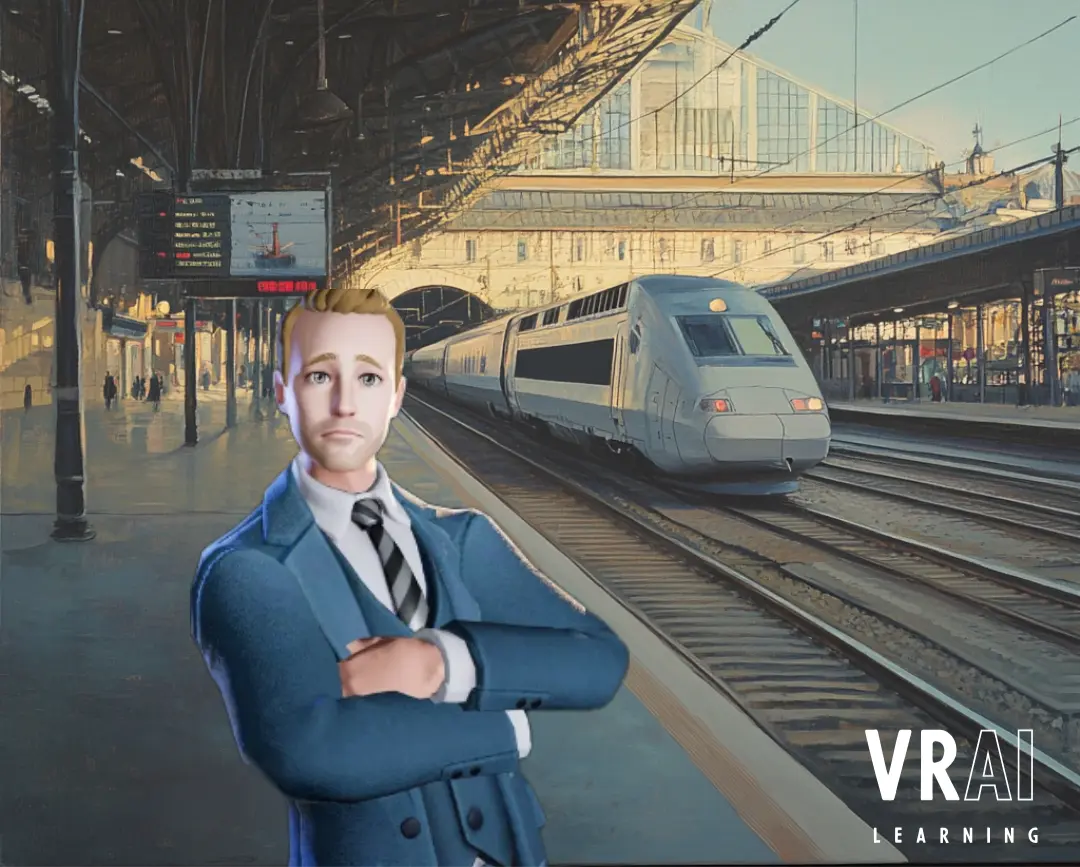
In train stations, airports, and more broadly in high-traffic public spaces, information must be accessible, fast, and reliable. Travelers expect immediate responses, often in situations of stress, urgency, or uncertainty.
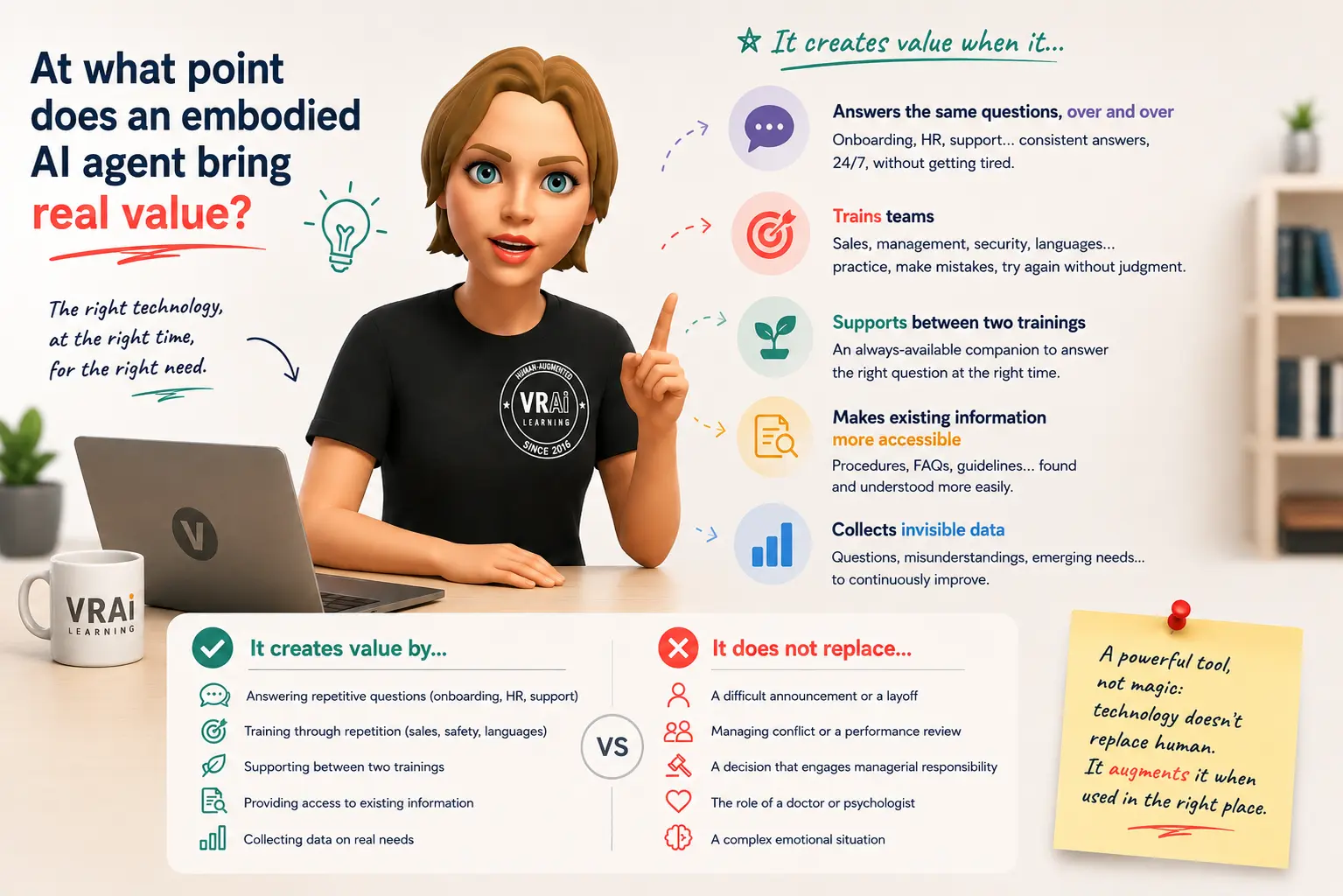
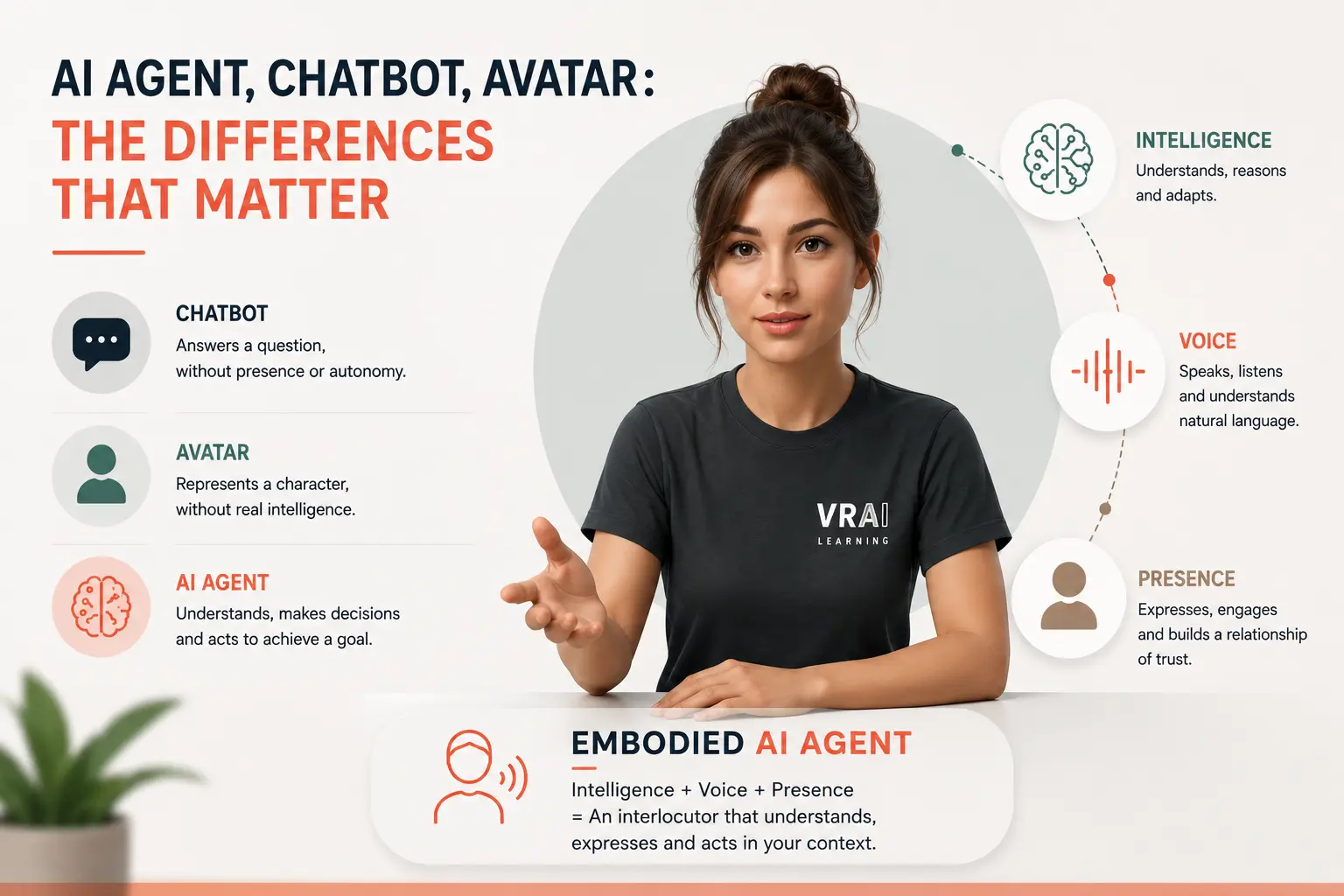
In this context, conversational avatars connected to artificial intelligence are establishing themselves as an innovative solution for improving the user experience. Present on kiosks, screens, or mobile devices, these virtual assistants do not replace human agents — they complement them. Their role is clear: streamline reception, orient travelers, and answer the most frequently asked questions, while freeing agents to focus on higher-value situations.
How does AI enable more fluid and instant traveler reception?
In a train station or airport, a large share of requests concerns simple but urgent information: schedules, delays, platforms, boarding gates, access to services, or safety instructions. Studies show that 70 to 80% of questions asked to reception agents are recurring. Thanks to conversational AI, an interactive avatar can answer these requests instantly, without waiting, 24/7.
Examples of common interactions:
- Airport: "Where is boarding gate B12?"
- Train station: "My train is delayed — what should I do?"
- Public space: "Where is the nearest accessible entrance for persons with reduced mobility?"
Result: fewer queues at service desks, less stress for travelers, and consistent, always up-to-date information.
How does an AI assistant complement the work of reception agents?
Far from replacing human agents, the intelligent avatar acts as a genuine daily ally. By handling simple, repetitive requests, it allows reception teams to refocus on their core mission. According to several studies on conversational AI, these systems make it possible to reduce first-level request volume by 25 to 40%.
Concrete advantages for agents:
- Less overload from repetitive questions
- Support available 24/7, even during peak periods
- More time to handle complex, sensitive, or human situations
- Better quality of interaction with travelers who have specific needs
Agents thus gain availability, peace of mind, and efficiency.
Why do AI avatars improve accessibility for all travelers?
Accessibility is a major challenge in transport and public spaces. According to the WHO, 15% of the world's population lives with a disability, whether permanent or temporary. Conversational AI avatars are powerful levers for inclusion:
- Multilingual, they facilitate the welcome of international travelers
- Voice-enabled, they improve access to information for visually impaired persons
- Clear and pedagogical, they help users who are less comfortable with digital tools
These systems contribute to a more equitable and inclusive experience — for everyone.
Adapting to the new expectations of travelers
Uses are evolving, and so are expectations. Today's travelers are accustomed to instant, personalized services accessible on all devices. AI avatars meet these new requirements:
- Available on screens, interactive kiosks, and smartphones
- Multilingual, for international service
- Designed from the outset for accessibility and inclusion
According to PwC, digital assistance systems can increase user satisfaction by 20 to 35% in high-traffic locations.
Simple, connected, and scalable deployment
AI avatar solutions integrate easily with existing infrastructure. Connected to real-time information systems (schedules, delays, maps, services), they provide reliable, contextualized responses. These avatars evolve continuously: content updates, improved responses through AI, adaptation to peak periods or exceptional events. They thus represent a durable, scalable solution for operators.
Concrete benefits for transport operators
Integrating intelligent avatars generates measurable gains:
- Optimized reception and customer experience
- Reduced queues by 20 to 30% during peak periods
- Better management of passenger flows
- Enhanced role of reception agents
- Innovative and modern infrastructure image
Operators thus have an effective tool to improve service quality without increasing human deployment.
An enriched user experience without dehumanizing reception
The AI avatar is not a replacement. It is a mediator — an additional point of contact that facilitates access to information and gives human teams back their time. In train stations, airports, and public spaces, these intelligent assistants participate in a natural evolution of reception: more fluid, more accessible, more serene.
AI at the service of the human experience
Integrating conversational AI avatars marks a key step in improving the traveler experience. By supporting reception agents and offering users immediate, clear, and personalized information, these solutions become a strategic lever for operators. The future of reception in public spaces lies at the intersection of technology, user experience, and human presence. Intelligent avatars are one of its most concrete expressions.
What is the cost of deploying an AI avatar in a train station or airport?
The cost of deploying an AI avatar in a train station or airport varies according to several factors: the type of support (physical kiosk, wall screen, mobile application), the number of languages activated, the level of integration with existing information systems, and the scope of deployment. For a pilot project covering one or two reception points, initial investments cover avatar configuration, connection to real-time databases (schedules, delays, maps), and graphic personalization. These costs are generally recouped within a few months thanks to generated savings: reduced first-level agent workload, fewer orientation errors, and lower traveler complaints. Solutions like those from VRAI Learning operate on a SaaS model, which limits hardware investments and enables progressive scaling. Return on investment is also measurable in user satisfaction: less waiting, less stress, a modernized brand image. Each deployment is the subject of personalized scoping according to the operator's priorities.
How does an AI avatar handle a crisis or real-time incident?
During an incident — major delay, strike, security issue, evacuation — travelers need reliable information immediately and in large quantities. This is precisely when human service desks are most saturated. A real-time AI avatar connected to information systems automatically switches to crisis messages as soon as an alert is triggered by the operator. It broadcasts validated instructions, indicates available alternatives (replacement trains, shuttles, refunds), and directs passengers to the right human contacts for complex cases. Unlike a static poster or a looped message on screen, the avatar answers each traveler's specific questions in their language. VRAI Learning solutions are designed to absorb traffic peaks without degradation: hundreds of simultaneous interactions are possible on a single infrastructure. Human agents can thus focus on physical accompaniment and managing sensitive situations, while the avatar handles the information flow. This is operational complementarity in its most concrete expression.
Frequently asked questions about AI avatars in train stations and airports
Can an AI avatar handle multiple languages simultaneously in the same space?
Yes. Modern AI avatars, like those developed by VRAI Learning, support up to 62 languages in simultaneous interaction. Each traveler addresses the avatar in their own language — orally or in writing — and receives a response in that same language, in real time. On a shared screen or kiosk, language detection is automatic: the avatar adapts without human intervention. In an international airport welcoming travelers of dozens of different nationalities, this multilingual capability is a major accessibility lever. It also reduces misunderstandings caused by language barriers, a frequent source of stress and complaints.
How does an AI avatar integrate with the information systems of SNCF, ADP, or other transport operators?
Integration is done via API connections to the operator's information systems: schedule databases, delay feeds, access maps, construction information, security alerts. VRAI Learning accompanies each client through the technical interfacing phase, respecting the protocols and security constraints specific to critical infrastructure. Once connected, the avatar queries these systems in real time with each interaction — it never relies on static data that risks becoming outdated. Content updates (new line, terminal change, seasonal campaign) are reflected immediately without intervention on the system itself. This architecture guarantees response reliability — a non-negotiable point in transport.
What concrete results can be expected from an AI avatar pilot deployment in a transport location?
Feedback from pilot deployments in transport and high-traffic public spaces converges on several measurable indicators: a 20 to 30% reduction in queues at physical information points, a 25 to 40% decrease in first-level requests handled by agents, and a notable improvement in user satisfaction scores, particularly on the criteria of "ease of access to information" and "response time." Ground teams also report a reduction in stress levels during peak periods. A well-scoped pilot allows these gains to be validated on a limited perimeter — a station, a terminal — before larger-scale deployment. VRAI Learning provides end-to-end support, from scoping through to post-pilot results analysis.

Christèle Simeoni
Co-founder VRAI Learning (2023) · CMO
Co-fondatrice de VRAI Learning, spécialiste de la formation immersive VR et des avatars IA conversationnels.
See immersive training in action
Personalised demo, no commitment. We show you what it looks like for your context.
Book a demoExplore our solutions