Christèle Simeoni
10 min min read
Immersive Learning with XR and AI Avatars: Increased Engagement, Satisfaction, and Efficiency
CS
Christèle Simeoni
Co-founder & CMO, VRAI Learning
Traditional learning shows its limitations in meeting the current demands of the professional world. Immersive learning, combined with artificial intelligence and intelligent avatars, offers a powerful alternative to engage learners, optimize knowledge retention, and effectively prepare them for future careers.
What is the real impact of immersive learning on the satisfaction, engagement, and effectiveness of learners? The data is compelling.
What is immersive learning?
Immersive learning is an educational method that uses XR technologies — virtual reality (VR), augmented reality (AR), and mixed reality — to place the learner at the heart of an interactive simulated environment. Unlike traditional e-learning, the learner doesn't just observe: they act, make decisions, and experience the consequences of their choices in real-time. There are three levels of immersion. Virtual reality (VR) immerses the learner in a fully simulated 3D environment via a headset — ideal for situations impossible to recreate in a classroom (industrial fire, negotiation under pressure). Augmented reality (AR) overlays virtual elements onto the real world via tablets or smart glasses — useful for maintenance or field onboarding. Mixed reality (XR) combines both, allowing interaction with virtual objects in a real physical space. According to PwC (2020), learners trained in VR progress 4 times faster and retain information at a rate 75% higher than traditional training.
- Virtual Reality (VR): the learner is immersed in a fully simulated 3D environment, accessible via a headset. They interact with virtual objects and experience situations impossible to recreate in a classroom — an emergency intervention, a factory fire, a high-pressure business negotiation.
- Augmented Reality (AR): virtual elements are superimposed onto the real world via a tablet or connected glasses. Useful for maintenance, technical training on real equipment, or field onboarding.
- Mixed Reality (XR): combines both, allowing interaction with virtual objects in a real physical environment. The learner can grasp, move, and assemble objects that don't yet exist in reality.
This approach allows learners to "experience" learning rather than receive it passively, fostering better understanding and more concrete application of knowledge. According to PwC (2020), learners trained in VR progress 4 times faster and retain information at a rate 75% higher than traditional training.
Why does immersive learning improve learner engagement and satisfaction?
Immersive learning enhances engagement and satisfaction because it transforms the learner into an actor, not a spectator. Interaction with 3D environments, personalized pacing, and immediate feedback meet the fundamental needs of intrinsic motivation. According to an IDC study, 90% of learners who used VR/AR technologies reported enjoying the experience, and 85% said that immersive learning increased their motivation. PwC confirms a 275% increase in confidence in skill application compared to traditional e-learning. It's not just a novelty effect: neuroscience explains that emotional engagement and physical action (even simulated) enhance memory consolidation. Learners remember better what they've experienced than what they've simply read or heard. Combining fun, challenge, and immediate perceived utility, immersive learning creates a virtuous circle: the more engaged the learner is, the more they progress, and the more they return.
Reasons for this enthusiasm:
- Visual and interactive experience: interaction with virtual environments and 3D objects makes learning more stimulating, memorable, and concrete.
- Personalization: learners progress at their own pace and receive instant feedback, fostering a stronger understanding and faster progression.
- Realistic simulation: setting up real professional scenarios effectively prepares learners for field challenges in a safe context.
- Increased confidence: according to PwC, learners trained in VR show a 275% increase in confidence in applying acquired skills versus e-learning training.
The right to make mistakes: a major advantage of immersive learning
One of the most powerful yet underutilized benefits of immersive learning is the ability to learn from mistakes in a safe environment without real consequences.
Neuroscience confirms: error followed by immediate correction is one of the most effective learning mechanisms. It creates cognitive dissonance that forces the brain to actively revise its representation of the problem, thereby solidifying the correct practice sustainably. This is precisely what VR enables — experiencing the error, understanding the consequences in the scenario, and trying again until full assimilation.
This approach is especially valuable in high-stakes training:
- Safety procedures in industrial or medical environments
- Crisis management and decision-making under pressure
- Customer relations and conflict resolution
- Technical procedures on sensitive equipment
The absence of judgment and the ability to retry as many times as necessary also help reduce performance anxiety, thereby improving the quality of learning — especially for learners who are uncomfortable with traditional evaluative formats.
Most effective use cases
Immersive learning with XR and AI avatars shows particularly strong results in five major areas of training:
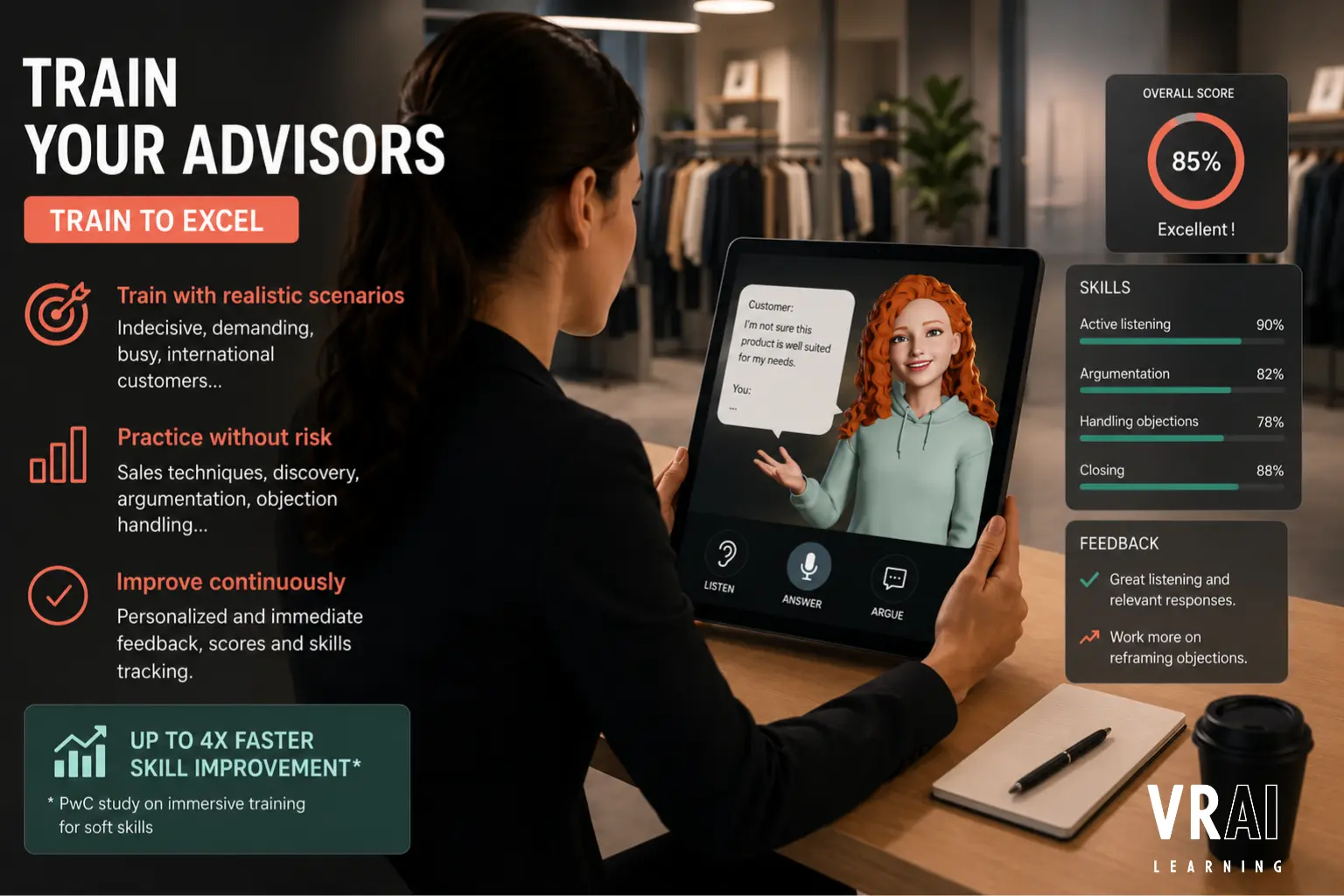
- Soft skills and customer relations: role-playing with AI avatars, conflict management, professional interviews, sales techniques — situations difficult to reproduce in a classroom without judgment bias.
- Safety and risk prevention: immersing in dangerous situations (fire, fall, industrial accident) to instill the right reflexes without real danger.
- Onboarding: exploring a complex environment (factory, warehouse, network of sales points) before physical arrival, reducing on-site adaptation time.
- Technical skills and maintenance: procedures on machines, equipment handling, surgical gestures — with unlimited repetition and immediate feedback.
- Leadership and management: simulations of difficult meetings, team management in crisis situations, 360° feedback via AI avatars.
How do AI avatars personalize assistance in immersive training?
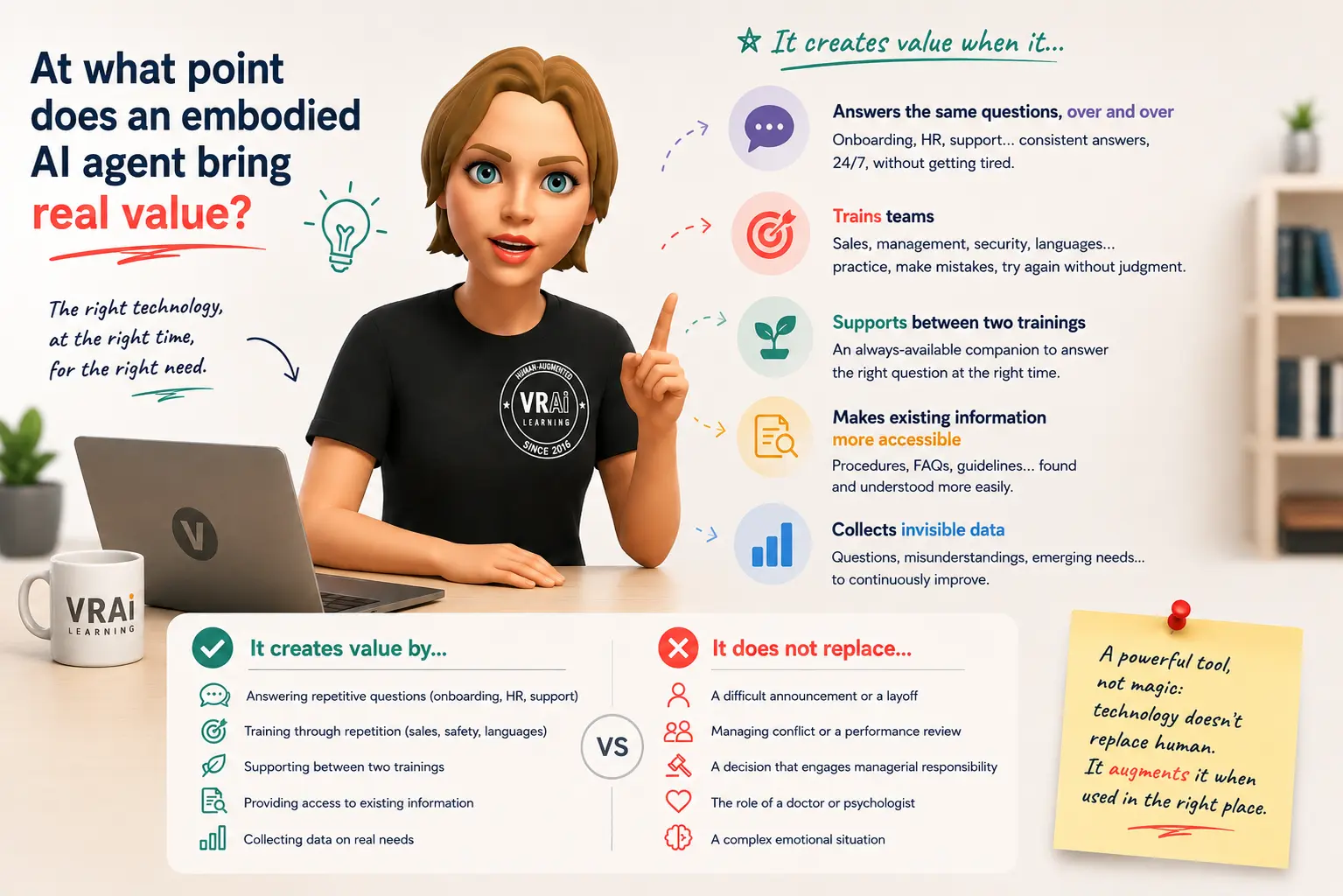
AI avatars personalize assistance by combining conversational artificial intelligence with embodied presence in the immersive environment. Connected to advanced language models, they analyze a learner's responses in real-time to adjust difficulty levels, offer targeted explanations, and provide immediate feedback — without waiting for a human trainer. For learners, this translates to 24/7 tutoring, realistic conversation simulations (interviews, negotiations, conflict situations), and personalized progress according to their profile and gaps. For trainers, avatars collect valuable behavioral data: response time, choices made, recurrent mistakes — all indicators to refine courses. This human-AI combination allows for large-scale personalization that is impossible to achieve manually. Avatars do not replace human pedagogical expertise, they amplify it.
For learners
- Personalized tutoring: avatars answer questions, provide additional explanations, give targeted feedback, and adjust the learning pace to individual needs.
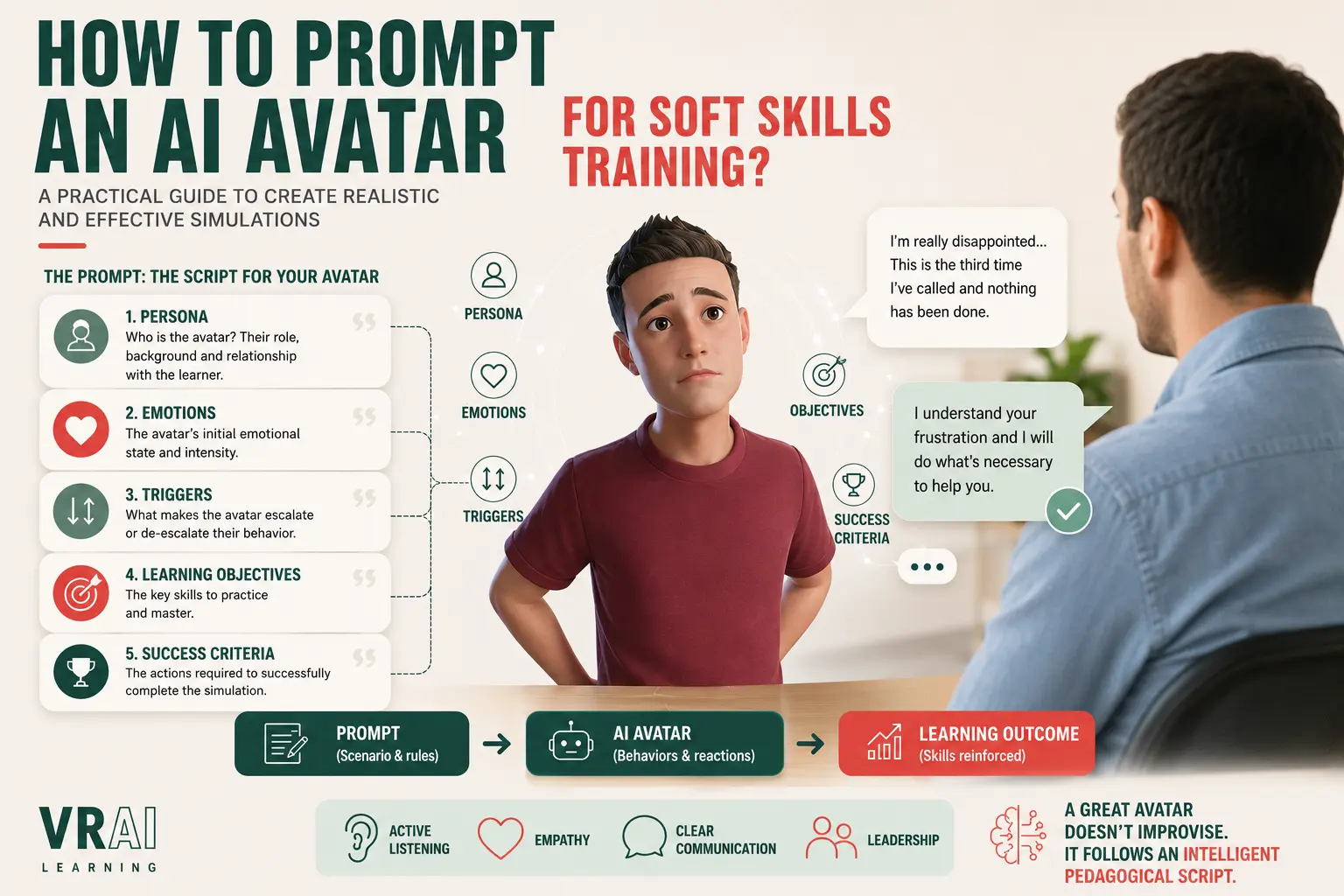
- Simulation of conversations and complex situations: interviews, negotiations, professional interactions — the AI avatar reacts realistically, allowing for the development of interpersonal skills in a safe setting.
- 24/7 availability: avatars are accessible anytime, from any device — VR headset, tablet, desktop — offering unparalleled learning flexibility.
For trainers
- Time-saving: avatars handle frequent questions and standardized feedback, freeing trainers for high-value guidance.
- Data collection and analysis: AI analyzes interactions to identify strengths and gaps of each learner, providing valuable data to adapt courses.
- Creation of interactive scenarios: trainers design engaging, personalized scenarios tailored to the specific needs of each group.
Measuring the impact of immersive learning
Effective immersive training must be measurable. Key indicators to track via a platform like Avatar Academy:
- Engagement rate: time spent in the module, actions taken, scenarios completed
- Retention rate: assessments immediately after (end of session) vs. later (day 7, day 30)
- Progression: frequent errors, sticking points, improvement between attempts
- Satisfaction: post-training NPS score, qualitative feedback from learners
- On-the-job transfer: business indicators before/after training (operational KPIs)
This data allows for the continuous improvement of modules and concretely demonstrates the value of training investment.
Conclusion
Enriched by smart AI-connected avatars, immersive learning offers a pedagogical approach that goes beyond mere technological innovation. By combining engagement and learner satisfaction with personalized accompaniment, realistic simulation, and the right to make mistakes, this method opens new perspectives for professional training.
AI avatars do not replace humans — they amplify their role and multiply their impact in the learning process.
To go further, discover our immersive training modules, our conversational AI avatars, and the measurable benefits of VR — or contact us to build your first immersive journey.
Frequently Asked Questions
What is the difference between immersive learning and traditional e-learning?
Immersive learning fundamentally differs from traditional e-learning in the level of agency given to the learner. In traditional e-learning, the learner consumes content — videos, slides, quizzes — linearly and passively. In an immersive setup, they are active: they make decisions, perform actions, interact with simulated characters, and experience the consequences of their choices in real-time. This difference is crucial from a cognitive perspective. Neuroscience shows that physical action and emotional engagement significantly enhance long-term retention. E-learning achieves an average retention rate of 20% to 30%, where immersive simulation reaches 75%, according to PwC. For businesses, this means fewer training repetitions, better skills transfer to the field, and a significantly higher training ROI on critical courses.
Is immersive learning suitable for all types of professional training?
Immersive learning is particularly effective for training where real-world simulation is difficult, costly, or risky. This is the case for safety training (emergency procedures, handling dangerous equipment), soft skills (conflict management, leadership, sales techniques), and onboarding in complex sites. However, for purely conceptual or declarative training — legislation, numerical data, corporate culture — traditional e-learning is often quicker and less costly to produce. The best approach is generally hybrid: using immersive techniques where they create the most value (behavioral anchoring, technical gestures, high-emotional-stakes situations) and combining them with lighter formats for informational content. Platforms like Avatar Academy allow managing these two dimensions in the same LMS.
How long does it take to deploy immersive training in a company?
The deployment time for immersive training depends on the scenario's complexity and the level of personalization desired. A standard VR module or AI avatar — based on existing blocks and typical scenarios — can be ready in 4 to 8 weeks. A custom journey integrating specific 3D environments, avatars personalized to the company's image, and complex business scenarios typically requires 3 to 6 months. The advantage of integrated LMS platforms like Avatar Academy is reducing this timeline through reusable scenario libraries and authoring tools accessible to training teams. Once deployed, an immersive module can be used continuously, easily updated, and distributed at scale — reducing per-learner cost over time and improving the overall ROI of the device.
How to measure the return on investment (ROI) of immersive training?
Measuring the ROI of immersive training requires combining learning indicators and business indicators. On the learning side, completion rate, immediate and delayed assessment scores (day 7, day 30), progress between attempts, and NPS satisfaction score are tracked. On the business side, operational KPIs are compared before and after training: workplace accident rates, onboarding time, sales performance, and customer service quality. PwC calculated that training in VR is 4 times faster than face-to-face training and 1.5 times more effective than e-learning for the same final result. By integrating the avoided travel costs, the saved trainer time, and the reduced turnover related to better onboarding, companies generally see a positive return from the second cohort trained on the same immersive module.
Also read
Virtual Reality Training in Companies: The Complete Guide →
Methods, costs, use cases, and results to deploy VR in your organization.

Christèle Simeoni
Co-founder VRAI Learning (2023) · CMO
15+ years of expertise in digital marketing and EdTech. International career: Québecor (TVA), Adviso Montreal, Marketing Director at Holberton School. On this blog, she unpacks the best marketing and communications strategies to maximise the ROI of immersive learning and AI avatars.
See immersive training in action
Personalised demo, no commitment. We show you what it looks like for your context.
Book a demo