CS
Christèle Simeoni
Co-founder & CMO, VRAI Learning
What Is a Digital Twin?
A digital twin is a virtual replica of a physical object, process, or system. It mirrors its real-world counterpart in real time, fed by data streams from sensors, IoT devices, and operational systems. First coined by NASA and later popularized in manufacturing, the concept has expanded far beyond its industrial roots.
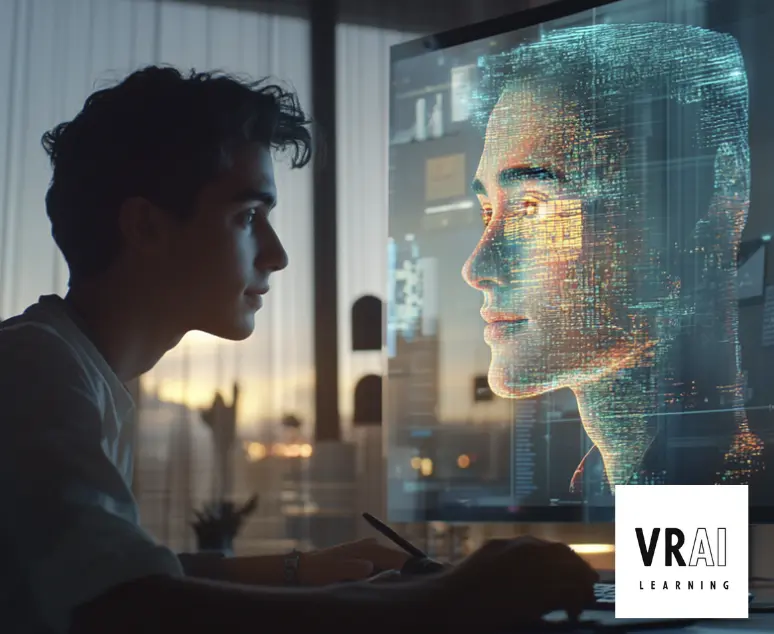
Think of it as a living, breathing digital shadow — one that evolves as its physical counterpart changes. Engineers use digital twins to simulate stress tests on a bridge before it's built. Healthcare professionals use them to model how a patient might respond to a treatment. And increasingly, learning and development teams are using them to create hyper-realistic training environments.
The Technology Behind Digital Twins
Digital twins sit at the intersection of several emerging technologies:
- IoT (Internet of Things): Sensors embedded in physical objects continuously feed data into their digital counterparts, keeping them synchronized in real time.
- Artificial Intelligence & Machine Learning: AI processes the incoming data to detect patterns, predict failures, and recommend actions — often faster than any human analyst could.
- 3D Modeling & Simulation: High-fidelity 3D models form the visual and structural backbone of the twin, enabling realistic rendering and interaction.
- Cloud Computing: The sheer volume of data involved requires scalable cloud infrastructure to store, process, and distribute.
- Virtual and Augmented Reality: VR and AR interfaces allow users to step inside the digital twin, manipulate it, and observe outcomes in an immersive environment.
Digital Twins and Industry 4.0
In manufacturing and Industry 4.0, digital twins are already transforming how factories operate. A production line can have a complete virtual replica that predicts equipment failures before they happen, optimizes throughput, and simulates the impact of changes before they are implemented on the physical floor.
Companies like Siemens, GE, and Airbus have embedded digital twin strategies at the core of their operations. The result: reduced downtime, lower maintenance costs, and faster time-to-market for new products.
But the real disruption may be just beginning — particularly in how organizations train their people.
Digital Twins for Immersive Corporate Training
Imagine a new technician training on the exact machine they will operate — not a simplified mockup, but a full digital twin of the actual equipment, rendered in virtual reality. They can make mistakes, explore edge cases, and repeat complex procedures without any risk to people, equipment, or production schedules.
This is where digital twins and immersive learning converge to create something genuinely transformative. At VRAI, we work at this intersection every day. Our VR training environments can be built around digital twins of real industrial assets, giving learners access to authentic, high-fidelity replicas of the tools and environments they will encounter on the job.
The benefits for corporate learning are significant:
- Realistic practice without real-world risk: Learners can rehearse dangerous procedures — high-voltage work, confined space entry, emergency protocols — in complete safety.
- Instant feedback loops: The simulation tracks every action, flags errors in real time, and provides detailed performance data to trainers and LMS platforms.
- Scalability: Once a digital twin training environment is built, it can be deployed to thousands of learners simultaneously, across geographies, with no additional infrastructure cost.
- Measurable outcomes: Because everything is tracked digitally, organizations gain unprecedented visibility into training effectiveness — not just completion rates, but actual skill acquisition.
Beyond Manufacturing: Expanding Use Cases
Digital twins are no longer limited to heavy industry. Their application is spreading rapidly across sectors:
- Healthcare: Patient digital twins enable personalized treatment planning and surgical rehearsal.
- Smart Cities: Urban planners use city-scale digital twins to model traffic flows, energy consumption, and emergency response.
- Retail & Logistics: Supply chain twins simulate disruptions and optimize inventory in real time.
- Energy: Wind farms and power grids run digital twins to maximize efficiency and anticipate maintenance needs.
- Corporate Learning: Any workplace environment — a warehouse, a cockpit, a hospital ward — can be twinned and used as a training ground.
The Role of AI in Making Twins Smarter
A static 3D model is not a digital twin. What makes a twin truly powerful is its intelligence — its ability to learn, adapt, and predict. AI is the engine that drives this capability.
In training contexts, AI-powered digital twins can adapt the difficulty and scenario complexity to each learner's performance profile. They can identify knowledge gaps, recommend targeted practice, and even simulate rare but critical situations — the kind of edge cases that are impossible to replicate safely in the real world.
This combination of immersive realism and adaptive intelligence is why digital twins represent one of the most exciting frontiers in corporate learning and development.
Challenges and Considerations
Despite their promise, digital twins come with real challenges that organizations must address:
- Data quality and integration: A twin is only as good as the data that feeds it. Poor sensor data or siloed systems undermine the fidelity of the replica.
- Cost of creation: Building a high-fidelity digital twin requires significant upfront investment in modeling, sensor integration, and software infrastructure.
- Security and privacy: Digital twins contain sensitive operational data. Protecting them from cyber threats is a critical concern, especially in regulated industries.
- Change management: Introducing digital twins into an organization requires cultural as well as technological change. Teams need to trust the insights the twin provides.
The Future: Autonomous and Collaborative Twins
The next frontier for digital twins is autonomy. Future twins will not just mirror and simulate — they will act. Equipped with AI decision-making, they will optimize systems in real time, trigger maintenance automatically, and even train the next generation of AI models.
In the learning world, this points toward fully adaptive, autonomous training environments that respond dynamically to each learner, adjust scenarios in real time, and continuously improve based on aggregate performance data across an entire workforce.
The line between the digital and physical worlds is blurring — and for organizations that embrace this shift, the competitive advantages in operational efficiency and talent development will be substantial.
Conclusion
Digital twins are no longer science fiction. They are live, operating systems reshaping manufacturing, healthcare, urban planning, and increasingly, corporate learning. For L&D leaders, the question is not whether digital twins will affect training — it is how quickly your organization will harness them.
At VRAI, we are already building the bridge between digital twin technology and immersive VR training. If you want to explore what this could mean for your organization, let's talk.

Christèle Simeoni
Co-founder VRAI Learning (2023) · CMO
Co-fondatrice de VRAI Learning, spécialiste de la formation immersive VR et des avatars IA conversationnels.
See immersive training in action
Personalised demo, no commitment. We show you what it looks like for your context.
Book a demoExplore our solutions